
Orc Marxism

A Review of The Mismeasure of Orcs

April 28, 2026

doi.org/10.63478/JTYA8EJD
978-1-4766-9435-1
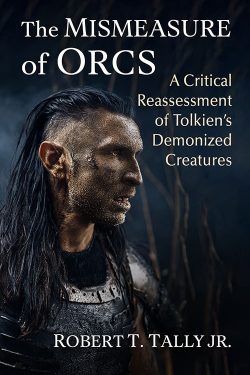
The Mismeasure of Orcs: A Critical Reassessment of Tolkien's Demonized Creatures
by Robert T. Tally Jr.
McFarland and Company
2025


Nothing is evil in the beginning. Even Sauron was not so.

—Elrond, The Lord of the Rings


Orcs are a bit of a problem. They’re loud. They’re quarrelsome. They’re a little too fond of machines. And they’re everywhere. J. R. R. Tolkien reportedly would exclaim “Orcs!” at the “savage sound” of a chainsaw. When he heard a motorcycle, he’d say, “There is an Orc!”1Robert T. Tally Jr., The Mismeasure of Orcs: A Critical Reassessment of Tolkien’s Demonized Creatures (Jefferson: McFarland and Company, 2025), 29, https://mcfarlandbooks.com/product/the-mismeasure-of-orcs/?srsltid=AfmBOopMJF2zN2NwOlvWwEN07Mpo-tlkKACpRpGCBbvg8OSBP-a_hwqI. Best not to let these noisy ruffians get too close to your borders. This, anyway, is what you might conclude if you casually read The Lord of the Rings or watched Peter Jackson’s adaptation. On this view, orcs are beastlike, humanoid creatures whose hideousness is straightforwardly analogous to their moral corruption. But what if we’ve been unfairly maligning these clangorous creatures? What if orcs deserve not contempt but sympathy or, dare one say it, solidarity?

This counterintuitive hypothesis drives Robert T. Tally Jr.’s enjoyable monograph, The Mismeasure of Orcs: A Critical Reassessment of Tolkien’s Demonized Creatures (McFarland, 2025). The allusion to Stephen Jay Gould’s The Mismeasure of Man—a classic assault on scientific racism—signals Tally’s ambition. He wants to rescue orcs from their infamy. Bringing a rigorous eye to Tolkien’s depiction of orcs, Tally asks us to consider them as human—all too human—subjects. Tally’s analysis helps clarify some of the ideological tangles of Tolkien’s powerful imagination, an imagination that has shaped our popular culture and has influenced countless writers, molding our understanding of power. The Mismeasure of Orcs offers a dialectical reconsideration of Tolkien’s legendarium, presented through the close analysis of its most vilified and, Tally argues, most misunderstood creatures. Tally brings an astute Marxist, and specifically Jamesonian, eye to the plight of these demonized denizens of Middle-earth.

Tally is not an unbiased guide. He is, by his own admission, an “unapologetic orc-sympathizer,” inclined to interpret against the grain.2Tally Jr., The Mismeasure of Orcs, 10. He’s also a professor of English at Texas State University and an increasingly essential Tolkien scholar. In the last five years, he’s published three full monographs on JR2T (Tolkien’s lesser-known nickname), including not only the volume under review but also J. R. R. Tolkien’s ‘The Hobbit’: Realizing History through Fantasy—A Critical Companion and Representing Middle-earth: Tolkien, Form, and Ideology.3Post by all-things-devours (@all-things-devours), tumblr, March 16, 2017, 9:09 p.m., https://www.tumblr.com/all-things-devours/158493879638/tolkiens-lesser-known-nickname; Robert T. Tally Jr., R. R. Tolkien’s ‘The Hobbit’: Realizing History Through Fantasy—A Critical Companion (London: Palgrave Macmillan, 2022); Robert T. Tally Jr., Representing Middle Earth: Tolkien, Form, and Ideology (Jefferson: McFarland and Company, 2023).

In his 2022 study of The Hobbit, Tally argues that the book is, counterintuitively, a “historical novel,” not in the sense that it depicts real historical events but in the sense of bringing a “historical register” to its mythopoeic raw materials.4Tally Jr., J. R. R. Tolkien’s ‘The Hobbit,’ 28. Bilbo makes history when he’s forced to exit his sheltered bourgeois hobbit hole. But it’s not exactly the case that the halfling enters history when he leaves the Shire. Instead, it’s his fish-out-of-water story and his sometimes anachronistic encounter with the mythic world of The Silmarillion (1977) that brings Arda down to Earth, so to speak, dragging a mythic world into history, sometimes kicking and screaming. In Representing Middle-earth, meanwhile, Tally aligns what Samwise Gamgee calls the “great tales” with what Fredric Jameson names history, a collective narrative we all partake in and which, as Sam puts it, “never end[s].” “We’re in the same tale still!” Sam concludes. “It’s going on.”

With The Mismeasure of Orcs, we might say that Tally has completed his own scholarly trilogy, a heroically dialectical rewriting of Tolkien Studies. Tally joins a robust debate about what orcs reveal about the racial structure of Tolkien’s influential secondary world, and how its racism is enmeshed in the professor’s vision of political economy and empire. Orcs are notoriously racialized figures. In a 1958 letter, Tolkien wrote that orcs are “corruptions of the ‘human’ form seen in Elves and Men. They are (or were) squat, broad, flat-nosed, sallow-skinned, with wide mouths and slant eyes: in fact degraded and repulsive versions of the (to Europeans) least lovely Mongol-types.”5Quoted in Tally Jr., The Mismeasure of Orcs, 27.
The more carefully you read Tolkien, the less clear Tolkien’s vision of these odd creatures.… Orcs are sometimes represented as achingly human, with names, individual personalities, a range of spoken dialects, and sharply articulated and heterogeneous opinions. At other times…they’re animalistic, swarm-like, mindless—little more than inhuman cannon fodder.

Scholars such as Charles W. Mills, Robert Stuart, and Dimitra Fimi have discussed race and racism in Tolkien’s writing at length.6Charles Mills, “The Wretched of Middle Earth: An Orkish Manifesto,” Southern Journal of Philosophy 60, no. S1 (2022): 105–35, https://doi.org/10.1111/sjp.12477; Robert Stuart, Tolkien, Race, and Racism in Middle-earth (Cham, Switzerland: Palgrave Macmillan, 2022), https://doi.org/10.1007/978-3-030-97475-6; Dimitra Fimi, Tolkien, Race and Cultural History: From Fairies to Hobbits (Basingstoke: Palgrave Macmillan, 2008). Orcs are, as Mills put it in a posthumously published article, “ontological zeroes”—beings with no inner life or moral claim on us, who exist only to be killed and whose degraded representation invites the reader to cheer their murder and eventual genocide at the end of The Lord of the Rings.7Mills, “The Wretched of Middle Earth,” 128. For Mills, Tolkien materializes an Aryan racial mythology as humanoid subtypes. Elves, humans/dwarves/hobbits, and orcs correspond to the Biblical lineage of Japheth, Shem, and Ham, respectively. Tally does not dispute this characterization, but he’s also highly attentive to the gaps, contradictions, and ideological confusions of Tolkien’s writing about orcs.

Tally cannot finally rescue orcs from the ideological and narrative role they have been forced to play, but his study of the fissures in Tolkien’s thought opens onto larger political questions (worth grappling with whether or not you’re a Tolkien aficionado) about who gets to count as human under capitalism and on what terms.

* * *

Tolkien’s writings are, when taken together, contradictory. He invented his mythic secondary world at the birth of mass mechanical warfare—during the First World War—but he imagined a mythic, quasifeudal prehistory for England. His love of Arda might be taken for escapism, a way of avoiding the unfolding horrors of the twentieth century. But Tolkien insisted that Arda must eventually become our Earth, moving from myth to history, and close readers of his oeuvre can find the terrors of the twentieth century lurking around every corner. It’s true that Tolkien resisted allegorical readings of his writing. But the ring of power remains a potent figure for new technology, one that arguably could only have been forged in the century that perfected total war. Perhaps it’s the bomb. Maybe it’s capital, or even modernity as such. As a symbol or image, it’s heavy, overdetermined.

But Tally isn’t interested in reading Tolkien allegorically. Like his mentor Jameson, he’s especially invested in the fissures and contradictions of literary works. Such fissures are not signs of authorial sloppiness, but rather openings into history, showing literary imagination at work, often exposing something even the author can’t quite articulate. Literature is, as Jameson put it in The Political Unconscious, a socially symbolic act—a way of attempting imaginatively to resolve real social contradictions.8Fredric Jameson, The Political Unconscious: Narrative as a Socially Symbolic Act (Ithaca: Cornell University Press, 1981). The Mismeasure of Orcs is a tutor text in dialectical close reading. To begin, the procedure is simple. You start by paying attention to the text, attending to its manifest meanings, showing how this internal or ideological picture does not hold together. Next, you ask a simple question: Why does the ideological picture fall apart? Answering requires looking through the text and its many mediating layers to the social and historical contradictions, and utopian longings, that ultimately shaped it.

Orcs are the perfect subject for this kind of scrutiny. The more carefully you read Tolkien, the less clear Tolkien’s vision of these odd creatures. For example, keeping just to The Lord of the Rings, orcs are sometimes represented as achingly human, with names, individual personalities, a range of spoken dialects, and sharply articulated and heterogeneous opinions. At other times, in the same text, they’re animalistic, swarm-like, mindless—little more than inhuman cannon fodder. When you read across Tolkien’s whole body of writing, even sharper contradictions emerge, leading one to wonder whether orc even refers to the same kind of imagined creature.

In noting these contradictions, Tally isn’t exactly uncovering Tolkien’s true or hidden authorial intentions, nor is he straightforwardly reading against the grain. Rather, he’s committing himself to a bracing kind of rigor: taking Tolkien at his word, to the letter, noting what his vast text actually says and does, suggesting that divisions within that text are grounded in a social process larger than one author (however great that author is).

* * *

Tolkien borrowed the term for his contradictory creatures from the Old English word orc, a word interpreted as demon or goblin, with the term orcneas, or demon corpses, appearing prominently in Beowulf. In his earliest formulations, orcs are fashioned by the evil Melko (the original name for Melkor) from “subterranean heats and slime,” with hearts of “granite.”9Quoted in Tally Jr., The Mismeasure of Orcs, 23. In the materials that would come to be published as The Silmarillion, however, the explanation changes. Here, they are described as corrupted elves, sentient beings transformed by the same evil power (now named Melkor, also known as Morgoth) into twisted shadows of themselves. In later letters, Tolkien is increasingly drawn to the idea that orcs are merely humans, derived from corrupted men. There is also some textual evidence for this possibility: the wizard Saruman “breeds” men and orcs. The details are fuzzy, but the existence of this breeding program suggests that the distance between men and orcs is one of degree rather than kind.

In The Hobbit, Tolkien includes creatures called goblins, which he would later insist was just another name for orcs. At other times, the difference between goblins, hobgoblins, and orcs seems to denote different ethnicities or cultural groupings. In The Hobbit, goblins have territory, cities, and leaders with names. But in The Lord of the Rings, orcs can more often seem merely subhuman. Yet even here, there are glimmers of something more. At one point in The Lord of the Rings, Tolkien shows orcs speaking different dialects; they are forced to use the Common Tongue to speak across ethnic and linguistic differences. Tolkien regards the miscegenation of men and orcs as a vile act, and his characters lament the birth of what are termed variously Orc-men, Men-orcs, half-orcs, and goblin-men.

When Legolas and Gimli play a game in which they gleefully compete to slay the most orcs, they’re killing sentient  beings who may have preferred not to step onto the battlefield that day, showing them less consideration than Tolkien offered to his German opponents during the Great War.

In these mixed figures, Tally sees a Utopian hope. Indeed, at one point, he provocatively suggests that Mordor “may well be the most multiracial, multicultural, and cosmopolitan country in Middle-earth.”10Tally Jr., The Mismeasure of Orcs, 99. After all, whereas our nominal heroes live in ethnically homogenized and deliberately purified communities, orcs in the service of the official villains often work and live alongside men of demonized nations—wild men, Easterlings, Southrons, Variags, and so on. Gandalf tells Frodo that in service of the Dark Lord “there are orcs and trolls, there are wargs and werewolves; and there have been and still are many Men, warriors and kings, that walk alive under the Sun, and yet are under his sway.”11Quoted in Tally Jr., The Mismeasure of Orcs, 99.

In The Two Towers, Sam overhears a suggestive conversation between two orc captains named Shagrat and Gorbag. These two discuss their discontents. Their overseers “don’t tell us all they know,” they grouse, and they complain that their Big Bosses “can make mistakes, even the Top Ones can.”12Quoted in Tally Jr., The Mismeasure of Orcs, 133. Here, Tolkien shows that orcs are capable of being frustrated with their lot. They’re tired of war. They dream of a better life beyond the control of the bosses who dominate and exploit them. Sure, orcs aren’t necessarily nice people, but in moments like this they’re people, not the mental slaves of Sauron or Saruman. They would prefer not to fight, if they had a say in the matter, but they find themselves caught between clashing forces far larger than themselves. From the point of view of the orc, the line between Sauron’s lust for power and order and the orc-hating defenders of the West matters little.

As Tally sums up, orcs have their own “motives, goals, dreams, loyalties, values, lives, communities, cultures, and languages.”13Tally Jr., The Mismeasure of Orcs, 108. Tolkien himself admitted this, seemingly with some reluctance; in a letter, he wrote that “there must have been orc-women. But in stories that seldom if ever see the Orcs except as soldiers of armies in the service of the evil lords we naturally would not learn much about their lives. Not much was known.”14Quoted in Tally Jr., The Mismeasure of Orcs. Perhaps against Tolkien’s preferences, the nominal enemy here gains a newfound depth, and our heroes come to seem like génocidaires, killing orcs with an aplomb bordering on the inhuman. When Legolas and Gimli play a game in which they gleefully compete to slay the most orcs, they’re killing sentient  beings who may have preferred not to step onto the battlefield that day, showing them less consideration than Tolkien offered to his German opponents during the Great War.

Tolkien’s difficulty in deciding on the orc’s ontological status was partly theological. It was important for him that only Eru Ilúvatar, the creator of Arda and stand-in for God, has the power to create animated, volitional beings. If orcs have souls, they cannot be wholly evil and their casual slaughter would come to seem, on Tolkien’s own terms, highly problematic, to say the least. Tolkien considered various solutions. At the end of The Lord of the Rings, however, all this complexity, all this questioning, is washed away. When the one ring is destroyed and the power of the Dark Lord is broken, orcs scatter, running “hither and thither mindless,” disbursing as though they were little more than Sauron’s puppets, setting aside all the evidence supporting their personhood.15Quoted in Tally Jr., The Mismeasure of Orcs, 160.

Tolkien wants the murder of orcs to be morally permissible, but he cannot bring himself to make them automata or inanimate background menaces. One might regard these different imperatives as an ordinary narrative problem. Tolkien aimed to write about the thrill of serialized face-to-face slaughter of worthy and interesting foes, but his Catholic commitments and meticulous worldbuilding drive led him to a repugnant conclusion about the moral meaning of this slaughter.

Tally leans into the humanizing potential of this contradiction, but it’s not, in my view, so easily resolved. That is, Tally tends to read the dialectic of Tolkien’s writing only in one direction, as a vindication of the maligned orc, but what makes the writing contradictory is that both possibilities, the positive and the negative, seem alive, almost at every moment. We might therefore put Tally’s conclusion differently, to highlight the problem, reading against the grain of his orc-friendly conclusions. Orcs aren’t only people; they are ontological zeroes (to quote again Mills’s classic formula)! Orcs are all-too-human, we might say, riffing on Friedrich Nietzsche, in that they’re just as worthy of dignity as any human; but they’re also all-too-human in their failings and foibles.

What, then, is the political meaning of this impasse? What specific social and historical contradictions do Tolkien’s orcs symbolically resolve? What is the Utopian horizon of the orc?

* * *

Here, we reach the limit of Tally’s careful analysis. Jameson’s famous slogan in The Political Unconscious is “Always historicize!” As Jameson, after Karl Marx, argues, the contradictions of a particular text can cast light on the shape of the great collective story we all inhabit: the history of social antagonisms and the changing modes of production. Tally’s analysis shows us the gap in Tolkien’s thought in clear and striking detail but stops short of spelling out what the gap tells us about history—not the time of Tolkien’s writing nor our own. What I offer here does not so much disagree with Tally as extend his analysis down roads he does not travel.

[Orcs] are the exemplary killable character. Killable characters are not so much individual characters as a mass, posing just enough threat to challenge our nominal heroes but not so much that they become fully individuated. They’re best killed in groups. Their multiplicity is the point. But it’s important, too, that they have humanoid faces and bodies.

One way of approaching the question of the historical meaning of the orc would be to note that when we talk about Tolkien, we’re not only talking about an individual author but a vast multibillion-dollar complex of intellectual property. That is, we might consider the material determinants of the media industries within which The Lord of the Rings circulates. Adopting this perspective, attending to the various institutional mediations that Tolkien has been subjected to, we might ask how orcs have traveled beyond Tolkien. Tally does discuss the dehumanizing representation of orcs in Peter Jackson’s popular films as well as the more positive vision in Amazon’s ongoing The Lord of the Rings: The Rings of Power.

In Amazon’s adaptation, we meet a fallen elf named Adar, whom we learn has been corrupted into one of the first orcs. Adar creates orcs of a more familiarly monstrous variety, calling them his children and insisting that “each one has a name. A heart. We are creations of The One, Master of the Secret Fire, the same as you. As worthy of the breath of life, and just as worthy of a home.”16Quoted in Tally Jr., The Mismeasure of Orcs, 169–70. Amazon’s adaptation offers a relatively sympathetic representation of orcs, one very much aligned with Tally’s study, suggesting that some contemporary readers might be ready to embrace a more generous understanding of the Uruk (the term preferred by Adar for his kind).

But Tolkien’s orcs have had consequences beyond direct adaptations. As Helen Young argues, modern fantasy inherits much from Tolkien’s racial ideology, especially what she calls its “habits of Whiteness.”17Helen Young, Race and Popular Fantasy Literature: Habits of Whiteness (New York: Routledge, 2016), https://doi.org/10.4324/9781315724843. For Young, orcs are “the most racialized of all Fantasy’s monsters,” and efforts at positive revision and humanization do little to change the fundamental anti-Blackness they embody.18Young, Race and Popular Fantasy Literature, 12. Orcs have come to be the template for myriad hideous creatures across the genre—from Robert Jordan’s Trollocs in The Wheel of Time to Dungeons & Dragons, Warhammer Fantasy, and an assortment of Warcraft tie-ins. Such orc-variants are the exemplary killable character. Killable characters are not so much individual characters as a mass, posing just enough threat to challenge our nominal heroes but not so much that they become fully individuated. They’re best killed in groups. Their multiplicity is the point. But it’s important, too, that they have humanoid faces and bodies.

Fantasy as a genre arguably needs killable characters. That is, orcs serve the ultimate interests of not only the Dark Lord but also conglomerate publishers, which rely on popular genres like fantasy to sell predictably. Such narratives need cannon fodder to sustain readerly interest. As long as the nameless horde keeps coming, more books will keep getting published. Tolkien was not himself part of the contemporary publishing field—it arose well after he published The Lord of the Rings—but in crafting the contradictory figure of the orc he inadvertently devised a narrative solution to the financial problems conglomerates would face.

Yet, as Tally shows in relation to Tolkien adaptations, within the fantasy field, the representation of monsters as demonized others is an active site of political struggle. Indeed, almost as soon as modern fantasy established itself, writers have been pushing the genre in new directions, working to disenchant its conventions, adding new layers of “realism” at odds with easy nostalgia for a pseudomedieval and white-supremacist past. Progressive and leftist fantasy writers have especially pushed against the representation of the enemy as disposable, subhuman, or killable. One might look to N. K. Jemisin’s Broken Earth trilogy for perhaps the most popular example of how writers have resisted the genre’s established tropes. The series centers a cast of racialized magical earthmovers, called orogenes. Orogenes are both monstrously othered—derided with the epithet rogga—and exploited for their considerable power.

Whether such revisionary efforts succeed within the fantasy field, a more characteristically Jamesonian approach would seek to answer the riddle of the orc at a larger scale. Such an analysis would ask how orcs register contradictions at the level of the political economy of capitalist modernity. Toward that end, I’d propose that orcs register how capitalism as a system feeds on human bodies as fuel to reproduce itself and to grow. The system regards the humans who power it with disinterest. One might see orcish characters therefore as figures for Indigenous or Black bodies, chewed up by the brutal history of European colonialism, chattel slavery, and genocidal settler colonialism.

Mills argues that the killing of orcs gives us a picture of “the joyful slaying of non-Europe by Europe.”19Mills, “The Wretched of Middle Earth,” 132. A more class-focused gloss might explain the mass nature of the orc by reaching for more conventional Marxist concepts like the proletariat (those separated from the means of production and forced to sell their labor power to live) or relative surplus population (referring to the reserve army of labor in its multiplicity of forms, which ultimately checks the growth of wages). Whatever frame we use, the lowly orc counsels us that racialization, class domination, imperialism, and genocide are not easily separable phenomena.

Viewed in these terms, the far right might see aspects of the truth of the orc more clearly than those who would simply straightforwardly humanize them, maintaining the existing system while cleaning up our popular fantasies—Tolkien, but without the contradictions! Reactionary fantasies of the killable mass remain alive and well, although the contours of such fantasies are always mutating. We might see orcs as direct ancestors to the contemporary right-wing NPC meme.20Kevin Roose, “What is NPC, the Pro-Trump Internet’s New Favorite Insult,” New York Times, October 16, 2018, https://www.nytimes.com/2018/10/16/us/politics/npc-twitter-ban.html. The acronym stands for non-player character, a term that originated in the world of tabletop role-playing games to refer to a character other than the players, one controlled by the gamemaster; the term derives from Gary Gygax and Dave Arneson, the creators of Dungeons & Dragons, a tabletop game influenced by Tolkien’s legendarium.21Oxford English Dictionary, s.v. “non-player character,” https://www.oed.com/dictionary/non-player-character_n, accessed March 18, 2026.

The term has also been extended to refer to nonplayer characters in video games, and has more broadly broken containment, coming to be widely circulated online, especially in far-right circles. The far right imagines the great mass of humanity, often grotesquely racialized, to be subhuman, low IQ plebs, over and against the Nietzschean founders, makers, and cognitive elite who alone are full persons. This elite cadre fancies itself to be uniquely and highly agentic, a term popular among Silicon Valley thinkfluencers.

Tolkien’s unsettled imagination of the orc anticipates the Silicon Valley right’s solipsistic aspiration to build what some characterize as a technofeudal future.22For more on the appropriation of Tolkien by Silicon’s reactionary right, see Lee Konstantinou, “Mythic Capital,” Arc, May 1, 2025, https://arcmag.org/mythic-capital. New versions of the orc persist because they solve certain problems for aspiring technofeudalists, problems that are at the same time political and narrative. As the NPC meme shows, our oligarchs would make NPCs of us all. Some of them see many of us as orcs, and they’re ready to subordinate us under the power of their clever machines. Or, failing that, to wipe us out. For our oligarchs, orcs remain a figuration of a collective that is degraded and expendable.

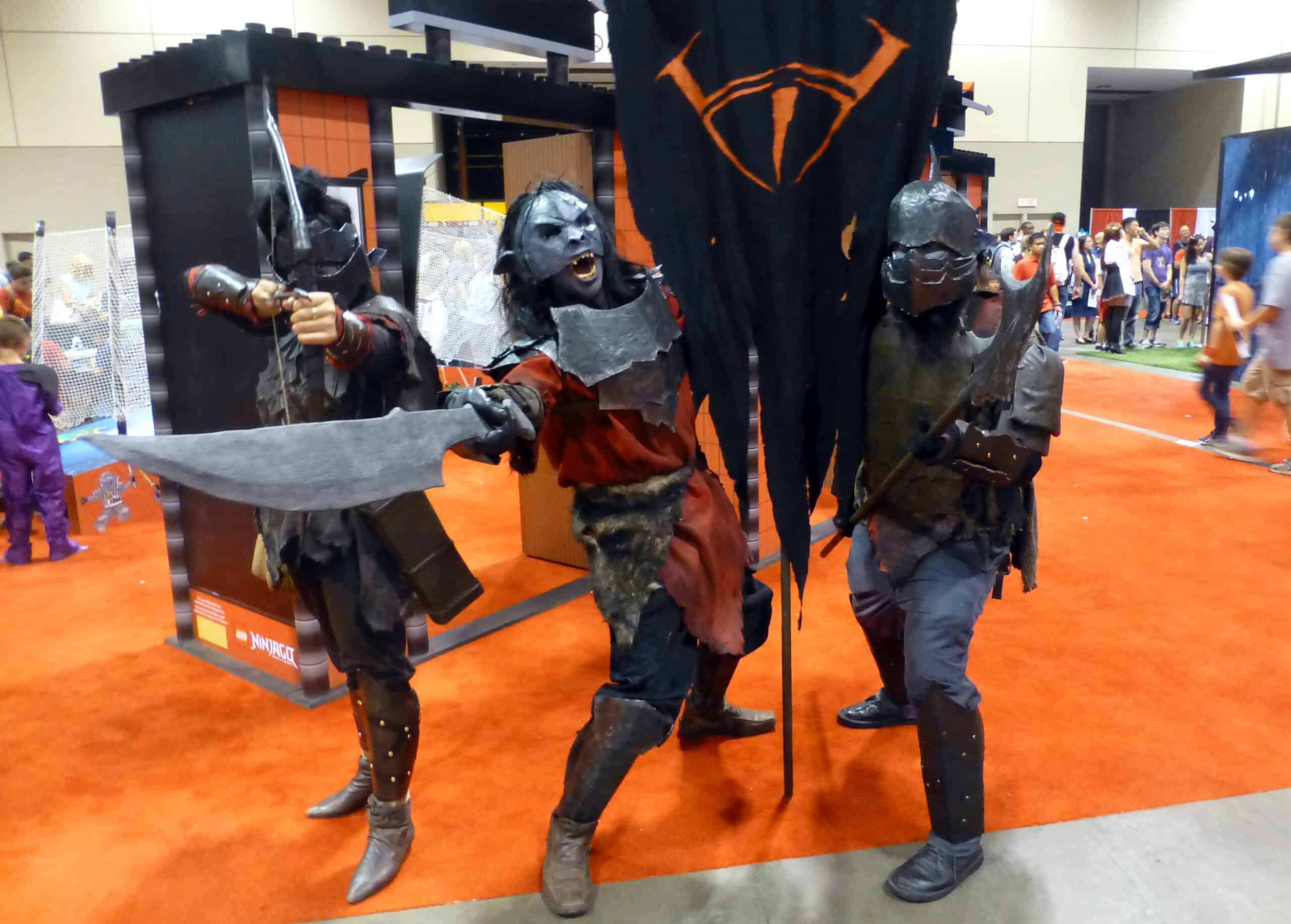
Orcs Cosplay at Fan Expo Canada in 2015. Photo Credit: GabboT via Wikimedia
Orc cosplay at Fan Expo Canada in 2015.
Photo Credit: GabboT via wikemedia

But this degradation of orcs as a mass is, as we’ve seen, only one horn of the dialectic. Tally’s recovery of the orc reminds us of the other. These foul creatures are often kept around because they’re ultimately useful for those who wield power, because they perform necessary labor or because they put downward pressure on wages. Complain all you like about the noise of chainsaws and motorcycles, but they’re useful tools. Similarly, the serialized logic of fantasy storytelling sees orcs as expendable, but because there always needs to be more profit, another book, and another and another in the series, fiendish orcs are—in one form or another—always destined to return for another epic battle. Just one more…

The ultimate technofeudal fantasy, undergirding much of the wild capital investment in artificial intelligence, is that one might make the orcs disappear for good, getting all the benefits of labor without any of the noisy, unpleasant, disobedient humans who actually do—or sometimes refuse to do—the work. It’s a final fantasy of the total elimination of workers, perhaps of the human as such, where the built world sustains itself without orcish effort, by means of what can only be called magic. What Tolkien’s uneasiness and confusion reveal, in the last instance, is that orcs are not so easy to dispense with. They may conveniently disappear at the end of Lord of the Rings, but—as Sam suspects in an unpublished epilogue—they’re still out there. They’ll be back.

There’s no getting rid of them, thank Ilúvatar.

SHARE

HELLO, COMRADE

While logged in, you may access all print issues.

If you’d like to log out, click here:

NEED TO UPDATE YOUR DETAILS?

Support our Work

Gift Subscriptions, Renewals, and More