
Reassessing the POUM in the Spanish Civil War
A Review of Andy Durgan’s The POUM
October 13, 2026
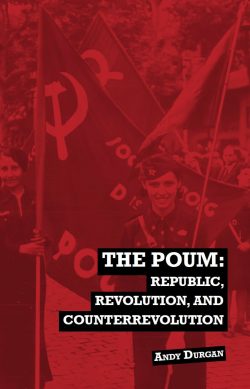
NINETY YEARS AFTER the outbreak of the Spanish Civil War, it is high time to reconsider the significance of the Workers Party of Marxist Unification (or POUM according to its Spanish initials)—the most important revolutionary party of the conflict. Just developing into a mass party when the war began, with about fifty thousand members at its height (some commentators suggest as many as seventy thousand), the POUM organized unions and workers militias, participated in workplace and land occupations, and waged armed struggle against fascism. Whatever its failings, this democratic and anti-Stalinist organization, was the one meaningful Marxist current at the time to pose the strategic need for a working-class revolution.
Yet assessing the POUM is challenging—in part because of the mountains of lies and slander heaped upon it by the official Communist movement. Things are not helped either by the shrill tone (as well as analytical shortcomings) of Leon Trotsky’s polemics against the group and its leaders during the Spanish Revolution. At a time when important debates about Marxist strategy and history are on the agenda, Andy Durgan’s short study, The POUM: Republic, Revolution, and Counterrevolution, should be welcomed as a serious Marxist appraisal of the organization and its political legacy.
Durgan’s text builds on a series of important interventions he has previously made analyzing the dynamics of the Spanish Civil War and the role of the revolutionary left therein.1In English, see, for instance, Andy Durgan, “Marxism, War, and Revolution: Trotsky and the POUM,” Revolutionary History, v. 9, no. 2 (2006); Durgan, The Spanish Revolution (London: Palgrave MacMillan, 2007); Durgan, “Trotsky and the POUM, International Socialism, series 2, no. 147 (Summer 2015); and Volunteers for the Revolution: The International Militia of the POUM in the Spanish Civil War (Leiden: Brill, 2025). Before reviewing this recent contribution, however, it is worth recalling how profound the revolution was that erupted in Spain in 1936. For this is the context in which the POUM matters.
Prelude to Revolution, 1931 to 1936
In April 1931, the electoral victory of a coalition of republican parties allied with the Socialists (PSOE) produced the collapse of Spain’s monarchy. Popular hopes were soon tempered, however, as the Second Republic introduced laws curbing unions and criminalizing poverty just as a global depression emerged. Meanwhile, the fascist Falange mounted armed attacks on the Left with the support of CEDA, the mass party of the Catholic far right.2Quoted by Richard A. H. Robinson, The Origins of Franco’s Spain: The Right, the Republic, and Revolution, 1931–1936 (Newton Abbott: David & Charles, 1970), 140. On pro-Nazi attitudes among CEDA members, see Wayne H. Bowen, Spaniards and Nazi Germany: Collaboration in the New Order (Columbia, Mo.: University of Missouri Press, 2000), 26; Durgan, Spanish Civil War, 27.
Then, as the Workers and Peasants’ Bloc (BOC)—forerunner of the POUM—called for a workers antifascist front, the miners of Asturias rose in 1934 against the entry of CEDA into the government, igniting a popular movement known as the Asturias Commune. Proletarian forces, including the BOC, held off the regular army for two weeks, building rudimentary forms of self-government. In the aftermath, hundreds were murdered, thousands more were arrested, many of them tortured.
A new round of national elections (in mid-January 1936) then shifted the tide to the left. Republican and left parties, grouped in the Popular Front, achieved a commanding parliamentary majority—277 deputies versus 132 for the Right and 32 for the parties of the Center. Of the left parties, the Socialists won 90 deputies, the Communists 16, and the POUM one. However, the government which took office excluded the left-wing parties.3This had much to do with the laudable opposition of the left of the PSOE, led by Francisco Largo Caballero, to participation in bourgeois governments.
Revolution and Workers’ Control
In the face of the electoral triumph of the Left, the army under General Franco rose in the Spanish-controlled part of Morocco on July 17, 1936, launching a military uprising against the popular upheaval. But the army’s success was far from guaranteed. This is because, everywhere they could, workers seized arms and organized popular militias.
They launched general strikes. They broke open the jails and burned churches. They took over their places of work and confiscated landed estates. They organized labor militias to secure the streets as police went into hiding. In many places, new organs of popular power, tied to unions and left-wing parties, displaced the old institutions of the state.
In Barcelona, a Central Anti-Fascist Military Committee became a crucial site of working-class power. Cities and towns, ports, and border crossings came under the control of unions and left organizations. The leaders of the military coup were now confronted with a revolutionary insurgency. One historian captures the depth of radicalization:
Landed properties were seized, some were collectivized, others divided among the peasants … Railways, streetcars and buses, taxicabs and shipping, electric light and power companies, gasworks and waterworks, engineering and automobile assembly plants, mines and cement works, textile mills and paper factories, electrical and chemical concerns, glass bottle factories and perfumeries, food processing plants and breweries, as well as a host of other enterprises, were confiscated or controlled by workers committees … Motion-picture theaters and legitimate theaters, newspapers and printing shops, department stores and hotels, deluxe restaurants and bars were likewise sequestered or controlled, as were the headquarters of business and professional associations and thousands of dwellings owned by the upper classes.4Burnett Bolloten, The Spanish Revolution: The Left and the Struggle for Power During the Civil War (Chapel Hill: University of North Carolina Press, 1979), 52–61. On the proliferation of collectives during the revolution, see Gaston Laval, Collectives in the Spanish Revolution, trans. Vernon Richards (Oakland: PM Press, 2018).
To be sure, the military scored some major successes, especially wherever workers waited for government to organize resistance. But in Bilbao, Barcelona, Madrid, Valencia, Granada, and most of the territory in between—over 60 percent of the country in all—the Republic held fast, secured above all by the power of workers militias. Nowhere was the hold of the Left greater than in Barcelona, where workers, led largely by the anarcho-syndicalist CNT (Confederatión Nacional del Trabjol/National Confederation of Labor), seized the post office and telephone exchanges, established their own police force and militias, and subjected factories, transport, and food distribution to the rule of popular committees.
On July 20, Luis Companys, president of the autonomous region of Catalonia, told a group of Barcelona anarcho-syndicalists, “Today you are the masters of the city and of Catalonia. You have conquered and everything is in your power.”5As quoted by Bolloten, 369. Yet, allergic to the idea of running the state—even a democratic workers state—the CNT leaders did not move to establish popular power. They agreed to support Companys and his liberal republican government.
By now, the union had grown to 1.5 million members and Companys set out to bring its representatives into his government to control them. In November, he persuaded CNT leaders to accept four ministries. Theoretically hostile to the state, these anarchist leaders would find themselves integrated into it. The revolutionary left alternative—a complete break with the liberal order and the founding of a workers state—was advanced only by the POUM among the major parties, as well as by the most revolutionary of the anarchist currents, such as the Friends of Durruti.6Augustin Guillamón, The Friends of Durruti Group: 1937–1939, trans. Paul Sharkey (Chico: AK Press, 1996).
But in the first few months after July 1936, the Central Anti-Fascist Military Committee remained at the center of everyday life in Barcelona. Policing, food distribution, expropriation of hotels, the organization of militias for the antifascist front—all this and more were in its hands. On the streets, in plebeian neighborhoods, in the workplaces, the social power of the working class was everywhere on display, especially in Red Barcelona. For people of the international left, the effects were electrifying.
Journalist Franz Borkenau, arriving in the city a month after the proletarian revolt had blocked the army, was stunned by the Barcelona he saw: “It was overwhelming. It was as if we had been landed on a continent different from anything I had seen before. The first impression: armed workers, rifles on their shoulders, but wearing their civilian clothes… They stood, as guards, before the entrances of hotels, administrative buildings, and the larger department stores.”7Franz Borkenau, The Spanish Cockpit (Ann Arbor: University of Michigan Press, 1963 [1937]), 69–70.
“The first feeling is one of liberation,” wrote Australian poet Mary Low upon arrival in Barcelona. “A feeling of new strength and activity seemed to radiate from the crowds of people in the streets.”8Mary Low and Juan Breá, Red Spanish Notebook: The First Six Months of the Revolution and the Civil War (London: Secker and Warburg, 1937), Ch. 2 (written by Low), marxists.org/history/spain/writers/low-brea/red_spanish_notebook.html. American radical Lois Orr arrived around the same time. “This is a gloriously exciting place to be,” she wrote.9Lois Orr, “Letter to her family,” 27–30 September 1936 in Letters from Barcelona: An American Woman in Revolution and Civil War, ed. Gerd-Rainer Horn (London: Palgrave Macmillan, 2009), 72–73.
Perhaps no English-language account of revolutionary Barcelona has been more influential than that of George Orwell—an international member of a POUM militia—whose memoir is still celebrated in Catalonia today. Marveling at the egalitarian spirit pervading all social interactions, Orwell wrote, “Above all there was a belief in the revolution and the future, a feeling of having suddenly emerged into an era of equality and freedom.”10George Orwell, Homage to Catalonia (London: William Collins, 2021 [1938]), 2–3, 4. On the positive reception of Orwell’s memoir in Catalonia, see Victor Alba (with Stephen Schwartz), Spanish Marxism Versus Soviet Communism (London: Routledge, 2017), 282.
Communists against the Revolution
Little of this met with the approval of the Communist Party of Spain (PCE), or the right-wing of the Socialist Party. For the PCE (and its Catalan section, the United Socialist–Communist Party, or PSUC), socialist demands had to be curtailed. Reaffirming the rights of property owners and curbing “anarchy” were essential to building an alliance with capital and the middle class they so desperately sought, as well as wooing the support of Britain and France—which would never come.
The Communists, in league with the republicans and the right of the Socialist Party, were attacking and undermining the ‘dual power’ institutions of the working class.
By late 1936, the Communists, in league with the Republicans and the right of the Socialist Party, were attacking and undermining the “dual power” institutions of the working class. In September, the government of Catalonia (the “Generalitat”) persuaded CNT officials to dissolve the Central Anti-Fascist Military Committee; soon after CNT leaders were persuaded to join the government. In October, the people’s committees were disbanded.
Meanwhile, to restore the free market, the government attacked the popular “supply committees” that had coordinated food distribution. It then moved to disarm the workers militias, demanding that all “private citizens” turn over “long arms,” mainly rifles and machine guns, to government officials.11Helen Graham, The Spanish Republic at War 1936–1939 (Cambridge: Cambridge University Press, 2002), 233–34; Alba and Schwartz, Spanish Marxism, 129–30.
Challenged by its left-wing, the Socialist Party often vacillated in the face of popular opposition. The antirevolutionary initiative thus passed to the Communist Party. Its Catalan section, the PSUC, energetically carried out campaigns against workers’ control—with results that would be disastrous for the revolution.
In December, a PSUC member, Eusebio Rodríguez Salas, having been made police commissioner for Catalonia, moved to bring all the popular security forces into a single organization under his control. Recognizing the calamity in store for the radical left, the POUM announced, “The fate of the Revolution is in the balance.” The PSUC next moved to dissolve the workers militias into the regular army. Again, the POUM sounded the alarm: “The only guarantee the working class can have as to the fate of the Revolution is its own army,” it warned.12La Batalla, March 3, 1937, and La Batalla (Barcelona), February 27, 1937, as quoted by Bolloten, Spanish Revolution, 391, 392.
Not, as Durgan points out, that the POUM opposed building a more centralized military force to win the Civil War. But it envisioned a centralized proletarian army with deeply democratic norms. Insisting that revolutionary soldiers could not be treated as “headless automatons,” the POUM advocated “a red army of the workers, fighting under a coordinated military command.”13POUM English-language Bureau, The Spanish Revolution, vol. 1, no. 2, October 28, 1936; Durgan, The POUM, 88–92.
The Communist-led attack on workers’ power obviously conformed to the wishes of Moscow. Indeed, Stalin had signed a letter advising the Republican government to support “the petty and middle urban bourgeoisie” by protecting its property from “attempts at confiscation.”14Stalin, Molotov, and Voroshilov, “To Comrade Caballero,” December 21, 1936, as reproduced in E. H. Carr, The Comintern and the Spanish Civil War (New York: Pantheon Books, 1984), 87. On “Pedro,” see Bolloten, Spanish Revolution, 378.
But these actions were not simply dictated by Moscow; they conformed to the shifting social composition of the PCE and PSUC. For by late 1936, the Communist Party had become the select vehicle of liberal businessmen, professionals, and officers of the regular army.15Communist leader Jésus Hernández, as quoted by Alba and Schwartz, Spanish Marxism, 128; and PSUC paper Treball, August 8, 1936, as quoted by Bolloten, Spanish Revolution, 376. Historian Helen Graham observes that, particularly in Catalonia where elites were most traumatized by the workers’ revolt, middle-class elements and white-collar workers turned to the PSUC “in search of protection in a hostile, apparently anarchist-dominated political environment.”16Graham, Spanish Republic, 263. The same point is made by Chris Ealham, Anarchism and the City: Revolution and Counter-Revolution in Barcelona, 1898–1937 (Oakland: AK Press, 2010), 177; Orwell, Homage, 55; Alba and Schwartz, Spanish Marxism, 163–64.
Turning Point: The May Days of 1937
By May Day 1937, hundreds of Barcelona’s workers were being disarmed every week by order of the Communist (PSUC) police commissioner. Returning to Barcelona after three-and-a-half months at the front, Orwell noted a “startling change in the social atmosphere.” Rich people were again crowding into luxury restaurants, he wrote, while workers were going hungry and beggars had reappeared on street corners.
Workers patrols had been dismantled “and the pre-war police were back on the streets.”17Orwell, Homage, 117–19. The next blow arrived on May 3, when Rodríguez Salas sent three truckloads of assault guards to reclaim control of the central telephone exchange from the workers occupying it, who were organized in a joint union committee of the CNT and the UGT, the Socialist labor federation. Everything was now on the line. For the logic of attacking the workers running the exchange was to undo all the expropriations—of workplaces, landed estates, luxury restaurants and hotels, mansions of the bourgeoisie and large landowners.
Storming the telephone exchange on May 3, the assault guards were halted by workers on the second floor who commanded a machinegun. Proletarian Barcelona quickly rallied and barricades were erected. Within hours, anarcho-syndicalists controlled the working-class neighborhoods.
Thousands of rank-and-file CNT members, allied with the POUM and the anarcho-communists of the Friends of Durruti group, continued to hold the barricades amid fierce fighting against troops largely commanded by the Communists.18Bolloten, Spanish Revolution, 405–06; Graham, Spanish Republic, 266–69; Alba and Schwartz, Spanish Marxism, 188–95; Pierre Broué and Emile Témine, The Revolution and the Civil War in Spain (Chicago: Haymarket Books, 2008), 282–83. Perhaps two dozen “Bolshevik-Leninists” of the Fourth International also supported the barricades. The divided forces of the Left now faced one another across armed barricades. But CNT leaders, desperate for a compromise, refused all-out mobilization.
Only a mass organization of the revolutionary left with deep social roots might have held things together. Organizationally fractured as it was—and without the backing of CNT leaders—the workers’ resistance stalled. Even the left anarchists of the Iberian Anarchist Federation (FAI) called for them to back down.
Only a mass organization of the revolutionary left with deep social roots might have held things together.
By May 6, three days after the invasion of the Central Telephone Exchange, the rebellion was waning. The next day, five thousand central government troops arrived, decisively shifting the balance of forces. Now the counterrevolution took its revenge. CNT offices were burned and the prisons filled with rebels. At least five hundred combatants lay dead; perhaps three times that number had been injured.19Graham, Spanish Republic, 283; Alba and Schwartz, Spanish Marxism, 195.
Emboldened, the PSUC moved a week later to criminalize the POUM. On May 28 the party’s newspaper was banned; the organization was fully outlawed on June 16 with roughly two hundred members imprisoned. International supporters of the POUM were also arrested and hauled off to secret prisons run by the Communists.20Orr, Letters from Barcelona, Ch. 8. Most ominous, party leader Andreu Nin—former executive member of the Communist International in Lenin’s era and early supporter of Trotsky’s Left Opposition—was kidnapped and moved by Communist officials to a Madrid prison, where he was tortured before being murdered.21Bolloten, Spanish Revolution, 455–56; Carr, The Comintern, 42–43; Graham, Spanish Republic, 284; Alba and Schwartz, Spanish Marxism, 226. On Nin’s political biography, see Durgan, The POUM, 20–22.
Trotsky and the POUM
Although the POUM defended Trotsky against Stalin, its relationship with Trotsky was fraught.22On the POUM’s defense of the Soviet Union, its denunciations of the Moscow Trials and the executions of Old Bolsheviks, Trotsky’s attacks on Nin, and the Spanish Left Opposition’s disagreement with entry into social democracy (the “French Turn”) see Alba and Schwartz, Spanish Marxism, 93, 95, 98, 131–32, 166, 88–89. For an overview of the disagreements between Trotsky and the POUM, see also Bolloten, Spanish Revolution, 381–83; Durgan, The POUM, 123–26. In 1934, the Spanish section of the International Left Opposition rejected Trotsky’s call for his followers to enter social democratic parties in hopes of building militant left-wing currents there. Incensed, Trotsky denounced “the falseness and danger of comrade Nin.” One of the considerable strengths of Durgan’s book is to critically examine Trotsky’s polemics with the POUM in the context of the actual dynamics of the revolutionary struggle.23See Trotsky, Collected Writings on the Spanish Revolution, Marxist Internet archive, marxists.org/archive/trotsky/spain/index.htm
At the level of political intervention, the most urgent question was whether the POUM, like the Communists, advocated a two-stage strategy: first a democratic revolution, to be followed considerably later by a socialist one. Trotsky attributed such a position to the POUM—Durgan argues persuasively that he was wrong.24Durgan, The POUM, 36.
When POUM leader Joaquin Maurin promoted a “socialist-democratic revolution” in Spain, he was in fact compressing the democratic and socialist revolutions into a single unitary process. “Our revolution is democratic and socialist at the same time,” he urged.25Joaquin Maurin in La Nueva Era, May 1937, quoted by Alba and Schwartz, Spanish Marxism, 109.
Maurin insisted that only the workers and poor peasants had a direct interest in advancing the democratic revolution—and in so doing, they would simultaneously begin the socialist one. This meant continuing working-
class incursions on capitalist and landlord power—transforming the democratic revolution into a fully socialist one.26This is the classic formula for permanent revolution. While the latter is often identified strictly with Trotsky, it has a much longer and more diverse heritage in the international left. In fact, Maurin’s commitment to the inseparability of the democratic and socialist revolutions goes back to Marx’s 1850 insistence on the need to “make the revolution permanent,” that is, for the workers to push the democratic revolution forward to a working-class one. See Karl Marx, “Address to the Central Committee (March 1850),” in Marx, The Revolutions of 1848 (Harmondsworth: Penguin Books, 1973), 323. This perspective then resurfaced as a significant current within early twentieth century international socialism. See Richard B. Day and Daniel Gaido, Witnesses to Permanent Revolution (Chicago: Haymarket Books, 2011).
The POUM was thus advancing a similar position to that of Lenin and the Bolsheviks in 1917. Indeed, Durgan documents one POUM leader telling a rally of twelve thousand people in Barcelona that, rather opposing “bourgeois democracy to fascism,” his organization counterposed to it “communism … the dictatorship of the proletariat.”27 As quoted by Durgan, The POUM, 50. If the POUM is to be faulted, however, it is for failing to argue for elections to workers committees and popular councils, which were largely constructed by agreements between the main left currents.
It is true that the POUM would eventually agree to participate in the Republican government of Catalonia—an episode to which I return. But the strategic deliberation here, right or wrong, had nothing to do with adherence to a two-stage strategy, as Trotsky wrongly believed. Before turning to that question, however, the POUM’s attitude toward questions of gender and national oppression ought to be reviewed.
Challenging Gender and National Oppressions
Like much of the global left of its era, the POUM paid scant attention to women’s liberation, as Durgan shows in an insightful chapter devoted to this question (Chapter 9). Yet, the POUM was significantly transformed by the great changes in gender relations that accompanied the revolution.
Not only did women take up arms to fight fascism; they moved into jobs in heavy industry as men left for the front; they marched in the streets, spoke at meetings and rallies; they joined political organizations. Reacting to all of this, the POUM launched a newspaper for women, Emancipación, and organized a Women’s Secretariat of the party. It also enlisted women into its militias; indeed, the POUM appears to have been the only organization with a militia led by a woman, the Argentinian revolutionary, Mika Etchebéhère, who became a hero of battles on the Madrid front and wrote a moving memoir of her experiences.
One of the POUM’s foremost leaders, Andreu Nin, who served for a controversial stint as Minister of Justice in the Catalonian Popular Front government, introduced civil marriage, an egalitarian divorce law, and social support for birth control. Yet, however much the POUM’s record was better than most, as Durgan shows, it by no means overcame traditional gender norms.28“Manifesto of the Women’s Secretariat of the P.O.U.M,” Spanish Revolution, vol. 1, no. 4, November 11, 1937; Mike Etchebéhère, Ma Guerre d’Espagne à Moi: Une femme à la tête d’une colonne au combat (Montreuil: Éditions Libertalia, 2021); George Esenwein and Adrian Shubert, Spain at War: The Spanish Civil War in Context, 1931–1939 (New York: Longman, 1995), 127–29.
More promising was the POUM’s attitude toward national and colonial oppression. Its predecessor group the BOC had opposed “the pan-Spanish imperialist state” and supported the right to self-determination of all oppressed nationalities—Basques, Galicians, and Catalans in particular—within it. In the same vein, the POUM declared that a liberated Spain “will become an Iberian Union of Socialist Republics.”29Alba and Schwartz, Spanish Marxism, 48; “The Programme of the POUM in 1936,” Marxist Internet Archive, marxists.org/history/etol/document/spain/spain07b.htm. Consistent with its anticolonial commitments, the POUM was the only left organization in Spain to demand independence for Morocco, a northern strip of which was controlled by Spain, while the rest of the country was a French colony.
Republican support for Moroccan independence, as advocated by the POUM, might have changed the military equation. Franco had recruited fifty thousand Spanish Moroccan troops for the war against the Republic. Yet, there was nothing inevitable about these soldiers being mobilized for the Nationalist side.
Anticolonialism had been sweeping through North Africa since the Rif War broke out in 1921, flowing into the Great Syrian Revolt of 1925 and the Palestinian Uprising of 1936. Arab revolutionaries from Algeria, most of them members of Messali Hadj’s Étoile Nord-Africaine (North African Star) movement, were already fighting in Spanish Republican militias.
Uncompromising support for Moroccan self-determination might well have fomented rebellion in and destabilized Franco’s army. George Padmore, the renowned anticolonial Marxist, insisted that a republican “gesture to the Moors” would have undermined Franco’s recruitment.30Alba and Schwartz, Spanish Marxism, 50, 182; Algerian radical to Nancy Cunard, cited in Lois Gordon, Nancy Cunard: Heiress, Muse, Political Journalist (New York: Columbia University Press, 2007), 221; George Padmore, Africa and World Peace (London: Secker & Warburg, 1937), 153. Here again, the POUM promoted the most advanced Marxist analysis of the time.
Trying to Win the Anarchist Workers
At the heart of the POUM’s political analysis was that revolution in Spain would be impossible without the support of most anarcho-syndicalist workers. Across the Spanish state, and particularly in Catalonia, the CNT represented the bulk of class-conscious workers, oriented to class struggle and steeped in a combative direct action culture of neighborhood and workplace struggle, underpinned by unions, community organizations, and radical popular education.31Among the best studies in English in this area, see Chris Ealham, Anarchism and the City: Revolution and Counter-Revolution in Barcelona, 1898–1937 (Oakland: AK Press, 2010; and Angel Smith, ed., Red Barcelona: Social Protest and Labour Mobilization in the Twentieth Century (London: Routledge, 2002). Rather than focus primarily on the Socialist Party, as Trotsky advised, the POUM recognized that the rank-and-file of the CNT were the key to the situation.
At the heart of the POUM’s political analysis was that revolution in Spain would be impossible without the support of a majority of anarcho-syndicalist workers.
For this reason, POUM militants worked tirelessly to convince anarchist workers that the Marxist calls for a “dictatorship of the proletariat” represented, as Nin put it, a call for “workers democracy exercised by all workers without exception.”32Quoted by Durgan, The POUM, 70. The POUM did in fact enjoy some success in building closer ties with anarchist fighters.
In February 1937, for instance, it formed a joint youth organization with the anarchist Libertarian Youth.33Durgan, “Trotsky and the POUM, 6. When the Communists attacked the workers occupying the Central Telephone Exchange of Barcelona in May, the Friends of Durruti fought arm-in-arm with them.
In fact, Andreu Nin’s entry as a minister into the Catalan government in the fall of 1936 seems to have been motivated, at least in part, by a desire to keep the POUM close to the left of the CNT. But that decision
was deeply compromising—notwithstanding the progressive measures Nin was able to take—especially as the government began rolling back popular power.34Durgan offers a thoughtful assessment of this period in The POUM, Ch. 7.
Nin and the three CNT figures in the government were regularly in a minority. Their best efforts often did little more than take the worst edge off bad policies. It appears Nin feared that resigning and provoking a civil war within the civil war could be fatal. But nothing was more fatal than taming popular forces.35Durgan, The POUM, 77-78; Alba and Schwartz, Spanish Marxism, 137–40.
There are valid political criticisms of this episode—but this is not what blocked a workers revolution. Trotsky, as Durgan argues, was surely wrong in suggesting that May 1937 represented a revolutionary situation in which the workers might have taken power were it not for the failures of the POUM.36Durgan, The POUM, 123–26. In fact, by May the working class was on the defensive after six months of rollbacks to workers’ control and popular power.
Trotsky was surely wrong in suggesting that May 1937 represented a revolutionary situation in which the workers might have taken power were it not for the failures of the POUM.
The right-wing of the republican forces—grouped around the Communists and moderate Socialists—had the initiative. A much larger revolutionary organization than the POUM might have been able to sustain a stronger defensive struggle, one that might have held more ground for future battles. But there was no revolutionary situation during those weeks that was squandered by the POUM.
“The Only Hope for the Revolution”
As we have seen, the May Days spelled the end of the revolutionary wave. E. H. Carr observed that, “the progressive shift to the Right in communist policy” had facilitated a government “shorn of every overtly revolutionary element.”37Carr, Comintern and Spanish Civil War (New York: Pantheon Books, 1984), 41, 43 Under the right-wing Socialist Miguel Azana, the post-May government was bourgeois to the core. As workers’ control and collectivization were reversed, as POUM and CNT activists were hunted down, the energy and enthusiasm of Republican troops receded.
Even if “something had been gained” by way of military and political centralization, wrote Carr:
much had been lost. The spontaneous revolutionary ardor, ill-organized and ill-coordinated though it was, which animated the republican armies in the first autumn and winter of the war, gave place to a dour defensive struggle to avert disaster, which discouraged any visionary hopes or ambitions for the future. The revolutionaries of many nations who had marched to the defense of Madrid in November 1936 found no corresponding inspiration in the defense of Azana’s bourgeois republic.38Carr, Comintern and Spanish Civil War, 45.
While Republican soldiers and Intern-ational Brigade volunteers fought courageously, the tide had irretrievably turned. In June, Franco’s Nationalist troops captured Bilbao, capital of the Basque Country in northern Spain. Within months, Madrid would fall. In the aftermath of the defeat, the warnings of the POUM and the policies it advanced look prescient.
If there was one hope for the defeat of the far right, it was the unleashing of mass popular power and energies—the fight for a socialist future. This is what POUM leader Joaquin Maurin intended when he argued in April 1936 that, “The choice is—I repeat—fascism or socialism.”39 As quoted by Alba and Schwartz, Spanish Marxism, 102. Whatever its flaws—and any organization made up of people formed under capitalism will have plenty of them—the POUM was an exemplary Marxist project.
As revolutionary poet Mary Low and her Cuban Trotskyist husband, Juan Breá, wrote after getting out of Spain, “This Spanish Workers Party was the only hope for the revolution, and it was a revolutionary party in spite of the mistakes it made.”40Low and Breá, Red Spanish Notebook, Ch. 4. That is the spirit in which Andy Durgan approaches the POUM. His important and provocative new book deserves to be widely read and debated. ×
Notes & References
- In English, see, for instance, Andy Durgan, “Marxism, War, and Revolution: Trotsky and the POUM,” Revolutionary History, v. 9, no. 2 (2006); Durgan, The Spanish Revolution (London: Palgrave MacMillan, 2007); Durgan, “Trotsky and the POUM, International Socialism, series 2, no. 147 (Summer 2015); and Volunteers for the Revolution: The International Militia of the POUM in the Spanish Civil War (Leiden: Brill, 2025).
- Quoted by Richard A. H. Robinson, The Origins of Franco’s Spain: The Right, the Republic, and Revolution, 1931–1936 (Newton Abbott: David & Charles, 1970), 140. On pro-Nazi attitudes among CEDA members, see Wayne H. Bowen, Spaniards and Nazi Germany: Collaboration in the New Order (Columbia, Mo.: University of Missouri Press, 2000), 26; Durgan, Spanish Civil War, 27.
- This had much to do with the laudable opposition of the left of the PSOE, led by Francisco Largo Caballero, to participation in bourgeois governments.
- Burnett Bolloten, The Spanish Revolution: The Left and the Struggle for Power During the Civil War (Chapel Hill: University of North Carolina Press, 1979), 52–61. On the proliferation of collectives during the revolution, see Gaston Laval, Collectives in the Spanish Revolution, trans. Vernon Richards (Oakland: PM Press, 2018).
- As quoted by Bolloten, 369.
- Augustin Guillamón, The Friends of Durruti Group: 1937–1939, trans. Paul Sharkey (Chico: AK Press, 1996).
- Franz Borkenau, The Spanish Cockpit (Ann Arbor: University of Michigan Press, 1963 [1937]), 69–70.
- Mary Low and Juan Breá, Red Spanish Notebook: The First Six Months of the Revolution and the Civil War (London: Secker and Warburg, 1937), Ch. 2 (written by Low), marxists.org/history/spain/writers/low-brea/red_spanish_notebook.html.
- Lois Orr, “Letter to her family,” 27–30 September 1936 in Letters from Barcelona: An American Woman in Revolution and Civil War, ed. Gerd-Rainer Horn (London: Palgrave Macmillan, 2009), 72–73.
- George Orwell, Homage to Catalonia (London: William Collins, 2021 [1938]), 2–3, 4. On the positive reception of Orwell’s memoir in Catalonia, see Victor Alba (with Stephen Schwartz), Spanish Marxism Versus Soviet Communism (London: Routledge, 2017), 282.
- Helen Graham, The Spanish Republic at War 1936–1939 (Cambridge: Cambridge University Press, 2002), 233–34; Alba and Schwartz, Spanish Marxism, 129–30.
- La Batalla, March 3, 1937, and La Batalla (Barcelona), February 27, 1937, as quoted by Bolloten, Spanish Revolution, 391, 392.
- POUM English-language Bureau, The Spanish Revolution, vol. 1, no. 2, October 28, 1936; Durgan, The POUM, 88–92.
- Stalin, Molotov, and Voroshilov, “To Comrade Caballero,” December 21, 1936, as reproduced in E. H. Carr, The Comintern and the Spanish Civil War (New York: Pantheon Books, 1984), 87. On “Pedro,” see Bolloten, Spanish Revolution, 378.
- Communist leader Jésus Hernández, as quoted by Alba and Schwartz, Spanish Marxism, 128; and PSUC paper Treball, August 8, 1936, as quoted by Bolloten, Spanish Revolution, 376.
- Graham, Spanish Republic, 263. The same point is made by Chris Ealham, Anarchism and the City: Revolution and Counter-Revolution in Barcelona, 1898–1937 (Oakland: AK Press, 2010), 177; Orwell, Homage, 55; Alba and Schwartz, Spanish Marxism, 163–64.
- Orwell, Homage, 117–19.
- Bolloten, Spanish Revolution, 405–06; Graham, Spanish Republic, 266–69; Alba and Schwartz, Spanish Marxism, 188–95; Pierre Broué and Emile Témine, The Revolution and the Civil War in Spain (Chicago: Haymarket Books, 2008), 282–83. Perhaps two dozen “Bolshevik-Leninists” of the Fourth International also supported the barricades.
- Graham, Spanish Republic, 283; Alba and Schwartz, Spanish Marxism, 195.
- Orr, Letters from Barcelona, Ch. 8.
- Bolloten, Spanish Revolution, 455–56; Carr, The Comintern, 42–43; Graham, Spanish Republic, 284; Alba and Schwartz, Spanish Marxism, 226. On Nin’s political biography, see Durgan, The POUM, 20–22.
- On the POUM’s defense of the Soviet Union, its denunciations of the Moscow Trials and the executions of Old Bolsheviks, Trotsky’s attacks on Nin, and the Spanish Left Opposition’s disagreement with entry into social democracy (the “French Turn”) see Alba and Schwartz, Spanish Marxism, 93, 95, 98, 131–32, 166, 88–89. For an overview of the disagreements between Trotsky and the POUM, see also Bolloten, Spanish Revolution, 381–83; Durgan, The POUM, 123–26.
- See Trotsky, Collected Writings on the Spanish Revolution, Marxist Internet archive, marxists.org/archive/trotsky/spain/index.htm
- Durgan, The POUM, 36.
- Joaquin Maurin in La Nueva Era, May 1937, quoted by Alba and Schwartz, Spanish Marxism, 109.
- This is the classic formula for permanent revolution. While the latter is often identified strictly with Trotsky, it has a much longer and more diverse heritage in the international left. In fact, Maurin’s commitment to the inseparability of the democratic and socialist revolutions goes back to Marx’s 1850 insistence on the need to “make the revolution permanent,” that is, for the workers to push the democratic revolution forward to a working-class one. See Karl Marx, “Address to the Central Committee (March 1850),” in Marx, The Revolutions of 1848 (Harmondsworth: Penguin Books, 1973), 323. This perspective then resurfaced as a significant current within early twentieth century international socialism. See Richard B. Day and Daniel Gaido, Witnesses to Permanent Revolution (Chicago: Haymarket Books, 2011).
- As quoted by Durgan, The POUM, 50.
- “Manifesto of the Women’s Secretariat of the P.O.U.M,” Spanish Revolution, vol. 1, no. 4, November 11, 1937; Mike Etchebéhère, Ma Guerre d’Espagne à Moi: Une femme à la tête d’une colonne au combat (Montreuil: Éditions Libertalia, 2021); George Esenwein and Adrian Shubert, Spain at War: The Spanish Civil War in Context, 1931–1939 (New York: Longman, 1995), 127–29.
- Alba and Schwartz, Spanish Marxism, 48; “The Programme of the POUM in 1936,” Marxist Internet Archive, marxists.org/history/etol/document/spain/spain07b.htm.
- Alba and Schwartz, Spanish Marxism, 50, 182; Algerian radical to Nancy Cunard, cited in Lois Gordon, Nancy Cunard: Heiress, Muse, Political Journalist (New York: Columbia University Press, 2007), 221; George Padmore, Africa and World Peace (London: Secker & Warburg, 1937), 153.
- Among the best studies in English in this area, see Chris Ealham, Anarchism and the City: Revolution and Counter-Revolution in Barcelona, 1898–1937 (Oakland: AK Press, 2010; and Angel Smith, ed., Red Barcelona: Social Protest and Labour Mobilization in the Twentieth Century (London: Routledge, 2002).
- Quoted by Durgan, The POUM, 70.
- Durgan, “Trotsky and the POUM, 6.
- Durgan offers a thoughtful assessment of this period in The POUM, Ch. 7.
- Durgan, The POUM, 77-78; Alba and Schwartz, Spanish Marxism, 137–40.
- Durgan, The POUM, 123–26.
- Carr, Comintern and Spanish Civil War (New York: Pantheon Books, 1984), 41, 43
- Carr, Comintern and Spanish Civil War, 45.
- As quoted by Alba and Schwartz, Spanish Marxism, 102.
- Low and Breá, Red Spanish Notebook, Ch. 4.