
The Historical Specificity of Fascism
A Review of Jeanelle Hope and Bill Mullen’s The Black Antifascist Tradition
October 13, 2026
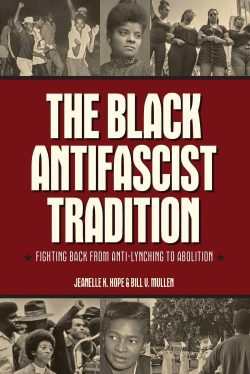
THE RETURN OF AN EMBOLDENED and vengeful Donald Trump to the White House, on the back of his attempts to stop the peaceful transfer of power in January 2021, have (re)turned attention to the “fascist threat” in the United States. That developments in the US have taken place within a wider global far right turn—involving an assortment of racist, white nationalist, authoritarian, and openly neofascist movements—underlines the significance of the moment and, to some degree at least, a similarity with the interwar era of what is widely described as “classical fascism.”
Indeed, as Jeanelle K. Hope and Bill V. Mullen’s The Black Antifascist Tradition asserts, fascism not only never went away, but its origins and techniques—not least in law-making—were largely inspired and learned from the historical experience of the United States. As the authors make clear, their book:
identifies the epicenter of modern racial Fascism as being in the United States, not Europe … We trace how Anti-Black Fascism is enshrined within American law and related political forms and ideologies, and how, unlike with European Fascism, there is no need for a singular Fascist regime to ensure its existence.1Jeanelle K. Hope and Bill V. Mullen, The Black Antifascist Tradition (Chicago: Haymarket Books, 2025), 9.
Hope and Mullen’s intervention speaks directly to the rise of the particular white nationalist, racist, authoritarian ideological constellation that characterizes much of MAGAism, arguing that an anti-Black racism is the consistent and primary ideological component of fascism over the longue durée.
Viewing the history of an anti-Black racism in the United States since Reconstruction, Hope and Mullen offer a comprehensive survey of what they describe as a distinct Black anti-fascist tradition that encompasses writers, activists (including but not limited to Ida B. Wells-Barnett, W. E. B. Du Bois, Angela Davis, and George Jackson), movements, and, correspondingly, concepts to understand and explain fascism, as well as strategies to resist it.
Historicizing Capitalism and Racism
Hope and Mullen’s book engages with a growing literature that draws more broadly on the concept of “racial capitalism,” and specifically a perspective on fascism that has sought to “provincialize” classical fascism and re-temporize it as a phenomenon that both predates and postdates the interwar era. Further—and unlike much of the decolonial turn in fascist studies—they center the United States as the primary incubator and practitioner of fascism and the inspiration for Mussolini and Hitler’s projects, rather than European colonialism.
How does this approach help us understand and explain fascism (both in terms of its distinct historical expressions and particular state forms) in relation to the development of capitalism and its crisis tendencies, and as a basis for a politics to counter it? Through their references to the work of Cedric Robinson, in particular, Hope and Mullen understand capitalism as a racializing and racist political economy and the United States as a singular social formation from its inception as a society organized around chattel slavery.
Racial capitalism—at least following Robinson—understands capitalism as a social system based on racial dispossession and this act or process as central to capitalism’s racializing features. Consequently, it is colonial/ racial dispossession—and its underlying violence—that establishes the hierarchical social order upon which capitalism emerges and develops.
Expropriation as much as exploitation is the defining feature of capitalism, and this not only means that racism is constitutive of capitalism but that racism is a necessary corollary of capitalism’s reproduction over the longue durée. Thus, while Hope and Mullen do not explicitly follow Robinson, they do make clear that despite the social, cultural, and political transformations of the last one hundred and fifty years in the organization and workings of capitalism and the place of space and race within it, the essential features or legacies of chattel slavery continue to define capitalism in the United States and hence the anti-Black racism of its homegrown fascism.
The problem in adopting such an understanding of capitalism—as others have highlighted—is that both racism and capitalism are not properly historicized.2Robert Knox and Ashok Kumar, “Re-examining Race and Capitalism in the Marxist Tradition–Editorial Introduction,” Historical Materialism: Research in Critical Marxist Theory 31, no. 2 (2023): 25–48; Robert Knox and Mary Robertson, “Locating Race in Capitalism’s Laws of Motion: The Case of Subprime,” Review of International Political Economy 33, no. 4 (2026): 1729–57. And, more fundamentally, the core social properties of capitalism and its dynamics of valorization and accumulation are left largely unexplained.3Vivek Chibber, “Interview with Vivek Chibber: Colonial Plunder Didn’t Create Capitalism,” Jacobin, December 14, 2025; Post, Charles “Racism and Capitalism: A Contingent or Necessary Relationship?” Historical Materialism: Research in Critical Marxist Theory 31, no. 2 (2023): 78–103. Thus, the social regimes of plantation slavery, then Jim Crow (including the New Deal) and neoliberalism all bleed into each other as “racial capitalism” without much distinction as to the specificities of each regime of accumulation and hegemony, including the distinct articulations of racism within each.
The problem in adopting such an understanding of capitalism is that both racism and capitalism are not properly historicized.
Instead, it is lynching and police harassment and violence alongside the “super-exploitation” of African Americans that provide the common thread for the permanence of racial capitalism. Such an understanding also rests on an assumption that the logics of class exploitation and racial oppression are based on separate and distinct social arrangements and dynamics.
This framing collapses the different modalities of accumulation, and the distinct spatial arrangements and political forms that undergird the main phases of capitalist history: 1870 to 1914; 1918 to 1945; 1945 to 1980; 1980 to 2008; and 2008 onwards. Moreover, the specificities of fascist modes of geopolitics and political economy are obscured from examination.
Fascism’s Distinctiveness
Further, what follows from this is the suggestion that the nature and consequences of anti-Black racism are largely unchanging and that fascism is, in effect, a permanent condition of the United States. However, while proto-fascist tendencies—of which an anti-Black racism was one important element among others—were clearly evident in the pre-1918 United States (as elsewhere), and fascist ideas and practices have characterized sections of US society and some state practices after 1945 (again as with many other liberal democracies). This is quite different from describing the defining characteristic of the United States over the longue durée as that of fascism and suggesting that the anti-Black racism that continues to persist within it is of a singularly fascist kind.
Let me unpack some of these issues in a little more detail in relation to the historical specificities of classical fascism and then turn to the more conceptual issues at stake in the use of “fascism” over the longue durée in relation to a liberal democracy like the United States. As the authors declare “there is no Fascism anywhere that is not also anti-Black.”4Hope and Mullen, Black Antifascist Tradition, 8.
However, fascist ideology and politics consists of a wider assemblage of ideas, practices, and forms, such that identifying fascism is no easy task. And if one should not be limited to its European interwar expression, nevertheless the characteristics of interwar Italian and German fascist movements and states and the conditions which produced them provide an important point of reference for thinking about fascism in general.
While fascist states remained capitalist, the spatial and legal–political arrangements that they introduced were novel and distinct from other types of the capitalist state, including the United States. All political opposition was destroyed, and this was particularly centered on the organized workers movement.
Consequently, the labor process was transformed—tout court, with a class animus driving the operations of the fascist state in empowering capital within the workplace. But this was no simple subordination to capital.
Rather, these new arrangements also affected the autonomy of capitalists and the means through which accumulation would be realized—via direct political negotiations with state functionaries and organs rather than through market competition. Further, the spatial arrangements within which exploitation and accumulation took place were also transformed through force.
And it is these features of capitalism—where capital and space are connected to fascism’s militarism and extreme nationalism as the capitalist economy becomes oriented toward military production, and the wider militarization of society provides the means to realize the new geopolitical arrangements—that underpin the fascist state. The point here is that these developments are qualitatively different from what characterized the United States at the time of classical fascism, even if the anti-Black racism of Jim Crow and its associated violence remained.
A key dimension of fascism is that it emerges and develops as a mass and subaltern politics in contexts of crisis.
There was nothing comparable in the US—even if the New Deal did involve political and material concessions to the racist arrangements of Jim Crow. This is also the reason why not all of the far right, racist, and authoritarian states that emerged during the era of classical fascism were fascist—Francoist Spain being one such case among others.
A key dimension of fascism—and what tends to differentiate it from the far right and especially the Right more generally—is that it emerges and develops as a mass and subaltern politics in contexts of crisis. So, while fascist ideas may circulate across time, the establishment of a genuine fascist politics requires the mobilization of the mass agency of widespread subaltern layers, including from sections of the working class.
It is this which gives fascism its radical and revolutionary dimension, as expressed in terms of how it mobilizes and the institutional forms it promotes and creates as the basis of its politics. Hence, fascism is deeply hostile to legally enforced constitutional limits on the operation of state power, the workings of representative institutions, and democracy as a mechanism to sanctify popular government.
If a politics is to be considered fascist, it must have these dimensions, even if it may not need the kind of aesthetic paraphernalia and mass-militarized form that characterized interwar fascism. Thus, following Geoff Eley’s framing, fascism needs to be seen as a permanent specter within the politics of capitalist states, which is only actualized at certain moments of combined crisis—in both the continuation of liberal democratic order and representation and the existing arrangements of capital accumulation.5Eley, Geoff, “What is Fascism and Where Does It Come From?” History Workshop Journal 91, no. 1 (2021): 1–28.
And it is this connection between structure and agency that best accounts for how fascism emerges, what fascism is—and its relationship to capitalism. Thus, following Eley, what causes fascism is not racism—even if this is an enabler of fascist ideas—but a political economy of crisis that existing liberal democratic and geopolitical arrangements are unable to overcome.
Not Fascist, Yet
And while there is a segue, requiring some degree of liberal–conservative complicity in the shift from a constitutional to a fascist political order, there is, nevertheless, a rupture point. The United States has never reached such a moment, yet.
Consequently, the conditions that propel fascism reveal its distinct kind of class politics. It is a class politics that tends to be opposed to big and international capital as much as it is anti-working class, and its political success has tended to involve the inability of parties and movements of the Left to effectively address the crisis conditions that give rise to and propel it.
And even if the symptoms of the fascist advance are revealed in racialized violence targeting specific racial groups, any effective opposition must prioritize cross-class appeals. This is something different from that prescribed by the Black anti-fascist tradition as revealed in Hope and Mullen’s volume.
The circulation of fascist ideas and the practices of fascist-like racist violence within the United States—including the way in which such racist ideas have constituted significant aspects of US law-making—are not the characteristics that define a fascist politics over the longue durée. And this definitional point also matters for an effective politics to counter fascism.
Indeed, it is here where parts of the decolonial left have undermined and self-sabotaged such a politics with the widespread deployment of “fascist” to describe an assortment of ideological and political infractions perpetrated by a range of political actors— many of which are patently not fascist. That this was also the case across parts of the anti-Trump 2024 US presidential campaign by the Democratic Party merely underlines the widespread problematic ways that the term “fascism” has come to be used.
In sum, while too much liberal historiography and politics treats fascism as an anomaly, separate and logically antagonistic to liberalism, this does not mean that an alternative critical position should accept the claim that fascism is a permanent and defining feature of liberalism and capitalism. ×
Notes & References
- Jeanelle K. Hope and Bill V. Mullen, The Black Antifascist Tradition (Chicago: Haymarket Books, 2025), 9.
- Robert Knox and Ashok Kumar, “Re-examining Race and Capitalism in the Marxist Tradition–Editorial Introduction,” Historical Materialism: Research in Critical Marxist Theory 31, no. 2 (2023): 25–48; Robert Knox and Mary Robertson, “Locating Race in Capitalism’s Laws of Motion: The Case of Subprime,” Review of International Political Economy 33, no. 4 (2026): 1729–57.
- Vivek Chibber, “Interview with Vivek Chibber: Colonial Plunder Didn’t Create Capitalism,” Jacobin, December 14, 2025; Post, Charles “Racism and Capitalism: A Contingent or Necessary Relationship?” Historical Materialism: Research in Critical Marxist Theory 31, no. 2 (2023): 78–103.
- Hope and Mullen, Black Antifascist Tradition, 8.
- Eley, Geoff, “What is Fascism and Where Does It Come From?” History Workshop Journal 91, no. 1 (2021): 1–28.