

Reading Third Camp Socialism in the Time of Trump and Xi

January 16, 2026

doi.org/10.63478/4FDCOUKS
Screenshot-2024-11-26-161741
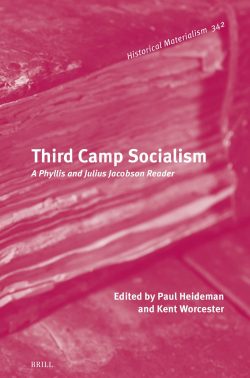
Third Camp Socialism: A Phyllis and Julius Jacobson Reader
by ed. Paul Heidemann and Kent Worcester
Historical Materialism, Brill
2025

We are living in a historical period deeply shaped by global capitalism’s Long Depression and by the worsening ecological crisis caused by this mode of production. These processes underpin both the sharpening rivalry between the West, China, and Russia and the dynamic of asymmetrical radicalization in which the right is growing stronger, the neoliberal centre is weakening, and an uneven resurgence of left radicalism lags far behind. In the current moment, left-wing forces are pulled politically either toward the stance of the rulers of the West or toward various often-reactionary forces in conflict with Western states. This results in a tendency to both pro- and anti-Western campism. Worryingly, the pull to either campism remains much stronger than the influence of insurgent popular struggles that encourage consistent internationalism, anticapitalism, and anti-imperialism. In addition, responses to pernicious anticommunism tend to adopt a sympathetic or celebratory stance to so-called   “socialist” countries rather than evaluating them from an emancipatory perspective.

When so much needs to be understood about the force of these dynamics in this context and about many other distinctive and important aspects of the world today, why would anyone want to devote time to reading two US socialists writing between the late 1940s and the turn of the century, especially given their preoccupation with the “Russian Question” (the social-political character of the long-gone USSR) and the politics of Communist Parties? In spite of what some readers will perceive as the irrelevance of the texts by Phyllis and Julius Jacobson compiled by Paul Heideman and Kent Worcester in the over 550-page long reader Third Camp Socialism, these writings are both of historical interest and (in some cases) real political value today.1Thanks to Aaron Jaffe, Charlie Post, and Joshua Nicholas Pineda for their comments on drafts of this piece, and to Peter Drucker, Sam Farber, Joel Geier, and Kim Moody for correspondence or conversation about related issues. The aim of this essay is neither to laud nor to polemicize against the authors. Rather, I aim to examine their Marxist commitments from the vantage of our moment in history. The Jacobsons’s analyses of the USSR, other “socialist” societies, and Communist Parties were flawed in nontrivial ways, and their socialist politics had other notable weaknesses. Nevertheless, they had a profound grasp of the indispensability of democracy for both the transition to communism and the development of working-class movements capable of launching such a transition. They also consistently maintained a resolute internationalist opposition to both the US ruling class and its geopolitical rivals, resisting the enormous pressure to accommodate one or the other. Indeed, situated as they were between Stalinism and Stalinophobia, both the Jacobsons’ failures and resolute successes in navigating between these political poles are instructive for contemporary Marxists in today’s context of increasing geopolitical rivalry.

Julius Jacobson (1922–2003) and Phyllis Garden (1922–2010)—who switched to using her husband’s last name in the 1960s to avoid trouble with the US Social Security system—became Trotskyists in New York City in their teens.2“Third Camp Politics: An Interview with Phyllis and Julius Jacobson,” in Third Camp Socialism: A Phyllis and Julius Jacobson Reader, eds. Paul Heideman and Kent Worcester (Leiden: Brill, 2025), 541. They were part of the large minority of the Socialist Workers’ Party (SWP) that broke away in 1940 to form the Workers’ Party (WP). The split was caused by the minority’s opposition to policies they found unacceptable—unconditional defence of the USSR (whose rulers had just signed a pact with Nazi Germany) and support for its invasions of Poland and Finland—and by disagreements on the character of socialist organization.3Peter Drucker describes these as “[d]ifferent approaches to Marxist theory and Marxist method [that] found immediate expression in sharp disagreements about how socialists should discuss and decide disputed issues and what it meant for a socialist organization to function democratically.” Peter Drucker, Max Shachtman and His Left: A Socialist’s Odyssey Through the “American Century” (New Jersey: Humanities Press, 1994), 116–17. Drucker is preparing a new edition of this book. The WP renamed itself the Independent Socialist League (ISL) in 1949. As Julius later wrote, after the war the WP/ISL “went into a more or less steady decline” (a decline, it must be noted, experienced by all left forces in the USA of the time).4Julius Jacobson, “The Two Deaths of Max Shachtman,” in Third Camp Socialism, 166. In a Cold War climate intensely hostile to radicalism, “[t]here was not only a decline in membership but a gradual erosion of the movement’s revolutionary ideological perspective”—a drift noticeable in the group’s foremost leader, Max Shachtman.5Jacobson, “Two Deaths,” in Third Camp Socialism, 166. Because of the calumnies levelled against the WP/ISL from some quarters of the socialist left, it needs to be said that, although the politics of most ISL members were drifting away from revolutionary socialism in the 1950s, the group did not capitulate to supporting Western imperialism. For Shachtman and those who followed him as he moved further to the right, capitulation came after the ISL’s dissolution. See Drucker, Max Shachtman, 259–82. At Shachtman’s initiative, the ISL dissolved into the social democratic Socialist Party in 1958.

In 1961 Julius and Phyllis launched the journal New Politics (first series 1961–76, second series 1986–). Their goal was to use the publication to communicate the “Third Camp” politics of the early ISL “[i]n an open forum with others” on the left who championed neither capitalism nor Stalinism.6“Third Camp Politics,” 549. The Jacobsons’s project was motivated by their opposition to Shachtman’s (and most other former members of the ISL’s) support for US imperialism against the USSR and abandonment of the politics they once supported: revolutionary-democratic socialist opposition from the standpoint of the exploited and oppressed to both capitalism and Stalinism (understood as a noncapitalist class society, or bureaucratic collectivism). Most of the articles contained in Third Camp Socialism were originally published in New Politics.

Most of the essays are credited to Julius but, as the book’s preface recognizes, he and Phyllis collaborated very closely in developing their ideas and writing. The writing is mostly very clear, well-crafted, and often lively—the product of learning to engage seriously with ideas at a young age in a vibrant working-class “infrastructure of dissent” afforded by the socialist organizations of the 1930s, rather than university classrooms.7On infrastructures of dissent, see Alan Sears, The Next New Left: A History of the Future (Winnipeg: Fernwood Publishing, 2014).

Third Camp Socialism is organized into five parts, each with a brief introduction by the editors: “Social Movements,” “Left Debates,” “The Russian Question,” “War and Peace,” and “Students and Teachers.” The reader also includes an editorial preface useful for readers unfamiliar with the authors and the WP/ISL, as well as an interesting interview with the Jacobsons.8The editors are mistaken in their claim that the Jacobsons broke politically with Shachtman “once he commenced his rightward march.” Paul Heideman and Kent Worcester, preface to Third Camp Socialism, ix). As Peter Drucker’s biography documents, that march began earlier than their break. Drucker, Max Shachtman, 189–253. Heidemann and Worcerster’s preface would have benefited from at least briefly discussing the history of the notion of the Third Camp. The major themes of the compilation are the character of the USSR and its influence on world politics, the CPUSA, the Cold War, US imperialism, fighting racism in the US, and defending civil liberties. There are also noteworthy defences of young New Leftists and Kate Millett’s Sexual Politics against criticism by Irving Howe (the founder of the journal Dissent who had quit the ISL as he moved rightwards). The book also includes Julius’s memorable short essay “The Two Deaths of Max Shachtman,” which conveys the admiration and affection many young Trotskyists of the 1930s felt for Shachtman as well as revulsion for the “moral and political death” represented by his becoming a renegade.9Jacobson, “Two Deaths,” 166.

Historical Insights and Blinkers

People interested in the history of the radical left in the US will find much of interest in Third Camp Socialism. Julius edited the magazine Anvil from 1949 to 1952 (soon renamed Anvil and Student Partisan after a merger) and his articles give the reader a sense of student politics in the early years of the Cold War, before the emergence of the New Left in the 1960s. The same is true of political debates in the Civil Rights Movement in the mid-1960s and the extent of racism in US unions in that decade. Phyllis’s review essay on the memoir Scoundrel Time by blacklisted Hollywood writer Lillian Hellman identifies the “almost complete political amnesia” and retrospective self-justification of this former longtime sympathizer of the CPUSA. Identifying these problems with participant accounts of the Red Scare is a helpful corrective to many people interested in left history today, who remain insufficiently attentive to them.10Phyllis Jacobson, “A Time of Assorted Scoundrels,” in Third Camp Socialism, 169.

The foremost expression of this commitment is their understanding that the democratic control of society by the working class is indispensable for transition towards a classless and stateless society of freedom (communism in Marx’s understanding). A society not ruled by the direct producers themselves cannot be in transition to communism.

Some of the material included in the reader illuminates the politics of the WP/ISL. Thanks to the interview with Phyllis and Julius, they also illuminate aspects of the life of the organization and two of its leaders, Shachtman and Hal Draper. A significant feature of these politics is the combination of an unsparing opposition to racism coupled with a lack of recognition of the importance of Black self-activity. In contrast, such a recognition had been expressed by CLR James in 1948, the year after he left the WP: “the independent Negro struggle, has a vitality and a validity of its own;… is able to intervene with terrific force upon the general social and political life of the nation… and… has got a great contribution to make to the development of the proletariat in the United States.”11J. Meyer [CLR James], “The Revolutionary Answer to the Negro Problem in the United States,” Fourth International 9, no. 8 (December 1948): 242–51, available at https://www.Marxists.org/archive/james-clr/works/1948/07/meyer.htm. The Jacobsons’ disagreements with James and his cothinkers in the Johnson-Forest Tendency, whose politics took the “unguarded confidence in the imminent triumph” of working-class revolution as a “defining feature,” may well have hindered Julius and Phyllis from recognizing the importance of James’s insights on the dynamics of Black struggle. Kent Worcester, CLR James: A Political Biography (Albany: State University of New York Press, 1996), 87. A substantial 1961 article on socialism in the United States written by Julius for British readers emphasizes how the ease with which US workers won basic democratic rights in the 1800s “removed from the experience of the American working class their necessary participation as an independent, revolutionary political force.” This judgment ignores how Black and other racially-oppressed workers of non-European origin had to fight long and hard for such rights. It also fails to consider the political consequences of their struggles, insight into which was available at the time thanks to W. E. B DuBois’s Black Reconstruction (1935) and other historical studies. Finally, it also exaggerates how easily most nineteenth century European immigrant workers won these rights.12I thank Kim Moody for this latter point (Kim Moody, e-mail message to author, August 13, 2025). It is possible that WEB DuBois’s alignment with the CPUSA led the Jacobsons and other WP/ISL thinkers to ignore Black Reconstruction. Julius’s “The Relevance of American Socialism” also ignores settler colonialism but, unlike slavery, the significance of Indigenous dispossession for working-class formation had not yet received visible intellectual attention in 1961. Julius Jacobson, “The Relevance of American Socialism,” in Third Camp Socialism. This article is also oddly dismissive of the historical significance of the Industrial Workers of the World.

Considerable attention is given in Third Camp Socialism to the CPUSA. The Jacobsons’s emphasis on the party’s undemocratic Stalinist conception of socialism, functioning, and political culture will likely douse the enthusiasm of readers only familiar with its members’ energetic involvement in union and community organizing and with the anticommunist repression they faced. An article by Phyllis challenges “revisionist” historians who celebrate the accomplishments and initiative of CPUSA members, especially in the Popular Front years from 1935–39, reminding readers of the lack of “freedom of thought” and the “censorship and, no less tragic, self-censorship” of members.13Phyllis Jacobson, “The ‘Americanization’ of the Communist Party,” in Third Camp Socialism, 236. In her judgment on the party’s conception of socialism, Phyllis asks:

What was the effect of the Party on socialist consciousness?… In one word, disastrous…it lowered socialist consciousness by distorting the basic concepts of socialism, promulgating the idea that a society based on the destruction of working-class independence, on terror and the liquidation of millions was socialist, a view shared by reactionaries quick to point to Soviet society and say with delight: ‘That is socialism! Socialism means repression in every sphere of life.’… Thousands who were attracted to the Party and joined its ranks were cruelly disillusioned by the experience, lost to the socialist movement.14P. Jacobson, “‘Americanization,’” 237.

Unfortunately, the power of the Jacobsons’s unsparing Marxist critique of the CPUSA’s politics is weakened by its exaggeration of the party’s regressive character and the idea that the party was alien to US society. Julius wrote of “Stalinism’s historic mission to destroy the organization and image of socialism”—a formulation that confuses Stalinism’s very real and very harmful impact with a supposed “historic mission.” In 1961 he commented on the elimination of the “restrictive influence” of the CPUSA “as an obstacle to socialism.”15J. Jacobson, “Relevance,” 86, 87. But the marginalization of the CPUSA by the repression of the “Second Red Scare” that began in 1947 and lasted a decade did not improve the prospects of supporters of anti-Stalinist revolutionary socialism, for whom the influence of anticommunism in US society remained a major obstacle.

Years later Julius characterized the CPUSA as “not a movement of the American left but a totalitarian incubus that fed on labor and progressive organizations, functioning in the left and against it.”16Julius Jacobson, “Reflections on Fascism and Communism,” in Third Camp Socialism, 212. This aspect of their analysis is inaccurate and can fairly be dubbed Stalinophobic.17Interestingly, in the interview with them included in Third Camp Socialism, Julius and Phyllis acknowledged that their former WP/ISL comrade Hal Draper believed they were “Stalinophobes.” See “Third Camp Politics,” 553. This is even more curious given that the Jacobsons rejected Stalinophobia—at least as they understood it—characterizing it as a “political virus” that saw “all of politics…through the prism of anti-Stalinism” and led those in its grip to side with capitalism against Stalinism.18Julius Jacobson, “Liberals, the Left and the US War on Democracy,” in Third Camp Socialism, 407. Nevertheless, their particular Marxist critique of Marxist-Leninist forces outside of the “socialist” societies treated these parties as nonproletarian forces intrinsically alien to working-class movements—that is, as embryonic bureaucratic collectivist ruling classes. This view is not shared by most anti-Stalinist Marxist analyses; such parties are better understood as rooted among workers or peasants and committed to a politics that equated socialism with the kind of society established in the USSR.

This Stalinophobic error is not original to the Jacobsons. They adopted Shachtman’s theory developed after the end of the Second World War, which concluded, as Peter Drucker puts it, that “even in countries immune to direct Soviet control, Stalinism was a qualitatively greater danger than any other force.”19Drucker, Max Shachtman, 206. See, for example, Max Shachtman, “Stalinism: Anti-Labor in Theory and Practice,” Labor Action, February 16, 1948, available at https://www.Marxists.org/archive/shachtma/1948/02/stalinism.htm. For an analysis from the same period that does not make Shachtman’s mistake, see Hallas’s “The Stalinist Parties.” Duncan Hallas, “The Stalinist Parties,” in The Fourth International, Stalinism, and the origins of the International Socialists: Some Documents, ed. Duncan Hallas (London: Pluto, 1971), available at https://www.Marxists.org/archive/hallas/works/1951/xx/stalparty.htm. Readers should look elsewhere for guidance on understanding Communist parties.20For example, Bryan D Palmer, “How Can We Write Better Histories of Communism?,” Labour/Le Travail 83 (2019): 199–232, https://doi.org/10.1353/llt.2019.0008, available at https://www.lltjournal.ca/index.php/llt/article/view/5956/6848; John McIlroy and Alan Campbell, “The Hippopotamus and the Giraffe: Bolshevism, Stalinism, and American and British Communism in the 1920s,” in Dissenting Traditions: Essays on Bryan D Palmer, Marxism, and History, ed. Sean Carleton, Ted McCoy and Julia Smith, 207–54 (Edmonton: Canadian Committee on Labour History and Athabasca University Press, 2021), available at https://www.aupress.ca/app/uploads/120301_99Z_Carleton_McCoy_Smith_2021-Dissenting Traditions.pdf. I discuss the theory and practice of Marxism-Leninism in Red Flags: A Reckoning With Communism for the Future of the Left (Winnipeg: Fernwood Publishing, 2025), 99–117. According to Samuel Farber’s apt judgment, “The Jacobsons only partly recognized, and lagged behind in politically assimilating, the changes that had taken place [after the decline of the political influence of the CPUSA and the USSR in the 1950s], often lacking a sense of proportion in overestimating the influence of Stalinism.”21Samuel Farber, “Julius Jacobson (1922-2003),” Against the Current 105 (2003), https://againstthecurrent.org/atc105/p594/.

Lasting Political Value

What gives the articles compiled in this volume their enduring political value is the commitment to an emancipatory Marxism that burns at their theoretical core. The foremost expression of this commitment is their understanding that the democratic control of society by the working class is indispensable for transition towards a classless and stateless society of freedom (communism in Marx’s understanding). A society not ruled by the direct producers themselves cannot be in transition to communism. Nowhere is this clearer than in the longest chapter of the book, “Isaac Deutscher: The Anatomy of an Apologist,” a piece that every Marxist should read. Here Julius, while acknowledging Deutscher’s “brilliant literary style,” conducts a forensic examination of his observations and predictions about the USSR and Mao’s China. Crucially, Jacobson demolishes Deutscher’s claims that there is “a law of revolution which dictates that…it becomes the responsibility of a small elite to establish its dictatorial rule over the masses in order to smash the old order and consolidate the revolution, thereby permitting the eventual realization of the revolution’s long-term social objectives” and that supposedly socialist “benevolent dictatorship[s]” are justified by their “growth of the productive forces” in spite of their lamentable oppressive features.22Julius Jacobson, “Isaac Deutscher: The Anatomy of an Apologist,” in Third Camp Socialism, 89, 90, 90, 136. Read today, this critique of Deutscher’s thinking provides a devastating challenge to political defences of the Chinese and Cuban governments and, more broadly, to the view that societies organized along the lines first established in the USSR at the close of the 1920s were, notwithstanding their defects, in transition to communism. It makes clear that state ownership of the means of production does not necessarily make a society better than capitalism. Jacobson also shows that transition towards communism cannot happen when the direct producers have no control over how their labor is organized and allocated; working-class rule through radically democratic institutions is indispensable.

Much of the writing compiled in Third Camp Socialism is still worth reading today because of what it offers to Marxist analysis and political thinking despite the Stalinophobia that mars it in places. This testifies to the strength of the authors’ theoretical formation and the depth of their commitment.

However, in spite of their explicit rejection of it, their writing on the USSR is needlessly weakened by Stalinophobia. The USSR’s ruling class caused the deaths of millions of people, not “tens of millions.”23J. Jacobson, “Liberals, the Left,” 401. Moreover, calling the USSR a “Slave State” is inaccurate even though there was large-scale forced labor under Stalin.24Julius Jacobson, “War, Realism, and the ‘Lesser Evil,’” in Third Camp Socialism, 344. See Camfield, Red Flags, 33–34. Their frequent use of “totalitarian” to describe the USSR without explaining (except in one very brief comment) the difference between their use of the concept and the more common meaning given by anticommunists is at best unhelpful.25J. Jacobson, “Isaac Deutscher,” 153.  There is a good discussion of concepts of totalitarianism, an idea used prior to the Cold War by anti-Stalinist Marxists—including Trotsky—in Greene’s Stalinism and the Dialectics of Saturn. Douglas Greene, Stalinism and the Dialectics of Saturn: Anticommunism, Marxism, and the Fate of the Soviet Union (Lanham: Lexington Books, 2023), 27-91, https://doi.org/10.5040/9781978728646. Referring to Stalin as an “oriental despot” is dubious.26Julius Jacobson, “Socialism and Thermonuclear War,” in Third Camp Socialism, 356. To claim, as Julius did in 1962, that “the West is certainly preferable to the East,” sits uneasily with the socialist stance of “Neither Washington Nor Moscow” he and Phyllis adopted from 1940 on.27J. Jacobson, “Socialism and Thermonuclear War,” 350. This tendency in their outlook was in part a product of the mistaken WP/ISL view that capitalism was in decline and Stalinism, “the most immediate and forceful threat to capitalism,” was rising. 28Julius Jacobson and Gordon Haskell, “Civil Liberties and the Philosopher of the Cold War,” in Third Camp Socialism, 527. It also flows from the group’s inadequate theory of Stalinist societies and the relationship between their mode of production and global capitalism (matters not illuminated by anything found in Third Camp Socialism). Finally, it needs to be noted that the chapter “Reflections on Fascism and Communism” in this collection misses the specificity of the Nazis’ exterminationist racist project, a weakness also reflected in discussions of the Second World War in other chapters.29Julius Jacobson, “Reflections on Fascism and Communism,” in Third Camp Socialism, 186–214.

Another aspect of Phyllis and Julius’s politics is their intransigent defence of civil and democratic rights—including those of CP supporters—that makes no concessions to liberalism. In 1953, in the face of McCarthyism, Julius wrote that “socialists have a dual responsibility: they must demonstrate how [the] fight for the truly liberal values is inseparable from the fight against capitalism, for socialism; and, second, in a more concrete manner they must emphasize the validity of democratic values which are being called into question by liberals and negated by politicians.”30Julius Jacobson, “Capitalism’s Threat to Democracy,” in Third Camp Socialism, The relevance of this argument should be obvious at a time when already-weakened rights are under attack both by the right and its liberal “opponents,” including governments in London, Paris, and Ottawa.

The authors are equally consistent in their anti-imperialism up to and including the “War on Terror” at the end of their lives, with Julius writing scathingly in 2002 of “ex-leftists beating a hasty retreat from radical traditions and politics as they wave the American flag, write briefs extolling the virtues of their newly discovered patriotism, and diligently devote their intellectual energies to the patriotic mission of convincing as many who will listen that an imperialist war is a just war.”31J. Jacobson, “Liberals, the Left,” 431. Their anti-imperialism is notably untouched by the logic that the “enemy of my enemy is my friend,” This attitude—which embraces any and all enemies of the US state—was common in their times and persists in ours. Regrettably, the Jacobsons erred in the opposite direction in denying that the war against US imperialism in Vietnam was in any sense a national liberation struggle because it was led by Stalinists.32Julius Jacobson and Laurie Landy, “Neo-Stalinism: The Achilles’ Heel of the Peace Movement and the American Left,” in Third Camp Socialism, Hal Draper provided a political methodology for siding with movements against imperialism while not lending political support to leaderships hostile to socialism in “The ABC of National Liberation Movements.” Hal Draper “The ABC of National Liberation Movements: A Political Guide” (1969), available at https://www.Marxists.org/archive/draper/1969/abc/abc.htm.

The intergenerational solidarity—unwavering but not fawning—seen in their defences of the New Left and Millett against Howe is exemplary for older radicals today who recognize their obligation to defend young radicals against media vilification and punishment by university administrators and state authorities. Also of value are their discussions of the USSR’s relationship with Nazi Germany before the 1941 Nazi invasion, the USSR’s role in the Second World War, and the interimperialist character of that war. These subjects are frequently obscured both in mainstream histories and in accounts sympathetic to the USSR. The Jacobsons’ reflections are useful given the political salience of these topics for both anticommunists and Marxist-Leninists today.

Above all, Phyllis and Julius Jacobson were US Marxist political writers of their times. Much of the writing compiled in Third Camp Socialism is still worth reading today because of what it offers to Marxist analysis and political thinking despite the Stalinophobia that mars it in places. This testifies to the strength of the authors’ theoretical formation and the depth of their commitment. I do not think the same could be said were there to be analogous new compilations of writings by their counterparts of the same generation who were at the helm of publications like the social democratic Dissent and “Third Worldist” Monthly Review.

The pressures on leftists today to align with Western states or with their rivals—especially China with its rulers’ impressive state-steered capitalist development project—will not be overcome by delving into the writings of twentieth century anti-Stalinist Marxists. But anticapitalists who are at least open to critical evaluation of the “socialist” societies will benefit from reading at least some chapters of this book, which will appear in a paperback edition from Haymarket Publishing in 2026. It would be unfortunate if the length of this volume deters some potential readers from exploring its contents. Although the reader is not free of   repetition, the editors’ decisions about what to include are mostly unobjectionable in a book intended for library acquisition. But the sheer size of Third Camp Socialism makes it less appealing to the readers who will benefit most from sampling what it contains; for their benefit, a more stringent approach to selection that emphasized the authors’ very best work would have had merit. Readers should also be aware that, in spite of its title, the perspectives on offer in this collection are not entirely reflective of the politics of the current originating with the WP, a fuller understanding of which requires sampling the writings of at least Shachtman (before his rightward drift) and Draper as well as major documents of the WP/ISL. I believe it would be an error to think that an updated version of the politics of the WP/ISL could be adequate for our time; too much has changed in the world, and even at its best this socialism had significant shortcomings, some of which have been touched on in this review. That said, people who see the need for a liberatory socialism for our time can still learn a lot from the best ideas of this current.


SHARE

HELLO, COMRADE

While logged in, you may access all print issues.

If you’d like to log out, click here:

NEED TO UPDATE YOUR DETAILS?

Support our Work

Gift Subscriptions, Renewals, and More