
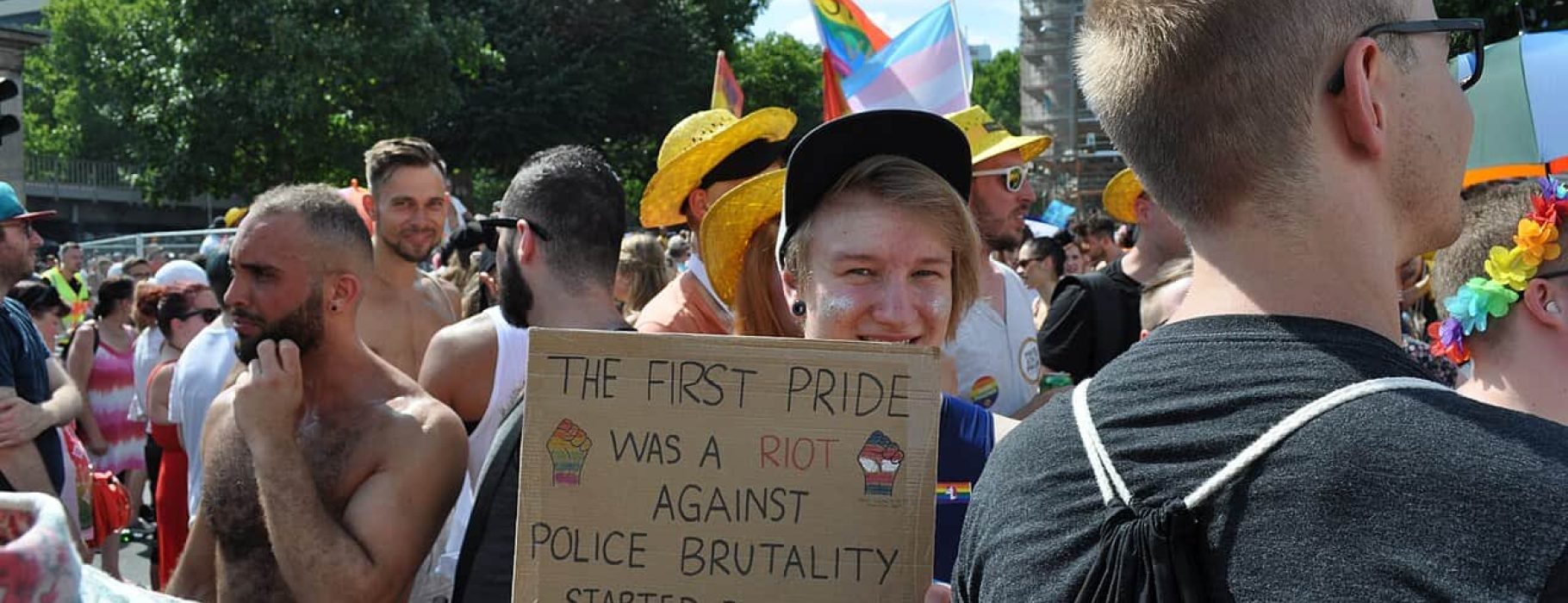
On Pride Sunday, I woke up to messages from Canada, where I live outside of my summers in Berlin. The first was by my straight neighbor: “Just checking in as we heard the news about Berlin.” Half asleep, I google “Berlin.” Top results: Attack on Pride with a van, one dead, many injured. We were there yesterday. And then: “The suspect is believed to belong to Islamist circles.”
More headlines and images by the hour. “We stand with Berlin.”1Post by Switchboard, LinkedIn, July 2026, www.linkedin.com/posts/berlinpride-berlinstehtzusammen-neverbesilentagain-share-7487608002011672576-oE6z. “We grieve with Berlin.” “Love conquers hate!”2Post by Palm Springs Pride (PalmSprings.Pride), Facebook, July 27, 2026, 3:16 pm, www.facebook.com/PalmSprings.Pride/posts/devastated-by-the-news-coming-out-of-berlin-what-was-supposed-to-be-a-weekend-of/1529551192532814. A frequently reused image shows the Brandenburg Gate—the iconic backdrop of key chapters in German history, from the Nazi takeover to partition and reunification. The gate has a huge rainbow projected onto it, with white letters: “Berlin, Stadt der Freiheit [City of Freedom].”3Entsetzen, offene Fragen und Forderungen nach mehr Härte,” Der Spiegel, July 27, 2026, www.spiegel.de/panorama/gesellschaft/anschlag-auf-den-csd-in-berlin-trauer-wut-und-politische-forderungen-a-8552976e-3a01-4a4f-93cf-32e19f2b85d9. Two people with long blonde hair are featured from behind, hugging, facing the gate, framing a crowd of mourners. It’s a great shot. I do a double take as I come across a second pic just like it, only the crowd is different. Was the gate already lit this way before the attack? I should be grateful for the epic demonstration of support, but instead I feel trapped in a trompe l’oeil. I can’t shake the feeling that we queers are more interesting—and useful—in death than in life.
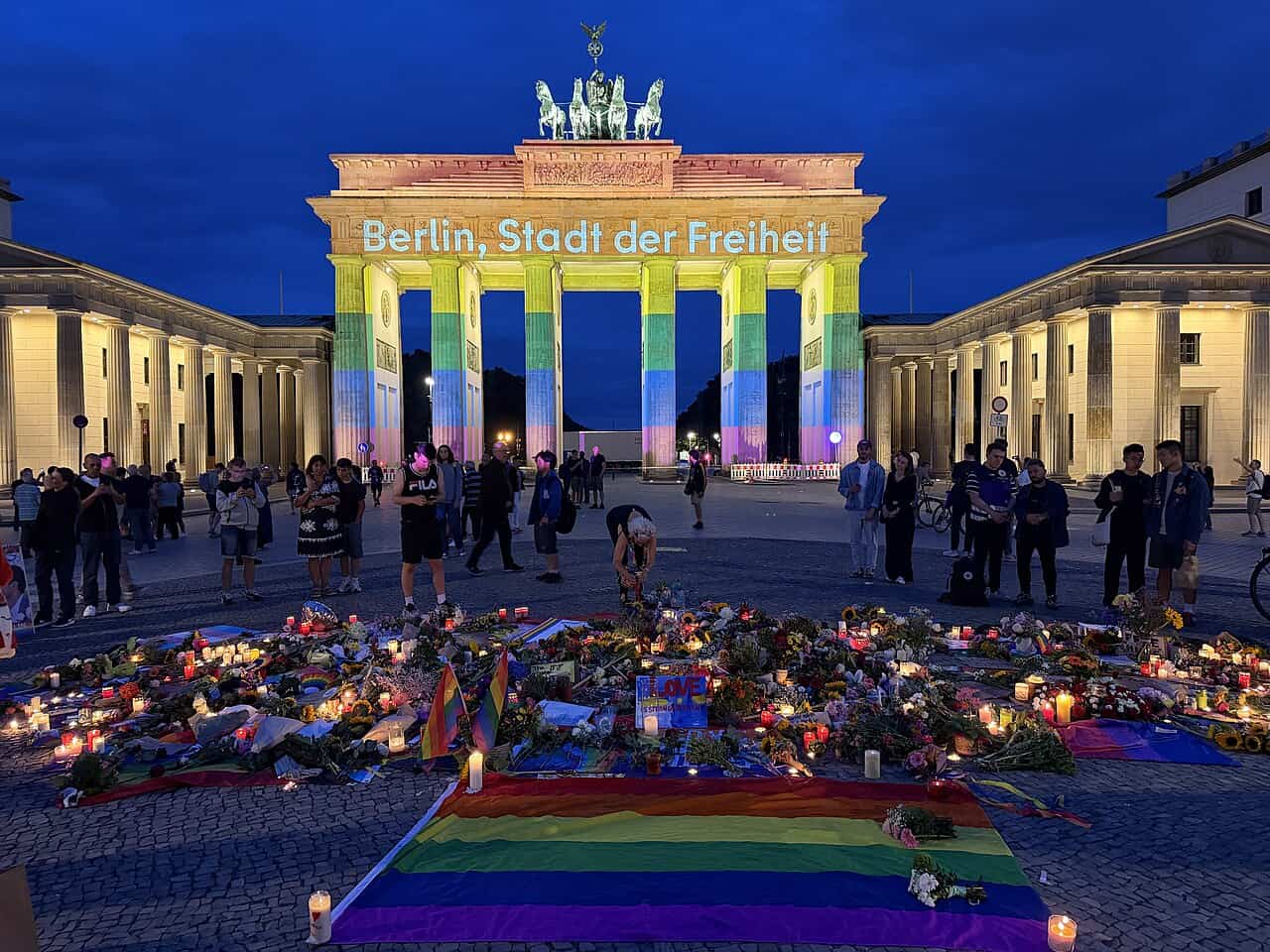
Photo Credit: Orator via Wikimedia
On social media, the mourning has gone global. In an increasingly fascist world, what happens in the city that famously overcame fascism seems to concern everyone.4This view treats fascism as an event that can be isolated in time and place, rather than a mutable structure that is immanent in liberal democracy, as Alberto Toscano argues, drawing on Black radical theories of racial capitalism. Alberto Toscano, Late Fascism: Race, Capitalism, and the Politics of Crisis (New York: Verso, 2023). This is the queer El Dorado, where the grass is still greener. All the queers want to live here (remember Sabi of Sort Of?).5Michael Cuby, “Sort Of Star Bilal Baig Talks the Series’ Final Season and What Comes Next,” W, February 9, 2024, www.wmagazine.com/culture/bilal-baig-sort-of-finale-season-3.
Everyone and their mother is writing and posting. The influencers. The BBC. A friend’s mother in Malaysia has heard about it. Mom groups across North America are mourning. Several Facebook friends in Toronto have Berlin-themed profile pics. A slide posted by the 519—Toronto’s big 2SLGBTQ+ organization—contains German: “Berlin/Stadt der Freiheit/today and always.6Post by The 519 (The519), Facebook, July 27, 2026, 10:26 am, www.facebook.com/The519/photos/we-are-heartbroken-by-the-violent-attack-that-took-place-at-berlin-pride-over-th/1475761134596044. The yearning for the Never Again that this city embodies flickers across the globe. In Germany, the Pride attack quickly becomes the biggest queer-themed headline in a while, maybe the twenty-first century.
Barely a day after the attack, Abdul B., the suspect, is shot by police. His death is widely reported on.7Simon Schwarz, “Abdul Ballout starb im Kleingarten-Idyll ‘Als die Schüsse fielen, ist mir ganz anders geworden,’” Tagesspiegel, www.tagesspiegel.de/berlin/bezirke/spandau/abdul-ballout-starb-im-kleingarten-idyll-als-die-schusse-fielen-ist-mir-ganz-anders-geworden-15887895.html. However, its circumstances, or even necessity, are barely interrogated. The police killing is reported as the successful operation of a special commando, whose steps are retraced like this: B. had hidden in an urban garden allotment. When officers found him, he approached them with a stabbing weapon. They shot him several times and he died on the scene. We do not learn—and few ask—if he needed to die. No thought is given to whether police tried to incapacitate him first. Journalists are compelled by other questions. Like the fact that B.’s life ended in the peaceful setting of the idyllic kleingarten—framed by the juxtaposition of his mugshot and the garden’s entrance signage, whose name is embossed in old German sütterlin letters.8Leon Pollok, “Experte: Tod von Attentäter ‘nicht überraschend,” T-Online, July 27, 2026, www.t-online.de/nachrichten/panorama/gesellschaft/id_101361710/csd-terrorist-abdul-ballout-tot-kriminologe-gab-es-mitwisser-.html. For cultural context, the kleingarten is an ultra-German signifier, a natural habitat of white pensioners and garden dwarves. How ironic, grotesque even, according to the encoding, that B.’s life would find its end here. Given the depravity of his actions and the avalanche of collective grief, his death seems like a natural consequence. It seems too much to ask whether he should have had a trial or what this biggest queer story of recent times says about our much-invoked slide into fascism.
In the early days after the attack, anti-oppression groups of all stripes, including antiracists, encouraged us to seek counseling from the big queer organizations like the Lesbian and Gay Association Germany (LSVD —Verband Queere Vielfalt)—the equivalent of the Human Rights Campaign in the United States or Egale in Canada—and Maneo (Berlin’s gay antiviolence project). The LSVD’s own press release states “our grief cannot be instrumentalized” and “the community [should] not allow itself to be divided.”9“Attentat auf Berliner CSD trifft in das Herz der Community,” LSVD, July 26, 2026, www.lsvd.de/de/ct/17275-Attentat-auf-Berliner-CSD-trifft-in-das-Herz-der-Community. Many journalistic commentators, too, warn of “instrumentalization.” Some even drop the term homonationalism, whose critical local theorizations were spearheaded by radical queers of color with platforms no bigger than our kitchen tables. However, who or what is doing the instrumentalizing or dividing, and against whom, are never fully explored. While some spell out that it is Abdul B.’s Muslim background that might be instrumentalized, and that far-right politicians might be doing the instrumentalizing, the term mostly remains an empty signifier.10The empty signifier soon gets filled by those who have no qualms stating that Islam means Islamism for up to 30 percent of Muslims living in Germany. “Wie viele Muslime empfänglich für Extremismus sind,” Frankfurter Allgemeine Zeitung, July 28, 2026, www.faz.net/aktuell/politik/inland/wieso-gibt-es-unterschiedliche-zahlen-zu-gefaehrdern-201072423.html. It is enough to drop it and move on to the main argument, which is variously framed as an expression of collective grief or a call for more resources, reforms, recognition, and—above all—improved hate crime and police protections at Pride.11There were twice as many police present at Hamburg Pride, the next big event a week after the one in Berlin. Whether policing will make queers safe has long been a contested question. There is substantial literature criticizing the hate crime paradigm, which highlights the adverse effects of increasing policing on the safety of queers without race or class privileges who, as summarized in my book, are more likely to be arrested than protected by police. “No Pride in Policing” is gaining ground as an abolitionist and internationalist queer demand. No Pride in Policing, accessed August 14, 2026, www.noprideinpolicing.ca; “Manifesto (IQPB, 2026),” Internationalist Queer Pride, March 2026, accessed August 14, 2026, iqpberlin.org/en/iqpb-manifesto. The mainstream Pride in Berlin has long exemplified queer assimilation into capital, giving rise to the formation of several counter-Prides in Berlin over the years. The current wave of collective grief thus also obfuscates conversations over what really makes us safe. What Really Makes Us Safe, accessed August 14, 2026, www.whatreallymakesussafe.com. Others have no qualms in assigning blame to whom they feel it belongs, and warn of a growing Islamism that leads to not only a growing homophobia, but also growing terror and crime, among youth in particular. There are (often lateral) appeals of the nature we’ve grown accustomed to: all Muslims should condemn the act and Islamism in general. Queer functionaries and left wingers who fund them should take responsibility, too. The message goes: If it wasn’t for their intersectional agenda, their apologism of backward Islamic regimes and of homophobic migrants and refugees abusing “our German Welcome Culture,” the hate would not have been allowed to undermine our civilizatory progress.12For examples, see Jan Feddersen, “Eine verhängnisvolle Liaison,” Cicero, July 29, 2026, www.cicero.de/innenpolitik/eine-verhangnisvolle-liaison; Jan Feddersen, “Nach dem CSD-Attentat: vom Zusammenleben auf der Neuköllner Sonnenallee, Deutschlandfunk Kultur, July 30, 2026; Vojin Sasa Vukadinovic, “Feuerwerk der Scheinheiligkeit,” Junge World, August 6, 2026, https://jungle.world/artikel/2026/32/feuerwerk-der-scheinheiligkeit/.
Taken together, these responses—the warning of “instrumentalization,” the unapologetic state authoritarian crackdown, and the nostalgic antiwokeness—indicate we are in the middle of a new conjuncture of racial capitalism whose sexual and racial contours are significantly shifting, rendering it necessary to take stock of earlier forms of liberal and neoliberal multiculturalism, their incorporations into state, media, and non-profit institutions, and their critiques and reactions.
Let’s start with the first notion: “instrumentalization.” The word seems strange from an organization like the LSVD. After all, the biggest LGBT organization was one of the key authors of the Muslim homophobia panic in Germany. As I note in my book Queer Lovers and Hateful Others: Regenerating Violent Times and Places, homophobia in Germany (as in many places across Europe and its settler colonies, long the key exporters of cisheteropatriarchy) was transformed—or “regenerated”—from a sexual into a racial problem.13Jin Haritaworn, Queer Loves and Hateful Others: Regenerating Violent Times and Places (London: Pluto Press, 2015), https://doi.org/10.2307/j.ctt183p5vv. For over two decades, bodies, communities, and neighborhoods constructed as Muslim have been declared the root of all homophobic evil. Homonormative organizations, left-wing politicians and journalists, but also radical queer and trans activists played a major role in this transformation. Early examples of these dynamics include press statements by the LSVD that “migrants”—meaning people of color who have often been in Germany for generations—“must clarify their relationship to homophobia”; kiss-ins staged in “problematic” (meaning migrant) areas by Maneo; smash homophobia and anti-hate demonstrations by radical queer activists in Berlin’s long-migrant, gentrifying districts of Kreuzberg and Neukölln; psychological studies into the religious predisposition of Muslim youth toward homophobia; action plans by the Green and Left Parties; and, most iconically, posters and ads with mixed-race kisses carrying the caption Love Deserves Respect (in German, Turkish, and Arabic, reinforcing the message that respect for queer lifestyles is an alien concept to those who will never fully speak, let alone be, German). The latter, plastered all over public transit and the cityscape, were commissioned by the LSVD, the same organization that now warns of “instrumentalization.”
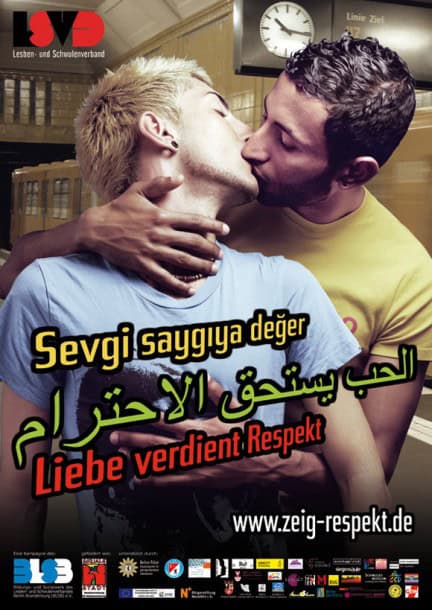
The transformations of homophobia from a sexual to a racial problem, and of sexual justice into criminal “justice,” cannot be reduced to a series of acts of instrumentalization. They are linked to a series of “regenerations,” both structural and symbolic, that have to do with global developments in late capitalism. These structural conditions include the rebranding of the inner city from a stigmatized “foreigners’ ghetto” into a “colorful” site of investment, whose faces included queers, artists, and other edgy subjects; the large-scale abandonment of racialized communities that were long confined to the inner city, and who now struggle to remain there in the face of gentrification and policing; the refiguration of former “guest workers” from “foreigners” and “migrants” into a globally interchangeable population of “Muslims,” and from a source of cheap labor, which was extracted and excluded from the welfare state that it built, to an increasingly naturalized population that needed to be excluded by other means; the global spread of neoliberalism (the replacement of local labor through relocation and automation, and the expansion of surplus populations to be kept as socially dead as possible); the embrace of criminalization and border control as prime fixes for the social problems caused by capitalist abandonment; and, in line with this carceral embrace, the development of an international LGBT movement that proposed hate crime legislation as a key solution to homophobia and transphobia.14
On gentrification, see “Neil Smith: Gentrification in Berlin and the Revanchist State,” Einstellung!, October 20, 2007, einstellung.so36.net/en/ps/524.html.On social death, see Lisa Marie Cacho, Social Death: Racialized Rightlessness and the Criminalization of the Unprotected, chapter 3 (New York: NYU Press, 2012). Cacho variously approaches social death as absolute rightlessness, but also as the process through which human life is turned into waste—often through criminalization and border enforcement. The criminalized youth who are at the forefront of moral panics in Germany are rarely completely rightless—many formally possess residence or citizenship rights. Rather than treat social death as a definitive state, I am interested in how architects of moral panics attempt to discursively or materially disenfranchise and render socially dead those who, following social gains, can no longer be kept out via traditional means. Moral panics thus produce consent for new means that must be invented to disenfranchise these newly “enfranchised” populations.
For an analysis of global shifts in capitalist production and the work of incarceration in the management of surplus population, see Angela Davis, Are Prisons Obsolete? (New York: Seven Stories Press, 2003). For an analysis of the prison “fix” to problems created by social abandonment during neoliberalism, see Ruth Wilson Gilmore, The Golden Gulag: Prisons, Surplus, Crisis, and Opposition in Globalizing California (Oakland: University of California Press, 2007). For a queer and trans of color abolitionist critique of hate crime activism and its origins in Los Angeles, see Ren-Yo Hwang, “Accounting for Carceral Reformations: Gay and Transgender Jailing in Los Angeles as Justice Impossible,” Critical Ethnic Studies 2, no. 2 (2016): 82–103, doi.org/10.5749/jcritethnstud.2.2.0082.
First formulated in 1980s Los Angeles, the homophobic hate crime paradigm arrived in 2000s Germany belatedly, on a soil well ploughed by the War on Terror and constantly recycled crises in migration and integration. As many have argued, and I have summarized in my book, both hate and crime are insufficient analytics through which to tackle cisheteropatriarchy. Suffice it to say, in Germany, the new hate crime paradigm found its perpetrator subjects inside existing molds of Muslim hate, Muslim terror, and youth criminality.
Yet any deal that will be brokered from this tragedy is made in blood. The allyship of the powerful in this moment looks cheap and performative, especially when compared to their actual record. Conservative chancellor Friedrich Merz—known for his jokes that gays are fine as long as they don’t come near him, break the law, or bother children, his statement that a gay man could not become chancellor, and his axing of the national queer funding plan—speaks of an “attack on us all.”24“Kanzler Merz spricht von einem ‘Angriff auf unsere Gessellschaft,’” Der Spiegel, July 27, 2026, https://www.spiegel.de/panorama/justiz/reaktionen-auf-csd-angriff-es-trifft-unsere-stadt-mitten-ins-herz-a-ff6e572c-563b-4d06-b903-d8fa28f8587c. Conservative interior minister Alexander Dobrindt, who used the attack to whip out the above measures on the same day, speaks of a “cowardly, despicable attack on peacefully celebrating humans.” That “dangerous individuals” are not the only ones on which he likes to keep tabs became clear when he tried to introduce a register for trans people, leading to a public outcry.25Antonetta Stephany and Björn-Hendrik Otte, “Was sagt das Gesetz zu Dobrindts Forderungen,” Tagesschau, July 28, 2026, www.tagesschau.de/inland/innenpolitik/csd-anschlag-forderungen-recht-100.html. Kai Wegner, outgoing conservative mayor of Berlin whose legacy includes the financial decimation of queer and antiracist projects in the name of austerity and silencing pro-Palestine protest, thrusts in the same direction: He is “at a loss for words” that someone like B. would have ever been offered probation.26“‘Da fehlen schon die Worte’ – Unions-Politiker wundern sich, dass Abdul Ballout auf freiem Fuß war,” Welt, July 27, 2026, www.welt.de/politik/deutschland/article6a66baa3fe2765826e0fe5f0/anschlag-auf-csd-da-fehlen-schon-die-worte-unions-politiker-wundern-sich-dass-abdul-ballout-auf-freiem-fuss-war.html. Wegner drew criticism after spending €375,000 on his own Pride float.
Apparently, queer people do not deserve social programs or political education, but there’s always money for law enforcement and a good show. Meanwhile, the police presence was much higher at the Internationalist Pride happening on the same day as the big Pride parade—not to protect, but to intimidate and actively assault queers who refuse to pinkwash the genocide against Palestinians.27Udi Raz, “Germany’s Grievable Queers. And Us.,” Patreon, July 26, 2026, www.patreon.com/UdiRaz/posts/germanys-queers-164873260. And while neoliberal multicultural principles of equity, diversity, and inclusion have long given way to an authoritarian consensus built on “antiwokeness,” politicians of all parties, including the AfD, are chiming the by-now ghostly bell of diversity policing once more for electoral luck.
If anything positive has come out of the debate following the Pride attack, it’s that many are now noting the hypocrisy of politicians who also treat queers as disposable. This is not simply a moment for noticing contradiction. It is a moment for shouting: The emperor wears no clothes! Politicians do not care for queer or racialized youth, let alone queer racialized youth. Projects providing services and education in these intersections were the first to be cut. We need a sober reality check that even privileged queers are no longer cozy bedfellows. The teddy bear may be pulled out from a dusty corner occasionally, but it has already been thrown out. It may well be true that authoritarianism informed Abdul B.’s motives. Given the political climate we’re in, there will be more deadly attacks—not all against queers and certainly not all by Muslims. The many, often mass or serial, killings of Black people and people of color that rarely gain this level of spontaneous publicity are a testament to the increasingly deadly nature of this conjuncture. And while it is true that authoritarianism is globally on the rise in all sectors of society, appealing to one authoritarianism to keep another in check will do little to save us.
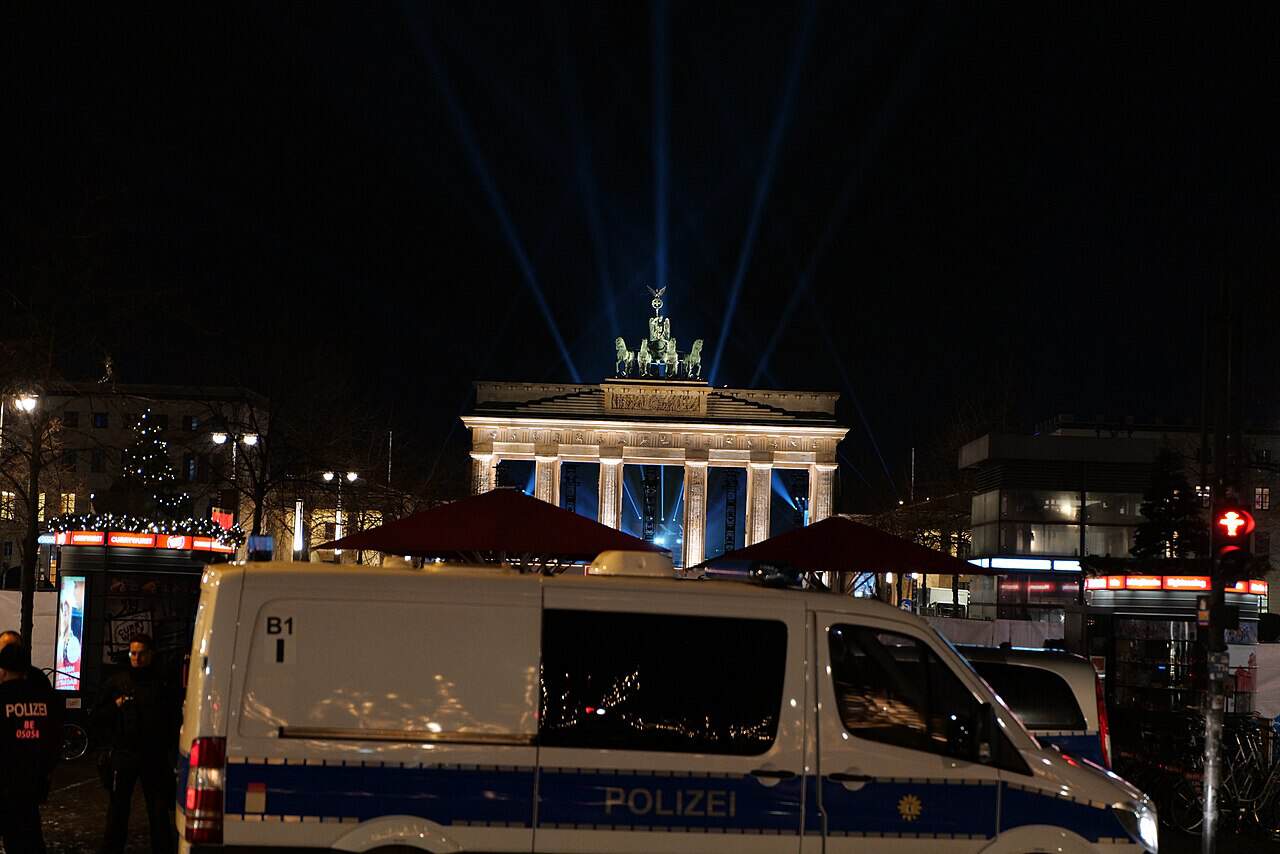
Photo Credit: Leonhard Lenz via Wikimedia.
Everyone drops a disclaimer against instrumentalization, but few bother to recall its history. The history of the Muslim homophobia discourse would not be complete without the wider context of youth criminalization of which it is but a variation. Stamping out migrant youth crime has long been a staple of authoritarian state agendas, whose proponents have included a whole spectrum from the far right to the center left. In fact, policies and election campaigns on crime, migration, and citizenship by Christian Democrats, Social Democrats, and even the Green Party have often mimicked and preempted those of the AfD.
Let’s look at a few snapshots. In the 2000s, the intensivtäter debate fueled political careers, including that of youth judge Kirsten Heisig, who became a media star with her playbook of hard and fast sentences that prefigures today’s. Heisig declared racialized youth irreparable. After her death, she received obituaries from the big gay organizations. The repeat offender was also the subject of the widely disseminated Pfeiffer study that “proved” that Muslim youth are more likely to fit this profile than any other group due to their supposed religiosity and archaic cultural backgrounds.28Dirk Baier et al., Kinder und Jugendliche in Deutschland: Gewaltfahrungen, Integration, Medienkonsun, Forschungbericht no. 109 (Hannover: Kriminologisches Forschunginstitut Niedersachen, 2010), available at kfn.de/wp-content/uploads/Forschungsberichte/FB_109.pdf. One of the study’s authors, incidentally, is now giving expert interviews on Abdul B.29Pollok, “Tod von Attentäter.” Such cross-fertilizations can be traced back to the 2000s, when the figure of the repeat offender inspired hate crime activists to call for the protection of queers from Muslims specifically, again citing their religious and cultural backgrounds. This is the era of the global War on Terror, when the biggest national minorities across Europe are rebranded as Muslim.30Yasemin Yildiz, “Turkish Girls, Allah’s Daughters, and the Contemporary German Subject: Itinerary of a Figure,” German Life and Letters 62, no. 4 (2009): 465–81, doi.org/10.1111/j.1468-0483.2009.01475.x. People in the second and third generation of migration in particular get refigured as potential terrorist sleepers. These suspicions, if anything, increased for the generations born and raised in Germany, abetting the erosion of immigration and citizenship rights and the supplanting of social-justice programs with deradicalization ones.
In the same period, antisemitism (and by implication fascism) were converted from a German into a Muslim problem, rendering suspects of antisemitism, terrorism, youth criminality, and homophobic hate crime increasingly interchangeable.31Anna-Esther Younes, “Fighting Anti-Semitism in Contemporary Germany,” Islamophobia Studies Journal 5, no. 2 (Fall 2020): 249–66, https://doi.org/10.13169/islastudj.5.2.0249. More recently, riots during COVID-19 and New Year’s Eve invigorated calls for youth criminalization, remigration, and denaturalization.32Cengiz Barskanmaz, “Rechsstaatliche und strafverfahrensrechtliche Ernüchterung nach der ‘Berliner Silversternacht,” Verfassungsblog: On Matters Constitutional (blog), January 13, 2023, doi.org/10.17176/20230113-121813-0. In early 2023, Merz launches his election campaign on this very platform while targeting the youngest—Arab elementary school boys, who he branded as “little pashas,” disrespecting their female teachers. Later that year, the German raison d’etat to protect Israel entered German schools and universities, along with the International Holocaust Remembrance Alliance definition of antisemitism, which renders any criticism of Israel automatically antisemitic and terrorist.33Anna Younes and Hanna Al-Taher, “Erasing Palestine in Germany’s Educational System: The Racial Frontiers of Liberal Freedom,” Middle East Critique 33, no. 3 (2024): 397–417, doi.org/10.1080/19436149.2024.2383444. Palestinian children and pro-Palestine youth were (and are) declared national folk devils. Young children are hunted at demonstrations by police. Schools are encouraged to call police on children of any age who wear Palestinian symbols and make pro-Palestine statements.34Jin Haritaworn, “‘Middle East Conflict in Berlin Schools’: On the Affectability of ‘Fake News,’” Communication, Culture, and Critique 17, no. 3 (2024): 217–20, doi.org/10.1093/ccc/tcae022. Here, too, policing supplants education.
There is a longer history of racist moral panic that we must stay attentive to now. Some of it has spoken the language of protecting gays and, significantly right now, Jews. There’s an ever-larger part that does not hide its dehumanizing intent. How many children and youth have already been imprisoned, deported, or banished from life as a result of these moral panics? Can we grieve them, too?
Abdul B.’s shooting feels like an extrajudicial execution. It is met with little outcry. The ubiquitous calls for love and unity sound cynical. I watch the rainbow flag flutter across the AI slides, and wonder exactly who or what we’re mourning now.