
What, exactly, are we doing when we “read Marx”? Are we excavating a fixed doctrine from a canonical author documenting the intellectual itinerary of a nineteenth-century revolutionary? Perhaps we are constructing concepts along with him to meet the demands of our present. One particularly generative place to pose this question is when we confront the late notebooks and marginalia that have emerged in the second Marx-Engels-Gesamtausgabe (MEGA²). The authority of “Marxism” has so often rested on editorial and institutional decisions that narrowed the field of what counted as Karl Marx. Those decisions helped found a research program and a political tradition, but they also disciplined how generations approached the corpus.
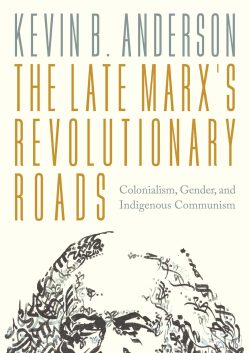
Kevin B. Anderson’s The Late Marx’s Revolutionary Roads: Colonialism, Gender, and Indigenous Communism is a timely intervention in that larger story. It offers a capacious guide through the new materials and, just as importantly, invites us to ask what kind of interpretive work is called for when we bring a nineteenth-century thinker into twenty-first-century debates.
Following his death in 1883, Frederick Engels devoted himself to bringing volumes two and three of Capital to print, an editorial achievement that also saturated subsequent reception, while works like Anti-Dühring and Socialism: Utopian and Scientific helped form Marx’s thought into a system.1For more detailed accounts of the twists and turns Marx’s literary estate, see Marcello Musto, “The Rediscovery of Karl Marx,” International Review of Social History 52 (2007): 477–98, https://doi.org/10.1017/S0020859007003070; Jürgen Rojahn, “Publishing Marx and Engels after 1989: The Fate of the MEGA,” Critique 29, no. 1 (2009): 196–207, https://doi.org/10.1080/03017600308413467; Rolf Hecker, Manfred Neuhaus, Richard Sperl, and Hu Xiaochen, “MEGA (From the Historical-Critical Dictionary of Marxism),” trans. Kaan Kangal, Historical Materialism, accessed November 4, 2025, https://www.historicalmaterialism.org/article/mega-from-the-historical-critical-dictionary-of-marxism/. In an age enamored with science and Darwinian evolution, this lent Marx’s open-ended critique a deterministic cast. Under the influence of Karl Kautsky and the Second and Third Internationals, manuals and compendia eclipsed the texts themselves while editorial “tidying” and outright censorship spread.
Meanwhile, the plans for a complete forty-two-volume edition of Marx and Engels’ work began in the early 1920s in the Soviet Union under the editorial direction of David Riazanov.2Riazonov was dismissed from his post at the Marx-Engels Institute and condemned to deportation in 1931. The project was ultimately discontinued in the early 1940s after publishing just twelve volumes. While Riazonov and his team issued such major writings as the 1844 Manuscripts, German Ideology, and Grundrisse, they also tended to downplay Marx’s later research, with Riazonov himself suggesting that the elderly Marx’s exhaustive summaries on seemingly obscure topics were largely a “waste of time” and “inexcusable pedantry.”3David Riazonov, “Neueste Mitteilungen über den literarischen Nachlaß von Karl Marx und Friedrich Engels,” Archiv für die Geschichte des Sozialismus und der Arbeiterbewegung, 11 (1925), 399, cited in Anderson.
The turning point in assessments of Marx’s late work came gradually. In the 1970s and ’80s, heterodox currents began to read the late Marx against the grain of orthodoxy. Lawrence Krader’s publication of The Ethnological Notebooks (1972), Teodor Shanin’s Late Marx and the Russian Road (1983), and the recovery of Marx’s correspondence with Russian revolutionaries pried open the period and made it legible as a moment when Marx was wrestling with colonialism, communal forms, and nonlinear historical pathways. All of this has been cemented by the relaunch of MEGA², whose fourth section has made available the excerpt notebooks on anthropology, history, law, natural sciences, and agrarian relations—precisely the materials that Engels and Riazanov deemed marginal. As those notes have circulated, a wave of scholarship, from Heather A. Brown on gender to Kohei Saito on ecology, has reoriented debates around the late Marx’s significance for the present.4Although there are slight differences, most consider approximately the last decade of Marx’s life as his “late” period. This was a time in which Marx was consistently troubled by illness, published very little, and, until 1872, was preoccupied with his duties as part of the General Council of the International Workingmen’s Association. Here I follow Anderson in considering the years 1869–82, and particularly his notebooks, as the late Marx.
Anderson writes, as well as participates, in that context. For example, he notes his role in editing an English edition of these notebooks. Anderson’s earlier book, Marx at the Margins, made an influential case for the centrality of nationalism, ethnicity, and non-Western societies to Marx’s politics and theory. Anderson’s new book, The Late Marx’s Revolutionary Roads: Colonialism, Gender, and Indigenous Communism widens the lens, reconstructing, synthesizing, and contextualizing the late notebooks—primarily those from 1879 to 1882—in a set of thematic chapters. There is reflection on communal social formations; gender, kinship, and women’s empowerment; multilinear concepts of development; colonialism and resistance; Rome, India, and Russia as agrarian societies in flux; and new concepts of revolutionary change and alternatives to capitalism. One of the virtues of Anderson’s book is that it gives a reader who may never reach MEGA² IV/27 a reliable itinerary through a vast, difficult, and fragmentary terrain.
It is important to delineate Anderson’s development and his line of argument. The story begins with Marx’s intensified interest in social forms outside the European core. Chapter One tracks Marx’s notes on communal social formations across a staggering range: Iroquois and Aztec gentile organization; the matrilineal inheritance rules of clan societies; Roman gentes and their transformations under the Republic and Empire; Germanic and Celtic practices that survived feudalization; the Russian mir; and precolonial and colonial India and Algeria. The guiding thread is Marx’s insistence on seeing “communal social formations” rather than only communal property. In other words, Marx was centering the forms of social labor and reproduction that structured ownership, kinship, and politics. Anderson carefully draws out Marx’s dialectical sensibility here and showcases his recognition of the egalitarian and democratic elements in clan societies alongside the internal hierarchies and seeds of caste and class that grow within them.