

For many leftists, political struggle is always about defying the alterity of here and there. In the major tendencies of leftist thought and action in the United States—Indigenous, immigrant, Black, worker, feminist, queer—the political texture of life reflects the experience of being buffeted by history, having left there, being inassimilable or refusing to be absorbed into the here of this nation-state. This is true whether it is the regional scrambling of workers due to economic shifts, the state pulling the base from beneath Native lifeways, legacies of mass state-coordinated transatlantic abduction and its afterlives, experiences of cross-border migration compelled by economic necessity, or relocation motivated by the violence of the natal home. The diversity of this national tapestry of movements—geographic as well as political—belies some of the enduring ideas about the nature of class in this country.
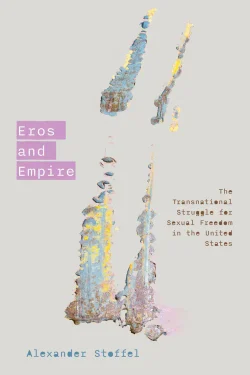
Just as W. E. B. Du Bois reframed abolition as the greatest general strike, teaching us that the accumulation of difference is the substance of class itself, Alexander Stoffel reveals in Eros and Empire: The Transnational Struggle for Sexual Freedom in the United States how three key US queer movements of the 1960s, ’70s, ’80s, and ’90s must be understood as sites of class struggle.1 W. E. B. Du Bois, Black Reconstruction in America: An Essay Toward a History of the Part Which Black Folk Played in the Attempt to Reconstruct Democracy in America, 1860–1880 (Harcourt, Brace and Company, 1935). This is not because these movements were exclusively populated by working-class people, although the centrality of proletarians (including lumpenproletarians) to these movements is in evidence. Rather, Stoffel’s crucial intervention is the argument that internationalist gay liberation, Black lesbian feminism, and AIDS activism (the movements that anchor the first three body chapters of the book) each emerged as the self-organization of a constituency that had been made to serve as a scapegoat for its era’s particular crisis in capital. The introduction places the “erotic worldmaking” through which queer and trans social movements operated in the context of postwar US economic conditions and imperial expansion.2 Alex Stoffel, Eros and Empire: The Transnational Struggle for Sexual Freedom in the United States (Stanford University Press, 2025), 4, https://doi.org/10.1515/9781503641679. The first chapter demonstrates that internationalist gay liberation was an answer to the postwar Fordist state’s stifling incursion into social life to “manage unruly surplus populations in cities and discipline non-normative family arrangements.”3 Stoffel, Eros and Empire, 13. The second chapter reads Black feminism as the political response to the vilification of Black maternity, onto which the state displaced blame for the widely felt mid-1970s fiscal crisis that, if accurately understood, would have revealed “the contradiction between the limitlessness of capital accumulation and the national state form.”4 Stoffel, Eros and Empire, 13. Finally, chapter three characterizes AIDS activism as a response to gay panics that sought to legitimize the privatization and extraction that characterized US capitalism in the 1980s and early ’90s, veiled in the idiomatic notion of “cleaning up cities.” In each case, the bourgeois political and media elites stoked the vilification of a social group whose existence capitalism had constituted, literally amassed to fill a labor need, and then also extracted from as an alibi for widespread cross-sectoral proletarian immiseration.