
LA’s Left-Liberal Electoral Problem
Reflections on LA's Mayoral Race and Beyond
July 7, 2026
On the night of Zohran Mamdani’s historic victory last November, the four Los Angeles city councilmembers endorsed by the LA chapter of the Democratic Socialists of America (DSA)—Eunisses Hernandez, Ysabel Jurado, Nithya Raman, and Hugo Soto-Martinez—gathered with their allies in celebration from the other coast. These councilmembers occupy four of the fifteen seats on Los Angeles’ city council, making Los Angeles one of the strongest DSA chapters in terms of electoral representation in a city legislature. But when asked by a journalist about Los Angeles’s own upcoming mayoral race, Raman proclaimed that establishment incumbent Karen Bass is already “the most progressive mayor that LA has had.”1David Zahniser, “Taking Inspiration from Mamdani, Democratic Socialists Look to Expand Their Power in LA,” Los Angeles Times, November 8, 2025, https://www.latimes.com/california/story/2025-11-08/mamdani-democratic-socialists-los-angeles. Soto-Martinez had even already pledged his support to Bass earlier in the year. But Bass’ neoliberal and reactionary policies, especially in increasing the LAPD budget to new heights, coupled with her mismanagement of the city budget have alienated many across the political spectrum.2Jacob Woocher, “LA Mayor Karen Bass Puts a Progressive Veneer on Centrism,” Jacobin, August 28, 2024, https://jacobin.com/2024/08/los-angeles-karen-bass-centrism.
Less than a month later, DSA-LA member and community organizer Rae Huang launched her campaign challenging Bass for the mayoral seat. But, just hours before the election deadline, Raman abruptly announced her own bid for the mayoral seat, running on a platform to the right of Huang. Despite having endorsed Raman’s city council campaign, DSA-LA chapter members voted not to endorse Raman’s mayoral bid—but neither did they vote to endorse Huang.3DSA-LA Steering Committee, “Statement by DSA-LA’s Endorsement for Mayor,” DSA-LA, March 6, 2026, https://dsa-la.org/statement-on-dsa-las-endorsement-for-mayor/. However, the chapter soon released a voter guide that recommended a vote for Raman. The other two DSA-LA-backed city council members, Jurado and Hernandez, later followed Soto-Martinez to endorse Bass over Raman just weeks before the primaries. In the primaries, Raman surpassed far right media personality Spencer Pratt to qualify for one of the two slots in the November general election, where she will face Bass. Huang ultimately came in fifth.
This confounding electoral debacle reveals both the ideological fissures within the LA left and the absence of a robust socialist electoral strategy to unite it. Indeed, the 2020s have seen steady growth of the LA left, from the accumulating victories in DSA-LA-backed city council races to an uptick in labor and other social movements. But two political tendencies have emerged from this milieu. One is a reformist and electorally driven left led by DSA-LA and grounded in an alliance with the city’s labor leadership and nonprofits. The other is the radical left beyond DSA-LA, comprising an eclectic orbit of radical grassroots collectives mobilizing around antigentrification, anti-imperialism, abolition, tenant power, mutual aid, and immigrant defense. These are not mutually exclusive blocs, as there are those who collaborate across these camps. Nonetheless, they express different theories of change.
Raman and Huang do not directly represent these two constituencies: both are DSA-LA members whose campaigns are quite disconnected from the chapter’s branch life, and neither is formally endorsed by the chapter. Raman’s campaign is more linked to the chapter, which had endorsed her city council run and recommended her for the mayoral race, despite its membership’s refusal to endorse her. Huang’s platform is closer to that of Mamdani’s campaign and DSA, which includes advocating for the expansion of socially owned housing and free buses.4Ben Burgis, “Meet Rae Huang, the Progressive Pastor Running for LA Mayor: Interview with Rae Huang,” Jacobin, May 23, 2026, https://jacobin.com/2026/05/huang-la-mayor-race-housing-transportation. Raman and Huang’s contest for the LA left in the mayoral campaign has sharpened these distinctions. While the former aims to subordinate the left into an alliance with the liberal establishment, the latter aims to unify the DSA-LA progressive left and the left beyond DSA-LA.
And so, the split between the two candidates also forces movements to more precisely identify for themselves what constitutes the LA left. Broadly speaking, the left represents movements, political figures, and organizations united by a critique of the capitalist system and the Republican and Democratic establishments and the fight for more social protections and power for the working class and other underprivileged classes. But this unity encompasses fundamentally different strategies for achieving this goal and visions of what it would require. In Los Angeles, I argue that one side lacks a vision of political independence from LA’s Democratic establishment and the other lacks the cohesion necessary to organize a political alternative to contest this establishment.
The rivalry between Raman and Huang reveals key ideological and strategic differences among the LA left that must be reckoned with. Despite the successes of DSA-LA-backed city council races, the left’s vexed relationship with both mayoral campaigns shows that the LA left still lacks a coherent approach and strategy for organizing the working class for independent political action. Thus, the key challenge facing the LA left after these elections is how to unify the best of our ranks around strengthening independent working class organization toward forms of political action that genuinely represent workers’ power.
Counting Our Forces
While the LA left has grown in recent years, the split in the left between Huang and Raman reveals deeper tensions. The LA left has been built from the upsurge in labor, anti imperialist, immigrant justice, and other movements in recent years. Multiple key strikes, particularly by teachers, Hollywood workers, higher education workers, city workers, and healthcare workers, neighborhood level immigrant defense through rapid response networks, and Palestine solidarity have rippled through the early 2020s. These steady waves of movement struggles have produced two currents in the LA left. While the lines between these two camps are not fixed—with some elements unifying around some legislative measures and immigrant defense rapid response work—they express different strategies and values.
On the one hand, the DSA-LA has developed a reformist strategy grounded in a left-liberal alliance with the city’s Democratic establishment, including the trade union and nonprofit bureaucracies. Its strength lies in its developed electoral infrastructure, enabling it to win elections and pass policies. However, its links to the organized working class are generally indirect and mediated primarily through its relationships with union and nonprofit staff.
On the other hand, beyond DSA-LA lies a highly diverse ecosystem of radical movements, though it has little consensus on a strategy for power. Many of these groups share a distrust of the electoral process and of DSA-LA. Some have real, direct links to a mass working class base, most notably the LA Tenants Union (LATU) and the Community Self-Defense Coalition (CSDC).5Tracy Rosenthal and Leonardo Vilchis, “How the LA Tenants Union Fights Displacement with Community,” In These Times, December 23, 2024, https://inthesetimes.com/article/abolish-rent-la-tenants-union; Alejandra Molina, “New self-defense coalition aims to protect immigrants from ICE raids in Southern California,” LA Local, February 15, 2025, https://thelalocal.org/immigration/community-self-defense-coalition-immigrants-ice-raids-southern-california/; Rosalind Jones, “One Year of the Community Self-Defense Coalition,” Knock LA, February 18, 2026, https://knock-la.com/one-year-of-community-self-defense-coalition/. But they lack unified political campaigns and programs to gather their forces to contest power at the city level.
Some straddle both of these sides in their organizational affiliations, while others may collaborate around some legislative measures, immigrant defense rapid response work, or even certain electoral candidates. Some have even emerged from one milieu and left for the other. Nonetheless, there are two distinct political currents. One has champions in city hall with ties to some union leadership. But this layer of electoral and union leaders have little independence from Bass and establishment politics, and are not fully accountable to DSA-LA. The other centers the self organization and demands of working class communities on the ground. However, it is unevenly composed of some who are developing workers’ power by empowering working class communities and others centered on militant agitation against the Democratic establishment, but with little base in workers’ power. The former’s strength lies in lobbying and canvassing voters. Certain elements in the latter find ways to mobilize workers to fight for their own interest through collective action, like through a tenant union struggling against its landlord increasing their building’s rent.
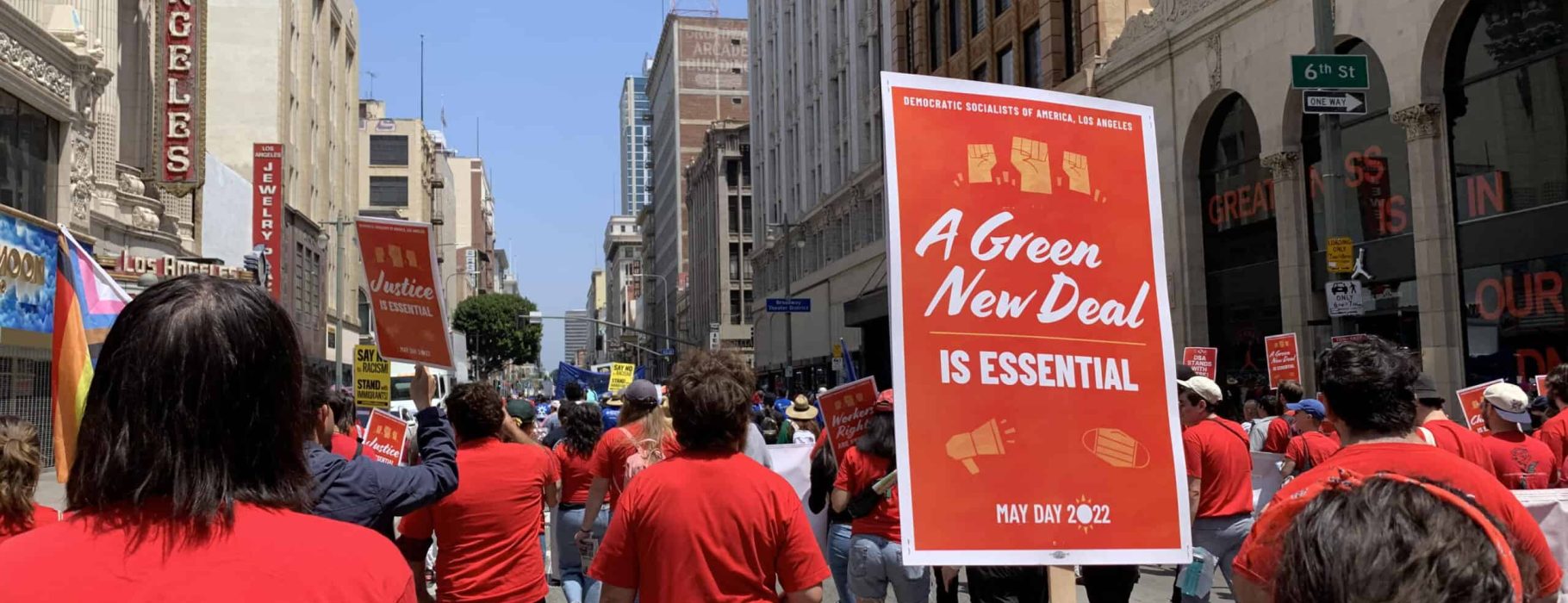
These opposite strategies mean that their campaigns are occasionally pitted directly against each other. For example, the DSA-LA-backed Fair Games campaign, which calls for wage gains for tourism workers for the upcoming LA Olympics, is counterposed to NOlympics’s more maximalist campaign to cancel the LA Olympics entirely from an antigentrification and abolitionist angle.6“Fighting the Forever Games,” NOlympics LA, November 11, 2025, https://nolympicsla.com/2025/11/11/fighting-the-forever-games/. During the UCLA Palestine solidarity encampment and the UC strike in 2024, the DSA-LA-linked union leadership in UAW 4811 at UCLA was opposed by its left, the UCLA Rank and File Caucus.7“Homepage,” Rank and File for a Democratic Union, accessed July 2, 2026, https://www.rnfdu.org/. This year’s Mayday featured two separate marches—one led by unions and nonprofits, and another by CSDC—that passed each other like ships in the dark: one ended as the other began at opposite ends of Grand Park.
In other words, both sides lack an adequate understanding of how to meaningfully connect worker power to electoral campaigns. The Marxist approach identifies both the limitations and the possibilities in electoral campaigns for workers and their oppressed allies.8August H. Nimtz, The Ballot, the Streets—or Both: From Marx and Engels to Lenin and the October Revolution (Chicago: Haymarket Books, 2019). While elections and elected office are not in themselves revolutionary, like a barometer, they can reflect the visibility, successes, and weaknesses of the class struggle at different stages. Regardless of electoral victory, they allow us to gauge both our own level of mass support (Marx and Engels called this “counting our forces) and that of our opponents.9Karl Marx and Frederick Engels, “Address of the Central Committee to the Communist League,” London, Communist Review 6, no. 10 (1926), available at https://www.marxists.org/archive/marx/works/1847/communist-league/1850-ad1.htm. This can help us judge how much we can really muster when we publicly stake out our program and how many actually trust us to represent their interests once in a seat of power.
A socialist electoral strategy should focus on running our own cadre members to amplify a political platform democratically decided by socialists and representatives of the working class. We can use elected campaigns and offices as a pulpit for our platform. The electoral arena can enable socialists to broaden our ideas with the public, consolidate our movement victories, and practice governing on the basis of workers’ power. Socialist elected officials can show workers that we can successfully win partial gains under the current system. Ultimately, their core duty is to defend and represent a political platform, democratically decided by a member led socialist organization that builds independent worker power outside of the electoral realm.
We need only look at DSA-endorsed campaigns in other cities to see sketches of such an electoral strategy. In his campaign last year, democratic socialist Jersey City Council member Jake Ephros clearly stated that he would not have run “without being a member of DSA.” He further argues that while contesting for elected positions is important for the socialist movement, “elected officials can’t do much without workers organized in their workplaces.”10Sara Wexler, “Socialist Jake Ephros is Running for Jersey City Council: Interview with Jake Ephros,” Jacobin, September 27, 2025, https://jacobin.com/2025/09/ephros-jersey-city-council-election-dsa. Before her campaign as part of New York City’s democratic socialist slate for Congress, Claire Valdez was not only a member, but a chapter membership coordinator, of NYC DSA, spending years “onboarding new members, developing DSA 101s, welcoming literally hundreds and hundreds of members into this organization and trying to inspire them … to take their political power into their own hands.”11Daniel Denvir, “Claire Valdez on Taking the Mamdani Coalition to Congress: Interview with Claire Valdez,” Jacobin, June 19, 2026, https://jacobin.com/2026/06/valdez-congress-dsa-socialism-mamdani. Another member of this slate, Darializa Avila Chevalier, has been active in pro Palestine movements for years and was a leader of the Columbia University’s Gaza solidarity encampment. Both Valdez and Chevalier were rank and file members of UAW.
The key challenge facing the LA left after these elections is how to unify the best of our ranks around strengthening independent working class organization toward forms of political action that genuinely represent workers’ power.
This approach sees building workers’ power as both the precondition and goal of electoral campaigns. When working class people and other oppressed groups are organized, they can form a genuine constituency for their own independent electoral candidate. An electoral campaign that represents workers’ power can help orient existing workers’ movements toward their own political alternative to the establishment, and vie for power on the basis of their successes. Mirroring the alternatives within DSA-LA, two distinct currents of worker organizing run through Los Angeles’s left.
Today, building workers’ power in Los Angeles no longer simply entails struggles around wages and working hours. Some, by mobilizing the working class toward militant action, have activated working class communities toward class power in other ways, like through organizing workers (or former workers) as tenants or as community members united in defense of immigrant workers. But, despite the growing importance of these more expansive workers struggles, traditional wage and contract struggles in unions also remain pertinent. DSA-LA, through its ties with the trade union bureaucracy, helps amplify and support these actions. These two workers’ movements, if combined, could create a strong working class foundation that can contest political power.
But the primaries also show that these two working class currents are divided between the DSA-LA left and the left beyond DSA-LA. On the one hand, there are traditional unions—some, like United Teachers Los Angeles (UTLA) and UAW 4811, more honed through militant struggle than others—with which DSA-LA has forged an alliance. On the other hand, working class struggles beyond unions are represented in groups like LATU. We must understand the strengths and weaknesses of each of these organizing milieus to understand how we can surmount the barriers to unity.
DSA-LA and the Left-Liberal Alliance
DSA-LA draws its strength from its alliances with the trade-union leadership and the nonprofit sector, what some members call the “left-labor bloc,” reinforced by a well-oiled machine of canvassers for ballot and electoral initiatives. While DSA-LA is not a monolith, and includes elements interested in building workers’ power beyond the electoral realm, these remain a minority in the chapter. It aspires to be the face of a ‘competent left’, one that does not shy away from alliances with liberals to prove that it can concretely deliver progressive policy victories through legislative advocacy. This marks a departure from the chapter politics of the early DSA upsurge in 2017-8, when the chapter’s relationship with city hall and nonprofits was more peripheral.
For example, the chapter’s ‘Sanctuary City Working Group’ during Trump’s first term served as the direct action arm of the ICE out of LA coalition, as a small, burgeoning activist group that pressured elected officials on immigrant rights in ways that nonprofit members of the coalition could not.12Promise Li, “The Fight for Sanctuary in Los Angeles,” Democratic Socialists of America, June 7, 2017, https://www.dsausa.org/blog/the_fight_for_sanctuary_in_los_angeles_a_revolutionary_demand/. Today, key nonprofit leaders are DSA-LA members themselves or working directly with the chapter’s elected officials to shape policy. This shift has deepened DSA-LA’s access to institutional resources and lobbying expertise, enabling it to win policy reforms.
But there are tradeoffs to DSA-LA’s alliance with the city’s liberal technocracy. LA’s trade unions and nonprofits remain deeply entangled with the Democratic establishment, thereby limiting the political potential of any working class base they may represent. This is because the trade union bureaucracy, which is often subordinate to the city’s ruling elites, discourages rank and file upsurges from developing forms of organization and demands that run counter to the designs of the Democratic establishment represented by Bass. As LATU organizer Jacob Woocher puts it, “Bass’s rise in mainstream politics has been based on her ability to provide wealthy LA residents and business owners a palatable alternative to organizing rooted in the poorest and most oppressed groups in the city.”13Jacob Woocher, “LA Mayor Karen Bass Puts a Progressive Veneer on Centrism,” Jacobin, August 28, 2024, https://jacobin.com/2024/08/los-angeles-karen-bass-centrism. While there are some key exceptions, like UAW 4811 and UTLA, DSA-LA’s allies include many from, to borrow T. E. Moon’s description, “the progressive-liberal NGO complex,” which expresses “a politics of permission—neutered, risk-averse, and entirely dependent on foundation grants, carefully sanitized focus-group language, and backroom negotiations with the very machine figures trading away working-class power.”14T. E. Moon, “Socialists Win Big in New York: Now is the Time for a Grand Offensive!” Geese Magazine, June 24, 2026, https://www.geesemag.com/articles/socialists-win-big-in-new-york-now-is-the-time-for-the-offensive.
For instance, there is little sense of a broadly engaged membership in my former union, SEIU 721. It rarely mobilizes members to attend mass actions that put genuine pressure on the status quo. The union endorsed Bass over the other progressive challengers early in her campaign. 721 makes most major decisions by negotiating behind closed doors, leaving most members in the dark. When Bass threatened to lay off city workers in her proposed budget last year, union leadership mainly credited relationships with the mayor’s office as what ultimately averted the crisis. Members were often not privy to the bargaining process, be it last year’s layoff threat or its 2023 strike while bargaining their contract. At Occidental College, SEIU 721 leadership bureaucratically pushed the newly formed student workers’ union—Rising Occidental Student Employees (ROSE)—to ratify its first contract, despite the workers’ organizing committee’s opposition.15Post by Rising Occidental Student Employees (Affiliated with SEIU) (@rose.seiu), Instagram, April 23, 2026, https://www.instagram.com/p/DXfsmQlFN0u/?igsh=NTc4MTIwNjQ2YQ==.
Nevertheless, DSA-LA has hoped to leverage its legislative resources and electoral alliances with the likes of Bass to secure policy gains—an approach spearheaded by its endorsed city council members. But it has done so with little in the way of an independently organized base among the city’s working class and little desire to construct an independent pole of opposition against the city’s political establishment. As DSA-LA-backed councilmembers’ ready endorsement of Bass shows, the chapter’s endorsed elected candidates also have their own interests that are not always identical to the will of the chapter membership. Raman’s housing platform, while including some provisions for tenant rights, emphasizes relying on the market to build more housing as a key solution to LA’s housing crisis. This reflects the interests of liberal YIMBYs (most of whom are backed and funded by corporate developers), who are another key part of her base.16Oren Hadar, “Nithya Raman’s YIMBY Moment,” The Future Is LA, September 17, 2025, https://futureis.la/p/nithya-ramans-yimby-moment; Ben Rosenfield and Holden Taylor, “Municipal Socialism’s ‘YIMBY’ Problem: The Housing Crisis and Zohran—which way forward?” https://doi.org/10.63478/SHTMZMYB. This approach often leaves DSA-LA’s progressive bloc in government in a position to provide left cover for the Democratic establishment and other liberal forces that are fundamentally opposed to socialist politics.
Worse yet, there is little organizational discipline governing this chapter’s elected leaders. At times, these city council members even get in the way of social movements (and run counter to DSA’s own political principles). Raman regularly votes for increasing the police budget, and has repeatedly doubled down on her support of Israel.17Jack Lundquist, “Socialists Don’t Vote For Cop Budgets,” Socialist Forum, August 2, 2023, https://socialistforum.dsausa.org/issues/2023-dsa-national-convention-discussion/socialists-dont-vote-for-cop-budgets/; Louis Keene, “She’s a democratic socialist who affirmed Israel’s right to exist. Can she be LA’s next mayor?” Forward, February 18, 2026, https://forward.com/news/806134/nithya-raman-dsa-mamdani-jewish-vote/. Despite their campaign promises of stopping police sweeps on unhoused communities, Raman, Soto-Martinez, and Hernandez have not only continued but even increased them during their tenure.18Phoenix Tso, “Have progressive LA politicians broken their promises on sweeps?” Los Angeles Public Press, May 14, 2026, https://lapublicpress.org/2026/05/la-sweeps-homelessness-elections-2026-city-council/. Hernandez betrayed her campaign promise to the Hillside Villa tenant union, one of the LA tenant movement’s strongest forces in recent years. During her campaign, she promised to support the tenants’ initial demand that the city acquire the building from their slumlord through eminent domain. Instead, upon her victory, her office negotiated concessions with the tenants’ landlord behind the tenants’ backs and pressured the tenants to accept them. The tenants’ historic victory after six years of rent strike was ultimately not a product of Hernandez’s efforts; on the contrary, her office became one of the tenants’ final major barriers.
To be clear, the decisions of these DSA-LA-endorsed elected officials do not always reflect the chapter’s priorities and values. But this reveals another problem in itself: a layer of electoral bureaucracy that operates fairly autonomously from the rest of the chapter. There is little oversight or control. Rarely does DSA-LA speak out, let alone agitate, against these endorsed officials. Only Raman’s abhorrent stance of actively seeking and accepting the endorsement of Democrats for Israel in early 2024 triggered a rare public censure of an endorsed council member by the chapter.19“Letter of Censure: DSA-LA member and Los Angeles City Councilmember Nithya Raman,” DSA-LA, February 4, 2024, https://dsa-la.org/letter-of-censure-nithya-raman/. This lack of opposition stands in sharp contrast to pressure campaigns by organized factions of NYC-DSA, in coalition with non-DSA allies, toward Mamdani for betrayals of basic socialist principles, from his inaction on Chinese home care workers’ demands to concessions to NYPD Commissioner Jessica Tisch.20Marxist Unity Group, “No More 24 is a Battle for Democracy,” Light & Air, April 2, 2026, https://www.marxistunity.com/no-more-24/; DSA Emerge, “Socialist Governance Means Fund People Not Police: On Zohran Mamdani and the NYPD,” Emerge, June 8, 2026, https://dsaemerge.org/2026/06/08/socialist-governance-means-fund-people-not-police-on-zohran-mamdani-and-the-nypd/.
DSA-LA’s indirect and mediated links with working class organizations also limit the chapter’s power. Few DSA members are independently organized into fractions or caucuses—let alone leading them—within major unions or sectors. While DSA-LA has played an essential role in campaigning for more tenant friendly policies, it has little base in LA’s tenant union movement, which LATU mainly organizes. While the chapter has consistently supported the latest strikes and other major union upsurges through solidarity actions, it is rarely able to provide an alternative outlet for these working class advances to congeal into its own independent political organization and demands.
Indeed, some LA unions are strongly organized, even fighting for demands beyond ‘bread and butter’ issues, as exemplified by UTLA’s “common good” bargaining framework that incorporates demands from expanding immigrant protections to limiting racially targeted searches of students.21Betty Hung and Kent Wong, “Bargaining for the Common Good: An Analysis of the Los Angeles Teachers’ Strike,” UCLA Labor Center, April 4, 2019, https://labor.ucla.edu/bargaining-for-the-common-good-an-analysis-of-the-los-angeles-teachers-strike/. But this momentum has not been consistently channeled into a visible political alternative to the Democratic establishment. That some major LA unions still lined up behind Bass, such as SEIU 99 and 721, shows that Raman’s relationship with labor remains tenuous, aside from UAW 4811’s support. In addition, LA has few ‘activist’ nonprofits with a working class base with sufficient experience of mass, militant struggle, which can bridge a progressive or democratic socialist electoral campaign to active social movements. In contrast, progressive nonprofits like DRUM and CAAAV mobilized a mass base in support of Mamdani’s campaign, playing a decisive role in his victory, especially among the Asian American working class.22Sasha Wijeyeratne, “Zohran Mamdani Spoke to Working-Class Immigrants’ Needs,” Jacobin, June 28, 2025, https://jacobin.com/2025/06/mamdani-nyc-immigrants-working-class. Valdez and Chevalier, as Moon notes, “did not win [the Democratic primaries] by collecting endorsements from non-profit executives; they won by bypassing them entirely.”23Moon, “Socialists Win Big in New York.”
DSA-LA’s main social base is educated professionals from a mix of working class and petit bourgeois backgrounds, including many transplants from other cities, mainly concentrated on LA’s Northeast neighborhoods, like Silver Lake and Echo Park. Despite its openness to left ideas and that individual members may be in unions, this social layer has had little experience of militant collective struggle in its own industries and workplaces thus far (with some exceptions, like the aforementioned teachers and Hollywood workers). The chapter’s labor work consists mostly of solidarity actions rather than waging its own worksite campaigns. While some may also have links to the organized working class, these are primarily mediated through work or service, often through union or nonprofit staff leadership, like in DSA-LA’s alliance with UNITE HERE Local 11. Some DSA-LA members may be active in unions as rank and file workers but only as individuals, at best supported by the chapter’s industry specific ‘labor circles’—but few of these are active or grounded in little collective strategy. DSA-LA Bread and Roses caucus members Thomas Malone and Carlos Callejo III argue that DSA-LA’s so called ‘left-labor bloc’ “just means coordination between DSA leaders and union leaders (or more truthfully, union staff). Outside of one or two relatively active labor circles, the labor work within the chapter effectively consists of occasional strike support and following the programs of UNITE HERE/UTLA and the needs of our socialists in office.”24Thomas Malone and Carlos Callejo III, “Don’t Mistake Access for Power: A Response to the Class Alignment Strategy,” Call, February 3, 2026, https://socialistcall.com/2026/02/03/dsa-los-angeles-unions-class-alignment-strategy/.
This approach, just like that of the Democratic establishment, may secure some policy gains and electoral successes that may benefit workers. However, it contributes little to strengthening the political independence of the working class, and developing a strategy that goes beyond simply incremental reforms.
Thus, DSA-LA’s links to the organized working class are often mediated by this layer of bureaucracy, which has never seriously challenged the power of the LA political establishment (though it has negotiated important progressive gains in recent years by leveraging this alliance). DSA-LA’s disconnection from independent working class organization informs its drift to the right, toward lobbying and advocacy at the expense of organizing workers in their workplaces. This is a different strategy from building members into organic leaders in their workplaces and working class communities, and leading mass working class institutions and struggles from within.
These factors all point to the chapter’s commitment to a reformist politics that, as DSA-LA cochair Sean Wakasa puts it in explaining the chapter’s recommendation of Raman, “a pragmatic approach and a belief that change comes incrementally.”25Jonah Valdez and Jessica Washington, “The LA Left is At War With Itself Over the Mayor’s Race,” Intercept, May 29, 2026, https://theintercept.com/2026/05/29/la-mayor-rae-huang-nithya-raman-spencer-pratt/. Chapter leaders argue that, despite any mistakes they make, these council members are still good enough for our support, especially as hard right challengers emerge to challenge their seats. In the words of LA members of DSA’s Socialist Majority Caucus, Leslie Chang and Paul Zappia, “despite our own disappointments with some of Nithya’s decisions, we continue to pursue a coalition strategy in LA that seeks to bring labor and the left together against right-wing, corporate forces.” Chang and Zappia further argue that “we cannot forsake power in the present in the hopes of establishing a more perfect form of governing in the future.”26Leslie Chang and Paul Zappia, “We Won’t Let the Bosses Win: Why We Supported DSA-LA’s Endorsement of Nithya Raman,” March 13, 2024, Agitator (blog), https://www.socialistmajority.com/theagitator/we-wont-let-the-bosses-win-why-we-supported-dsa-las-endorsement-of-nithya-raman.
But there is little sense that labor or the left has real power in such electoral alliances. The labor they invoke is dominated by the leaders and staff of bureaucratic unions, many of whom are not actively mobilizing the rank-and-file membership of these unions to build power independent of establishment politics. The left of which they speak is an adjunct to the establishment, exemplified by Soto-Martinez, Jurado, and Hernandez’s endorsement of Bass’ reelection. They prefer to accumulate reforms by trading favors with the likes of Bass rather than establishing an independent pole of opposition to politics as usual.
Most concerningly, there is little mechanism for holding these officials accountable for positions they take that are contrary to the will of DSA-LA’s own membership. They are not even accountable to each other: three of its elected officials would even sacrifice solidarity with their own political ally’s bid for power to back the establishment candidate. This bizarre situation, in which Raman’s closest political allies have instead endorsed her establishment rival’s run, only all too perfectly captures the chapter’s distance from, not expression of, power. This approach, just like that of the Democratic establishment, may secure some policy gains and electoral successes that may benefit workers. However, it contributes little to strengthening the political independence of the working class, and developing a strategy that goes beyond simply incremental reforms.
The Left Beyond DSA-LA
Dissatisfaction with various issues in DSA-LA has triggered several waves of member departures since the chapter’s initial explosive growth in 2016. Some of these exiles have joined and helped build a diverse left ecosystem in the 2020s within organizations such as LATU and NOlympics. This wing of the LA left is generally skeptical of the mainstream electoral process, including progressive, DSA-LA-backed officials and unified by a willingness to mobilize against the city’s political establishment through militant direct action. It sees DSA-LA-backed elected officials as equally legitimate targets for open pressure and protest as Bass and other establishment politicians. Many are hyperlocal or issue specific, such as NOlympics, LA Street Care, Palms Unhoused Mutual Aid, and Stop LAPD Spying. Community institutions like Midnight Books and All Power Books serve as common gathering places for this current.
But this side of the LA left also holds diverse positions toward the DSA-LA-backed elected city council members. Some see them as no different from establishment politicians at all. Others consider them conditional and necessary allies, or figures of power who can be more responsive to agitational pressure from movements seeking concessions. All, however, ultimately place little faith in these officials to advance their organizing. At the same time, those who still believe that there is a place for political action in the electoral sphere face a dearth of mass leaders anchored in a firmly socialist program that run campaigns charismatic enough to unify the left. Its leaders are still developing their leadership, many of whom have little experience in electoral politics or have not yet gained widespread organic support among working class communities.
This heterogeneous sea of radical activist groups also includes forces with real connections to and leadership roles within working class communities. In particular, these are led by the LATU and CSDC, two of the leading forces in the LA left that can claim a substantial working class base. This base does not uniformly have a consistent, let alone socialist, politics. However, it includes working class leaders who are activated to defend their own interests through disruptive, collective action. Over the past decade, LATU has steadily built an independent network of tenant unions across the city, representing the most active and politically independent infrastructure for working class self organization stretching across Los Angeles.
Led and convened by the longtime Chicano revolutionary nationalist group Unión del Barrio (UdB), which originated in San Diego, CSDC has unified nearly all the serious radical formations in Los Angeles outside DSA-LA, the nonprofit industry, and the trade union bureaucracy under a formal united front. This includes Palestine solidarity and campus groups, tenant unions, and suburban activist collectives unifying under one umbrella to support immigrant workers. Its rapid response infrastructure not only represents an alternative to the one led by LA’s most established immigrant nonprofit—the Coalition for Humane Immigrant Rights (CHIRLA)’s LA Rapid Response Network (RRN)—but also rivals it in efficiency, reach, and coordination. CSDC’s reach extends far beyond the city into areas with little DSA-LA influence, from the predominantly Black and Brown, working class South Central to the suburban towns in the San Gabriel Valley east of Los Angeles.
Some of these forces represent the closest thing to proletarian self organization in Los Angeles, expressed in militant action against capitalists and Democratic Party politicians (including progressive ones, if need be), an area that DSA-LA has generally vacated. These struggles are not primarily fought over wages. They are fought over evictions, police sweeps, deportations, and rent increases. Rather than contradicting the traditional Marxist principle of organizing the working class, these actions expand the terrain of class struggle to organize the worker (as Annie McClanahan puts it) “beneath the wage.”27Annie McClanahan, Beneath the Wage: Tips, Tasks, and Gigs in the Age of Service Work (New York: Zone, 2026), https://doi.org/10.2307/jj.40478850.
Both UdB and LATU openly identify as socialist, though not every affiliate organization or individual member does. Today, UdB is perhaps one of the most politically advanced socialist formations on the left beyond DSA-LA, with real roots to Latinx working class communities in the barrios.28Hector A. Rivera, “From Nepantla to Aztlan: Chicano Internationalism and the Struggle Against ICE,” Spectre no. 12, November 4, 2025, https://doi.org/10.63478/OEEV9PBL. It also has longtime roots in the teachers’ movement, helping to form groups like the Association of Raza Educators to advocate for immigrant rights and anti-imperialism among education workers since the 1990s.
Granting these achievements, we must also not overstate the strength of this part of the LA left. Unlike DSA-LA, it generally lacks rigorous processes for democratic discussion, debate, and membership. Its tenuous relationship to legislative and electoral work (with some exceptions) makes it challenging to consolidate its victories and its ranks in the political sphere. These groups struggle to rally their forces around a clear strategy toward political power and action.
We can sense this political fragility in some of their attempts at winning union leadership. Earlier this year, UdB ran members in the ‘Educator Power’ slate in the UTLA union elections. This is an important step forward for UdB in anchoring its power within one of LA’s strongest unions. But the results were mixed. While nearly all of the slate’s candidates for the Board of Directors of the National Educators’ Association (UTLA’s national union) won their seats, all but one of their candidates for the union’s citywide official positions lost. The union campaign did not attract as much fanfare as it deserved among broader community circles, despite the large number of groups formally organized under CSDC. At UCLA, the rank and file caucus of the graduate student workers’ union, UAW 4811, has challenged the union leadership, but it has consistently failed to win in recent elections.
Indeed, CSDC and LATU’s public statements and actions have consistently rejected class collaboration and established the need for independent working class organization. But the diverse rank and file membership across its affiliate organizations does not yet thoroughly understand and embrace such political values. Coordination among LATU locals remains sparse, and political consciousness remains markedly uneven between and within these locals. Much of the city’s working class remains deeply underorganized and demobilized, from those within established unions to nonunionized sectors.
Thus, while these groups may boast deeper ties to a militant working class than the DSA-LA left, this strength is relative. In my own experience organizing tenant unions in Chinatown and collaborating with LATU-backed tenant unions, I have found that tenant organizers continually contend with the uneven political consciousness of our base. Some tenants can rail against corporate development and privatization while spewing anti-Black and anti-unhoused rhetoric in the same breath. Many tenants may still not readily connect militant action against a landlord with the necessity of political action grounded in a developed program of working class independence. While CCED has nurtured and organized a network of tenant unions across Chinatown, each invigorated in struggle against their landlords, our layer of organic working class leaders who are willing to show up for political actions beyond their own buildings’ issues remains small.
Despite these challenges, it is still significant that such groups are grounded in a working class base, though this base may not yet fully grasp the fundamentals of left politics that many of these groups advocate. They also organize the worker more holistically beyond labor unions and bread and butter demands. The experience of common struggle, especially within the tenants’ movement, has cultivated trust between the radical left and oft neglected sections of LA’s working class and lumpenproletariat. These organizations are restoring the principle among the working classes that militant class struggle can be waged outside of the rigid timeline of the union contract and its no strike clauses.
What these primaries have shown is that Los Angeles still lacks a robust socialist organization and layer of cadre members with a working class constituency that is independently organized enough to meaningfully make use of the electoral sphere.
But, at the same time, these forces lack unity around a cohesive strategy of political action that can transform working class mobilization into a vehicle capable of contending for independent political power. The radical left’s values are not yet sufficiently clarified among and across its working class membership, especially in its cornerstone—the tenant movement. So far, there is too much distrust or a lack of understanding between the left and more politically sympathetic parts of the DSA-LA left to unify. This part of the left must also strive more to clarify its own position toward the question of the political independence of the working class and its oppressed allies, and how to enact it.
Nithya and Rae
The LA left’s disunity at the ballot box is a symptom of its broader weaknesses and divisions. Raman and Huang do not simply represent these different camps of the LA left, but their contest helped articulate these divisions. Some may argue that the city council races in these primaries prove the strength of socialist politics in Los Angeles. Indeed, as DSA-LA rightly argues, in many ways, city council members play a more decisive role in LA city politics than the mayor. Throughout the election cycle, the chapter has downplayed the mayoral race in favor of allocating more resources to council member races, citing LA’s “weak mayor” system, unlike NYC’s. In LA, many mayoral decisions must be approved by city council members. City council members can also reverse mayoral executive orders with a two-thirds vote. There are fewer divisions within DSA-LA’s ranks over those races, and both Raman and Huang have endorsed the DSA-LA-backed city council candidates. Those critical of DSA-LA’s incumbent council members from the radical left have not raised alternative challengers to their campaigns. Nearly all of DSA-LA’s endorsed candidates have won their races or made it to the runoff.
While we should indeed judge DSA-LA’s electoral performance this cycle by its endorsed candidates, we should not ignore that the mayoral race also provides an important test for the chapter. Despite LA’s weak mayor system, the mayoral seat is still a powerful one, especially for DSA-LA, which is looking to fill more than a third of city council seats for the first time. A mayor consistently backed by a progressive bloc on the city council can wield decisive political influence, making vetoes of executive decisions less likely. In other words, coordinating an electoral strategy around both the city council and the mayor can shift the DSA-LA left from being the mayor’s subordinate ally to wielding political power. The mayoral race is an opportunity for DSA-LA-backed candidates to coalesce around a city-wide bid for power. Accordingly, the split between Raman and Huang compelled the chapter to more clearly define its political values and strategy.
The Huang-Raman split shows that DSA-LA, despite its electoral victories, is not yet ready to unify to genuinely contest establishment power. On the one hand, within the chapter’s ranks, some are critical of the left-liberal popular frontism whose proponents have rallied behind Raman; at least a majority are conflicted enough to vote against endorsing her. DSA-LA members only support Raman’s campaign over Huang’s by a thin margin. This support was insufficient to reach the two-thirds majority required to secure Raman an actual chapter endorsement. Despite this democratic decision to not endorse either, the DSA-LA voter guide nonetheless recommends Raman in a space outside of the general active majority of the membership. Raman’s electoral base in the primaries is in Northeast neighborhoods—among predominantly white, renter, transplant communities that form DSA-LA’s usual strongholds.
Most damningly, Raman’s campaign reflects the inability of DSA-LA’s electoral champions to meaningfully consolidate into any sort of strategic bloc. Even Raman’s own political allies on the city council did not support her campaign. This shows that the electoral bureaucracy of DSA-LA itself is not unified enough to defend its own interests collectively when tested, instead choosing to accommodate the establishment at the expense of its own candidate.
At many decisive moments, LA’s progressive city council members tend to forgo their independent, oppositional identity on the city council. At best, the DSA-LA-backed candidates in office act as a bloc of junior partners to Bass’s mayoralty, hoping to trade political favors to achieve some progressive legislative gains. At worst, it lacks a coherent strategy for playing this junior partner role in Bass’s neoliberal administration, let alone for—as some in DSA, like the Reform and Revolution caucus, advocate—orienting this role toward the broader horizon of building DSA into a protoparty formation.29Sarah Milner and Ruy Martinez, “Why DSA Needs a Revolutionary Socialist Program,” Reform & Revolution, April 4, 2025, https://reformandrevolution.org/2025/04/04/why-dsa-needs-a-revolutionary-socialist-program/.
On the other hand, Huang’s campaign reveals the challenges of unifying both DSA-LA and social movements beyond the chapter. One problem is that there is little consensus amongst the left beyond DSA-LA on either the value of political action or how to contest political power. The two leading forces of this part of the left, LATU and CSDC, have not formally endorsed electoral campaigns. Some LATU locals or CSDC affiliate organizations are more open to working with progressive elected officials on select issues. Others have had too many negative encounters with the city’s elected officials, including progressive ones, to bother engaging in organized politics. At times, this part of the left is even split among candidates, as in the California governor’s race, which pitted the Peace and Freedom Party’s Ramsey Robinson against the Green Party’s Butch Ware (who was not featured on the ballot, though he campaigned asking voters to list him as a write-in candidate).
In sum, these groups have little experience in rallying masses of working class people toward a political consensus from which to organize and militantly vie for power. At this stage, the left beyond the DSA is still too scattered, uncoordinated, and diverse for political representation, let alone action. While it has shown the capacity to rouse tenants and working class people toward militant action, it has not yet demonstrated the consistent power to organize them behind a coherent political platform. In other words, it lacks a concrete vision of how to represent working class power and govern on its basis, let alone a strategy to achieve it collectively with their working class base.
Some have simply not found Huang’s campaign compelling or inspiring enough. Controversy over her matching funds further alienated the undecided in the left, fueling concerns of Huang’s lack of experience in the political sphere.30Candidates for LA city office are eligible to receive matching funds from the city for their campaigns if they meet certain requirements. Huang’s campaign declared that they have met the requirements to unlock matching funds back in March. But public records had shown otherwise, leading to further controversy over the state of Huang’s campaign finances in the final months of the primary election cycle. Elizabeth Chou, “What is Going On With Rae Huang’s Matching Funds?” LA Reporter, May 27, 2026, https://thelareporter.la/p/what-is-going-on-with-rae-huang-s-matching-funds. In the beginning, her program closely echoed Zohran’s platform, and struggled to develop its identity and resonate in broader circles. In any case, Huang’s campaign has failed to meaningfully unify the radical left and DSA-LA. There were a few enthusiastic endorsements from the strongest parts of the LA left with an active working class base. She also has little independent base in the city council and endorsed all of DSA-LA’s city council candidates, including the City Attorney race, where Huang endorsed the DSA-LA-backed Marissa Roy (who ran closely in sync with Raman and the DSA-LA bloc against independent left challenger Aida Ashouri). Huang’s low vote count in the primaries shows that the constituency she sought to forge may not be ready to coalesce around an independent candidate that truly represents working class power.
Beyond the Primaries
What these primaries have shown is that Los Angeles still lacks a robust socialist organization and layer of cadre members with a working class constituency that is independently organized enough to meaningfully make use of the electoral sphere. And so, regardless of the winner in November, the central task of the socialist left should be clear: we must continue building working class organizations independent of both Bass and Raman as a precondition for a truly effective socialist electoral strategy. To genuinely consolidate our power in the sphere of political action, we also need a strategy centered on developing workers’ parties and organizations independent of bourgeois parties, rather than simply trying to wrest concessions from the latter.
This approach does not ignore the differences between the two leading mayoral candidates. But we must be clear to those we organize that while Raman can be pressured to respond to movement demands, she does not represent a genuine political alternative to the current system. Going into November, socialists must not simply subordinate ourselves to the Raman’s left-liberal coalition. We support policies advocated by Raman and other DSA-backed elected officials when they benefit working class power, like tenant protections against harassment, evictions, and rent increases. We defend Raman and progressive allies from any attacks by Bass and LA’s Democratic establishment, who have already begun to court the right for support.31Ashleigh Fields, “Karen Bass Slams Nithya Raman over Homeless Encampments in LA Mayoral Race,” The Hill, June 8, 2026, https://thehill.com/homenews/state-watch/5914564-bass-raman-runoff-homelessness/ But we must also be clear that Raman’s base of supporters contains ultimately irreconcilable political interests. A genuine path to socialist transformation in Los Angeles requires exposing, not downplaying, that the YIMBYs and other liberals in Raman’s coalition will not deliver what working class communities need.
Indeed, an effective socialist campaign in LA would require building to some degree with those communities currently supportive of both Bass and Raman’s campaigns, from DSA-LA-affiliated renters in the Northeast to rank and file union members across the city yet to be organized by the left. More specifically, the left must find ways to bridge DSA-LA’s progressive renter base in the Northeast and other pockets of the city to the Black and Brown working class communities in the south and beyond LA in the suburban industrial belt. Currently, those who vote in majority Black and Latinx precincts, such as those in South LA, still predominantly back Bass and other establishment candidates. Incumbent council member Curren Price’s staffer, Jose Ugarte (who boasts the endorsements of the LA Democratic Party and some unions) came in first place against the DSA-LA-backed progressive challenger and housing advocate Estuardo Mazariegos.
Mazariegos’s campaign will be especially interesting to watch ahead of the general election, as it serves as a test for the DSA-LA left to break into a key working class district where it has long struggled to gain influence. But in the long run, it will take more than an electoral campaign for the left to overcome the churches and nonprofits’ hold over existing voters, along with longstanding political abstentionism, in these areas. The LA left must work to rebuild, strengthen, and support the vestiges of working class organization in a deindustrialized region that has little trust in organized politics.
The alternate focus of activating and strengthening working class organization everywhere demands some element of unity across different left currents and movements—reformist and revolutionary alike. As mentioned before, the two sides of the LA left are not mutually exclusive. City Controller Kenneth Meija’s resounding reelection success shows that competency and charisma, when consistently centered on exposing the hypocrisies and inefficiencies of city hall, can unify the LA left in the electoral realm. There is also some crosspollination across different groups through immigrant defense work (that is, the Home Depot watch), tenant rights legislation, and so on. Both DSA-LA-backed officials and LATU organizers have contributed to winning, defending, and extending renters’ protections. To her credit, Raman helped introduce the Tenant Anti-Harassment Ordinance (TAHO) in 2021, an important piece of legislation that has expanded tenant antiharassment protections, which was supported and pushed by tenant movements across the city. However, this law was rarely enforced—until LATU-organized tenants in Highland Park, supported by Hernandez’s office, forced the city to issue its first TAHO citations against their landlord through protest.32Mathilde Lind Gustavussen, “LA Tenants Have Won a Major Breakthrough Against Landlord Abuse,” Jacobin, November 8, 2025, https://jacobin.com/2025/11/los-angeles-tenant-organizing-landlord-ice-evictions. The lesson here is that while progressive Democrats can be pushed to support policies that benefit the working class, it is ultimately working class organization that realizes and extends them.
Building on this, socialists and allies across the LA left can also meaningfully collaborate to build and strengthen rank and file formations in our unions or to organize unorganized workplaces. While some DSA members serve as staff organizers in many of Los Angeles’s key trade unions, from UAW to SEIU, no socialist organization can boast a substantial mass base of members within or across most of these unions. However, there are individual socialists from different organizations who are rank and file members gathered in specific union locals. For example, a handful of SEIU 721 members and I tried to identify and recruit members at other workplaces to organize a Palestine solidarity grouping within our union, which eventually became SEIU 721 for Palestine.33“SEIU 721 for Palestine: Members Call for Leadership Support to End the Genocide,” Action Network, accessed July 2, 2026, https://actionnetwork.org/petitions/seiu721forpalestine/. Our initial nucleus of participants came from nearly half a dozen socialist organizations (including DSA), as well as unaffiliated militants seeking to bring change to the union. Some of us also helped to form Labor for Palestine LA, which provided a space for militant rank and file members from different unions in Los Angeles to gather. At its height, the formation included small nuclei of rank and file members and sympathetic staff organizers from most major unions across Los Angeles, including DSA-LA members and other socialists beyond the DSA.
Without energized working class movements organized into politically independent platforms and organizations, electoral victories are toothless in the long run.
But organized socialists remain a minority among the leading layers of advanced workers in these recent union campaigns. Many of the most active and diligent organizers who put in the spadework to build SEIU 721 for Palestine—organizing unorganized members in our union to participate, spearheading meetings, petitions, and general strategic direction—were workers unaffiliated with any socialist organization. In the University of Southern California’s non tenure track faculty’s recent unionization campaign, active members of socialist groups (like DSA and the Party for Socialism and Liberation (PSL)) are more likely to be found among staff organizers, rather than the union’s most dedicated rank and file leaders.
Thus, socialists from different organizations can do more to integrate with other politically advanced rank and file workers to help congeal and cultivate militant formations within our unions, from an issue based fraction to a reform caucus. For one, Bread and Roses caucus’ Malone and Callejo correctly argue that DSA-LA can begin with reforming and reenergizing its labor circles, such that “instead of functioning as an occasional discussion group, they should become vehicles for identifying workplace leaders, coordinating mentorship and political education, and giving members the tools to become trusted organizers in their own unions and workplaces.”34Malone and Callejo III, “Don’t Mistake Access for Power.” Such initiatives are foundational, as Kim Moody put it, “to enlarge the layer of workers in the class who are open to socialist ideas. The existence of a strong current of active, class-conscious workers is a precondition for the development of a strong current of socialist workers—and a socialist party.”35Kim Moody, The Rank and File Strategy (Detroit: Solidarity, 2000), 3.
Socialists must win over other radicals to the idea that movements can win more effectively when our organizing is grounded in building working class power and in transforming that power into an independent political constituency. As tenants and workers in our homes and workplaces, we have the leverage to disrupt the system by withholding our rent and wages. This militancy must also be connected to independent political demands and organizations that we can use to win over progressives and liberals when we can. But we must not allow our organizations to simply be their junior partners, believing that electing the right person into office would ensure our political power. Hernandez only won her seat in 2022 on an abolitionist platform because independent movements popularized abolition in the broader consciousness, thereby forging a viable electorate for such a campaign.
The experience of Hillside Villa Tenant Association in pressuring Hernandez when necessary shows that political visions are only as strong as the movements that first empowered them. Collapsing movements into purely electoral campaigns and offices—especially those with little independent political identity—would erode the very element of militancy that makes left political action meaningful in the first place. Similarly, UAW 4811’s development into a stronghold for progressive politics sprung from multiple strikes, including waging one of the few rare ‘political’ strikes in the post-Taft-Hartley era. Its 2024 strike was a response to student workers defending a Palestine solidarity encampment against the police and militant Zionists on campus last Mayday, in a scene reminiscent of the pitched labor battles of the pre-Wagner Act past.36Ed Rampell, “The Battle of UCLA: Inside the Class Struggle,” interview with Mona, Counterpunch, May 14, 2024, https://www.counterpunch.org/2024/05/14/the-battle-of-ucla-inside-the-class-struggle/; Jack Ross, Joey Scott, and Martín Macías, Jr., “Two Nights of Violence at UCLA’s Solidarity Encampment,” Los Angeles Public Press, May 8, 2024, https://lapublicpress.org/2024/05/two-nights-of-violence-at-uclas-solidarity-encampment/.
There is another promising arena of struggle for the LA left to unify around: the sprawling terrain of cities and movements outside LA city proper, which includes many of LA’s “hinterlands,” to invoke a term by Marxist geographer Phil Neel, where residents “experience class exploitation as a largely a matter of rents, rather than wages.”37Phil A. Neel, Hinterlands: America’s New Landscape of Class and Conflict (London: Reaktion Books, 2018), 37. While the left has generally had little presence in these areas for generations, it is growing, albeit unevenly, in strength today. The LA left can come together to strengthen and articulate these movements independently of both the Republican and Democratic establishments.
The heightened federal immigration raids since last summer have sparked an unprecedented network of neighborhood-level self-organization of everyday communities to form rapid-response groups across the LA suburbs to defend immigrants. Some of these efforts have produced grassroots organizations such as Whittier Unidos. In the majority-Latinx city of Whittier, the outrage over ICE’s treatment of immigrants provided the spark for voters to overturn a longtime Republican majority in the city council earlier this year.38Pascal Sabino, “How Immigrant Organizing Flipped Nixon’s Hometown,” Bolts, May 7, 2026, https://boltsmag.org/california-immigrant-organizing-and-elections-in-whittier/. The organized left can rally the movements to challenge stagnant establishment small town politics. These peripheral cities can help deepen and extend the LA left’s hegemony beyond LA city proper.
Other local issues, like tenant harassment and data centers, have also sparked grassroots campaigns—but the left must not only participate in these movements but also help clarify their politics toward a visible, left wing political platform and, at some point, an electoral alternative. In Rosemead, Rosemead Tenants Union has waged a tenant-led campaign defending trailer park residents from management’s harassment and eviction threats. A coordinated effort opposing a proposed data center in Monterey Park, led by grassroots organizations such as SGV Progressive Action, resulted in a historic victory in June’s primaries.39Susana Canales Barrón, “Monterey Park Overwhelmingly Votes to Ban Data Centers,” Los Angeles Public Press, June 4, 2026, https://lapublicpress.org/2026/06/monterey-park-data-center-ban-elections-2026/. The coalition has successfully organized residents to push Monterey Park to become the first city in the state to permanently ban data centers via a ballot initiative.
Such efforts mark a significant step forward for social movements in the San Gabriel Valley, and help model what building workers’ power in the LA suburban hinterlands can look like. Still, they risk remaining merely “populist” and ideologically undefined without active efforts to politicize and unify them as part of a larger movement against capitalism and for socialist transformation.
***
While Bass may be Los Angeles’s Cuomo, Raman is not the city’s Mamdani, as her record as a city council member has already shown. Even Mamdani’s mayoralty has required vigilance and organized opposition independent of his office to ensure that progressive gains and promises are not betrayed. For now, DSA-LA has shown little initiative to wage such independent opposition to its endorsed candidates when necessary. At the same time, the left beyond DSA-LA has little vision or strategy to consolidate around an alternative political vehicle. Los Angeles’s organized working class, which has undoubtedly grown in strength over the past decade, is split between the two currents. But if the LA left can unify traditional union contract battles and working class struggles beyond the union contract, this can provide an important model for proletarian organization whose impact can extend far beyond Los Angeles. Such a vision, however, would require the different sides of LA to clarify their politics, and work toward a common strategy of working class political independence.
While the prospects of progressive mayors ruling the two key cities on the two coasts may be compelling, this moment also calls for caution. Without energized working class movements organized into politically independent platforms and organizations, electoral victories are toothless in the long run. DSA as a whole still lacks a clear strategy for bridging its electoral successes with larger efforts to build workers’ power beyond the Democratic Party. This oversight risks the rise of an electoral bureaucracy, like in Los Angeles, that does not adequately represent the organization’s political values. This lack of discipline and accountability to socialist values disorganize the broader left, as it continues to make social movements skeptical of contesting for political power.
Raman’s second place finish is already being declared by left pundits as “a major victory for LA’s progressive left with the potential to reverberate for years in city hall politics.”40Valdez and Washington, “The LA Left is At War With Itself Over the Mayor’s Race.” But I argue that Raman’s primary victory only makes the stakes of clarifying and consolidating the divided politics of the LA left higher than ever, rather than signaling the triumph of a unified left politics. What will ultimately determine the fate of the organized left in Los Angeles is not the November elections but the left’s capacity to leverage this electoral season to strengthen working class organization and direct it toward independent political action.