

The Lovers’ International

Review of Eros and Empire: The Transnational Struggle for Sexual Freedom in the United States

August 11, 2026

38370
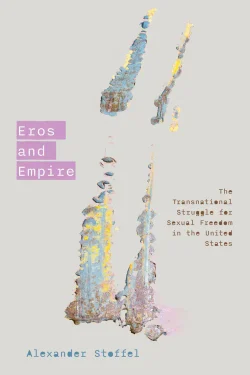
Eros and Empire: The Transnational Struggle for Sexual Freedom in the United States
by Alexander Stoffel
Stanford University Press
2025

For many leftists, political struggle is always about defying the alterity of here and there. In the major tendencies of leftist thought and action in the United States—Indigenous, immigrant, Black, worker, feminist, queer—the political texture of life reflects the experience of being buffeted by history, having left there, being inassimilable or refusing to be absorbed into the here of this nation-state. This is true whether it is the regional scrambling of workers due to economic shifts, the state pulling the base from beneath Native lifeways, legacies of mass state-coordinated transatlantic abduction and its afterlives, experiences of cross-border migration compelled by economic necessity, or relocation motivated by the violence of the natal home. The diversity of this national tapestry of movements—geographic as well as political—belies some of the enduring ideas about the nature of class in this country.

Just as W. E. B. Du Bois reframed abolition as the greatest general strike, teaching us that the accumulation of difference is the substance of class itself, Alexander Stoffel reveals in Eros and Empire: The Transnational Struggle for Sexual Freedom in the United States how three key US queer movements of the 1960s, ’70s, ’80s, and ’90s must be understood as sites of class struggle.1 W. E. B. Du Bois, Black Reconstruction in America: An Essay Toward a History of the Part Which Black Folk Played in the Attempt to Reconstruct Democracy in America, 1860–1880 (Harcourt, Brace and Company, 1935). This is not because these movements were exclusively populated by working-class people, although the centrality of proletarians (including lumpenproletarians) to these movements is in evidence. Rather, Stoffel’s crucial intervention is the argument that internationalist gay liberation, Black lesbian feminism, and AIDS activism (the movements that anchor the first three body chapters of the book) each emerged as the self-organization of a constituency that had been made to serve as a scapegoat for its era’s particular crisis in capital. The introduction places the “erotic worldmaking” through which queer and trans social movements operated in the context of postwar US economic conditions and imperial expansion.2 Alex Stoffel, Eros and Empire: The Transnational Struggle for Sexual Freedom in the United States (Stanford University Press, 2025), 4. The first chapter demonstrates that internationalist gay liberation was an answer to the postwar Fordist state’s stifling incursion into social life to “manage unruly surplus populations in cities and discipline non-normative family arrangements.”3 Stoffel, Eros and Empire, 13. The second chapter reads Black feminism as the political response to the vilification of Black maternity, onto which the state displaced blame for the widely felt mid-1970s fiscal crisis that, if accurately understood, would have revealed “the contradiction between the limitlessness of capital accumulation and the national state form.”4 Stoffel, Eros and Empire, 13. Finally, chapter three characterizes AIDS activism as a response to gay panics that sought to legitimize the privatization and extraction that characterized US capitalism in the 1980s and early ’90s, veiled in the idiomatic notion of “cleaning up cities.” In each case, the bourgeois political and media elites stoked the vilification of a social group whose existence capitalism had constituted, literally amassed to fill a labor need, and then also extracted from as an alibi for widespread cross-sectoral proletarian immiseration.

"...Eros and Empire accurately casts movements that have been considered in terms of identity politics as material struggles."

The book’s final chapters propose a Marxist theory of sexuality and desire that takes these movement case studies as its origin point. Their activities, considered a political genealogy of the US late-twentieth century, reveals the state’s celebration and promotion of the bourgeois nuclear family and its component emblem of the propertied citizen, which “mediated the contradiction of the bourgeois state by disavowing racial, gender, and sexual differences that were necessary to the production of an exploitable workforce and surplus labor populations.”5 Stoffel, Eros and Empire, 154. Queer politics expressed the general material contradictions that this disavowal of difference sought to obfuscate. For example, Black lesbian feminism expresses the reality of the economic conditions that led to the doubling of the number of poor families led by single mothers in the wake of economic crisis; of all poor Black families, 75 percent were led by single Black mothers, reflecting the particular effect of this development on Black women.6 Stoffel, Eros and Empire, 184. Likewise, AIDS activism is the social expression of the intense reality of real estate speculation in neighborhoods affected by the epidemic—an intensified site of a broader project of gentrification in many communities. These theoretical articulations set up the note of political promise with which Stoeffel ends the book: while recognizing the many ways that capitalist society instrumentalizes and weaponizes pleasure, he advocates celebration of the tradition of desire suffusing movements for collective autonomy.

In systematizing this analysis, Eros and Empire accurately casts movements that have been considered in terms of identity politics as material struggles. This is not only in the sense that they organize around satisfying material needs; the necessary work of pointing this out has been done well previously. Stoffel presents the new theoretical claim that these struggles emerge from the dialectical movement of capitalist class relations. As such, the book defies the braindead positing of an opposition between class politics and identity politics, including as it is posited by some Marxists. Eros and Empire offers a real starting point to the many more Marxists who have been inattentive to these forms of political activity because they don’t align with their models of class struggle. This is especially true of queer and trans struggles, which have only really entered Marxist analysis as a sort of generalized antibourgeois opposition or through recognition that many of their members are working-class. In terms of feminist struggle, a theory of social reproduction stemming from its woefully inadequate treatment in volume one of Karl Marx’s Capital clarifies the theoretical terrain of queer and trans life. However, because this analytic is based on the sexed and gendered division of productive and reproductive labor it has been difficult to disentangle it from heterosexuality. It is only now that the queer and trans analysis has found primary engagement there. The work of Kay Gabriel, Amy De’Ath, Sophie Lewis, and Bruno Monfort shows that social reproduction theory is not only relevant to women and LGBT people, but rather reveals the material basis of the domestic; it is the inextricability of these two categories, even as they are both constituted by internal contradictions related to feminization and racialization.

This book’s particular contribution to this broad generational project is a theory of desire. Stoffel distinguishes between a “vertical” form of desire, which attaches people to “objects that promise entry into the propertied conditions of whiteness, heteronormativity, Americanness, and other normative categories” from a “horizontal” form of desire, which resists subsumption and therefore “threaten[s] to disorganize, destabilize, and disturb the reproduction of those normative attachments” and thus is “corrosive and threatening to the reproduction of bourgeois society.”7 Stoffel, Eros and Empire, 156. The former produces the conditions for the latter, but ultimately, it is the vertical form that cannot endure. This is not because desire is anarchic, but because capitalism, colonialism, and white supremacy stoke, indeed depend on, desires they cannot ultimately satisfy. If fascism emerges and remerges by heightening this tendency of the bourgeois state to sustain itself on the production and disappointment of the feeling of belonging together and getting what we want (communism), to build on Walter Benjamin’s most famous formulation, we must respond by politicizing desire. As Stoffel teaches us, this does not only look like the joy of a picket line or the pleasures of sectoral comradeship, perhaps especially on Turtle Island. It also looks like provocations of gay seizure of public space, Black women strategizing together, and friends helping each other survive another day in the luxury of community.

It is no accident that this deeper materialist understanding of queer struggle comes from Stoffel’s consideration of these movements in their proper, and often neglected, transnational context. Nationalist incorporation of these struggles as representative of who we are depends on the sublation of New York’s relation to Cuba, Combahee’s relation to Algeria, San Francisco’s relation to South Africa, and Minneapolis’s relation to Gaza. Stoffel’s fine attention to the individual histories of these movements, including their internal contradictions, provides theoretical tools just as considering the real work of proletarian self-organization has grounded historical materialism. “Yanqui go home!” in Venezuela is the same as “No human being is illegal on stolen land!” in Anishinaabewaki. Offering hospitality to all people is the same thing as enacting vengeful inhospitality to the infrastructure and agents of colonial capitalist extraction. Here is there; there is here. From Punjab, to Abyei, to Derry, to Sonora: the border crossed us. We can hope for equally careful historical accounts that provincialize the United States by looking back at its movements from the outside.

If there is one thing that we know about the struggles to come, it’s that they must be total. Every shoulder must be at the wheel of uprising. The bourgeois media and political class have demonstrated that no amount of mass uprising will dislodge their fealty to the white supremacist image that they hold in their heads of the US working class. No matter how assiduously we tally the average incomes of a Donald Trump voter, they will not be moved. Theirs is the racist, misogynist, homophobic, transphobic, which is to say anti-working-class, lie that misrecognizes the donning of the outfits that Anderson Cooper imagines to be typical of white rural and suburban culture as a class position, even when worn by the owners of multimillion dollar second homes. They don’t believe this lie because they are ignorant. They promulgate this lie because it serves them. If Eros and Empire teaches us one thing, in my view, it is this. Or rather, that is the second lesson; the first is to always recognize the particular scapegoat of the moment as the protagonist of the imminent universal coalitional struggle to come.

SHARE

HELLO, COMRADE

While logged in, you may access all print issues.

If you’d like to log out, click here:

NEED TO UPDATE YOUR DETAILS?

Support our Work

Gift Subscriptions, Renewals, and More