

Spectacles of Fascism in an Age of Exhaustion

On Richard Seymour's Disaster Nationalism

July 21, 2026

doi.org/10.63478/27EPPNCB
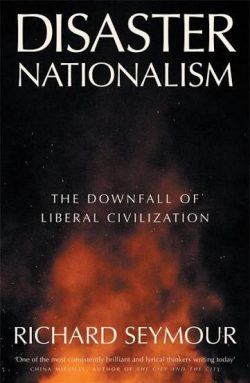
Disaster Nationalism: The Downfall of Liberal Civilization
by Richard Seymour
Verso
2024

It might seem strange that Walter Benjamin’s final work—written while on the run from Nazis during what Victor Serge called the “midnight of the century”—should be a meditation on historiography. Yet “Theses on the Philosophy of History” is as much about history as it is about political action in the present: how was it that socialists failed to see fascism coming? Or to put it another way, how was it that Walter Benjamin himself ended up on the run, in fascist occupied France, trying to flee on foot through the Pyrenees? Social democrats, Benjamin argued, tended to act as if liberal capitalism was the inevitable and only terminus of history. Socialists did not, as they are sometimes accused of, evacuate all principle and succumb to defeatism: quite the opposite. Their inaction stemmed from an unquestioned belief in their own progress; they believed they would win because history demanded it. Modernity may have violent origins, and yet whatever the temporary setback, the trajectory is inevitably a more just future. To the Finland Station begins with the French Revolution and ends with the takeover of the Winter Palace; the arc of history is long, but it wears a Budenovka. “Nothing has corrupted the German working class so much as the notion that it was swimming with the current,” Benjamin writes. In a letter to Adorno, Benjamin explained that the “survivals of positivism,” “vulgar Marxism,” and “social democratic evolutionism” were not so much questions as an autopsy of the left.

In a similar vein, Richard Seymour’s Disaster Nationalism argues against the inevitable progress of liberalism to suggest that, in seams and steam vents of both capitalism and the human psyche, revanchist and apocalyptic movements and ideologies lurk, always immanent.1Richard Seymour, Disaster Nationalism: The Downfall of Liberal Civilization (New York: Verso, 2024). How does one explain, in Seymour’s words, the desire by millions to “gladly…sometimes self-consciously hurt what they are told is their best interest: income, employment, health, and sometimes their lives…for the chance to destroy an enemy?”2Seymour, Disaster Nationalism, 25.  That is, how have antivaxxers, Brexiteers, climate deniers, tariff warriors, and incels triumphed, even as each in their turn could be said to reject any commonsense, rational self-interest? Seymour’s analysis of this new era of far-right politics is embedded in the seeming paradox of his own title. The nation-state was once conceived as a modality to construct homogenous consumers and workers, all within the sphere of a centralized metropolitan market. Once imagined as a vehicle for universalist and republican virtue in addition to economic planning the nation emerged, in Seymour’s words, as an “inchoate incubator” for “fascist forces to thrive.” Rather than the progressive vision of Jacobin councils, New Deal programs, or MLK’s “beloved community,” the last few decades have been marked by, across the globe, with the nation’s use as a vehicle for perverse, violent fantasies of libidinal doom.

While Seymour’s book lacks a totalizing theory of neofascism, or as he frames it “disaster nationalism,” his series of short essays on class, gender, sexuality, militarism, and genocide form a kind of collective portrait of the era’s far right. As opposed to Robert Paxton’s analytics of fascism or Enzo Traverso’s morphology of racial forms that constitute the Western nation and its exclusions, Seymour’s disaster nationalism offers a kind of fluid and conjunctural portrait of the “nationalist international.”3Robert O. Paxton, The Anatomy of Fascism (New York: Penguin, 2005); Enzo Traverso, The New Faces of Fascism: Populism and the Far Right (New York and London: Verso, 2019). The chapters are each bound by an obsession of the new right—on resentment against the cultural elite, reassertion of the cultures of patriarchy, pleasure in violence and militarism. These often libidinal reactionary obsessions gain both their frisson and  aura of legitimacy from liberalism’s apparent degeneration over the last several decades from a politics of freedom to a politics of restraint. Tied to liberal aspirations, social democracy could once promote itself as the philosophy of liberty—from want, restriction, and segregation, and for the expanse of the sensorium. Now liberalism is increasingly seen as a politics of austerity and of restraint: Democratic and Labour leaders pride themselves on balanced budgets and discourses of civility and restraint. Fascism, Seymour suggests, appears thus less as a politics of reaction than as a politics of rebellion—true only in so far as social democracy has diminished into a civic neoliberalism.

It should be remembered that fascism was once thought to be impossible. Not only was authoritarianism inimical to the self interest of the working class, a section of whom aligned with Nazis and the Blackshirts, but modernity was supposed to bring with it the progressive unfolding of democracy, human rights, scientific reason, and development. For liberals and democratic socialists, the angel of history was not—pace Benjamin—a captive of a hurricane, with wreckage piling at her feet, but rather, forward facing, the lady liberty leading us to the horizon with armed sansculottes. But it is not only revolutionary élan or liberal positivism that Benjamin objected to. Benjamin, alongside other Jewish critics of Western imaginaries like Theodore Adorno and Rosa Luxemburg, was all too aware that Europe believed itself as immune to the barbarism of the ancient world as a scientist to the dark. Even to Marxists, the increasing concentration of capital and its penetration around the globe was supposed to bring the final confrontation between the proletariat—divested from land and superstition both—with an ever-smaller number of bourgeois lords of finance. History was to be the history of class struggle.

That this concentration of wealth at one pole and increasing poverty and wage alienation at the other did not bring progressive revolutions, but rather mass hypernationalist, corporatist, and racist parties meant something had gone desperately wrong—not only with politics, but the project of civilization itself. Socialists, Benjamin warned, were as caught up in this ideal of progress as were liberals. Of course, Benjamin was not the only Marxist theorist to pose this question after the realization of the impossible—that is, the collapse not only of democracy but the emergence of mass, popular movements for the collective national suicide of World War II. For Gramsci, fascism arose out of a failure to analyze the state and civil society; for the Frankfurt School, the lineages of violence embedded in Enlightenment modalities of mastery and instrumentality; for Aimé Césaire and C. L. R James, the role colonial violence in constructing the idea of European modernity to begin with.

Seymour shares a lineage with all these thinkers in so far as he takes the rise of the far right to be something apart from, and perhaps even other to, what orthodox Marxists and liberals alike assume to be the cold rationality and “cash nexus” of the market. As Seymour states, “we would be foolish to dismiss rightist doom fantasies.”4Seymour, Disaster Nationalism, 6. In this, Seymour also departs with liberal analyses of reactionary voters: fascists are not dupes or idiots; fascism speaks to real needs and desires. As Herbert Marcuse wrote over half a century ago, the “freedom” offered under liberalism is the “domination of alienated labor” and the “love” a patriarchal and isolated family structure: these form a kind of inescapable if often invisible prison even in the best of times.5Herbert Marcuse, “Freedom and Freud’s Theory of Instincts,” in The Essential Marcuse: Selected Writings of Philosopher and Social Critic Herbert Marcuse, ed. Andrew Feenberg and William Leiss (Boston: Beacon Press, 2007). To say “capitalism produces fascism” means, to this tradition of Marxian theory, that the state of unfreedom is inherent to authoritarian institutions of capital, both inside and outside of the home. The drive for libidinal freedom and eros—whether for labor, love, or violence—is a condition of market liberalism: if the left does not offer a channel for freedom, the right will. Ironically, it is the “disaster nationalists” rather than social democrats who can articulate this gap between the rhetoric of market freedom and lived reality.

Fascism, Seymour suggests, appears thus less as a politics of reaction than as a politics of rebellion—true only in so far as social democracy has diminished into a civic neoliberalism.

What might this conversation among Marxists nearly a century ago tell us in the post-Cold War United States? The US, absent a mainstream and explicitly Marxist labor movement since the 1940s, hitched its ideals of progress not to the left, but to the project of liberalism—that is, the “New Camelot” invented and reinvented by JFK, Clinton, Obama, and Biden. As Seymour dramatizes, Bill Clinton’s slogan, “it’s the economy, stupid,” was to American liberalism what the angel of history was to the Marxism of Benjamin’s time. Embedded within the slogan was the assumption that the US working and middle classes would align their material interests with the political party that can offer the incremental and slow advancement of a generalized prosperity. “It’s the economy, stupid,” is not a vision of class warfare or even organized labor; it is a universal appeal to progressive development. It was and still is a statement that we live in the world of homo economicus, the rational economic human.

Other versions of this liberal commonsense include that oft quoted Obama era commonsense that “demography is destiny”: as the United States becomes more diverse, the Democratic Party will have an inevitable advantage in the coming century. The white supremacists will die out like Shakers, unable to reproduce the next generation. As much as demographics, such adherence to the progressive forces of rational market incentives has been the center of the Democratic Party’s policy solutions. As recently as last year, Biden’s approach to complex social and public health problems—such as a still-ongoing COVID-19 pandemic that has killed and disabled tens of millions and the increasingly catastrophic effects of climate change which threatens all life on this planet—was high-tech solutions that emphasized consumer choice. From new vaccines to electric cars, the Biden administration refused holistic approaches that would surely include both technology and choice, but would also require restructuring our political economy in ways that might challenge ever-accelerating capital accumulation.

If one listened to Democratic Party nominee Kamala Harris’ speech from the National Mall weeks before the election, one would get the sense that history conforms only to ideals of improvement: from the defeat of fascism in Europe to civil rights, from the feminist movement to the queer rights movement, America’s trajectory is toward a fairer country for everyone.6“Kamala Harris Rallies Tens of Thousands as She Delivers ‘Closing Arguments’ of 2024 Campaign,” Democracy Now, October 30, 2024, https://www.democracynow.org/2024/10/30/headlines/kamala_harris_rallies_tens_of_thousands_as_she_delivers_closing_arguments_of_2024_campaign.; Caitlin Yilek, “Harris Gives Closing Argument Speech at Ellipse, Offering a “Different Path” than Trump,” CBS News, October 30, 2024, https://www.cbsnews.com/news/kamala-harris-speech-ellipse-donald-trump-2024-election/. “The arc of the universe is long but bends toward justice” she intoned, quoting Dr. Martin Luther King. Harris said this of course in a country more segregated than it has been for over a century with greater wealth inequality than we’ve seen since the nineteenth century; having lost the right to abortion; and amid a shocking rise of antitrans violence, an ecocide, and, perhaps most saliently, a US- supported genocide in Palestine—all while courting anti-Trump Republicans instead of the left. And of course, as she spoke, hundreds of antiwar and antigenocide protesters organized by Code Pink were removed from the mall, without Harris once mentioning Israel’s slaughter—a war crime the US continues to fund.

Among the many explanations for Trump’s victory this past fall, there are two that function as the mirror inverse of one another despite their apparent opposition. The first is perhaps the return of Bill Clinton’s campaign slogan: it was the price of eggs, stupid.  Numerous stories touted inflation as one of the primary reasons for voter discontent, and now attempt to fact check the president regarding whether or not eggs have in fact decreased in price.7For example, see Andrew Stanton, “Democrats Just Flipped the Script on Donald Trump and the Republicans,” Newsweek, November 5, 2025, https://www.newsweek.com/democrats-flipped-script-donald-trump-republicans-109986.24.; “Donald Trump’s Viral ‘Shut Up About Egg Prices’ Repost on Truth Social Sparks Outrage as He Golfs While Americans Struggle with High Food Costs,” Economic Times, March 10, 2025, https://economictimes.indiatimes.com/news/international/us/donald-trumps-viral-shut-up-about-egg-prices-repost-on-truth-social-sparks-outrage-as-he-golfs-while-americans-struggle-with-hight-food-costs/articleshow/118891860.cms. The Biden and Harris campaigns tried with little success to counter that the economy is strong and that all the indicators one might traditionally rely on—employment, housing prices, and wages—indicated that the economy was, if not booming, at least recovering since the pandemic-driven recession of 2020 to 2021. Indeed, Biden’s entire campaign message was a “return to normal”—a promise that the Democratic Party can offer a return to the good old days of Bill Clinton and Barack Obama, ending both the pandemic and American racism with declarations of symbolic victory. Biden himself—with his aviator shades, taste for Ford muscle cars, commitment to the American imperium, and short, declarative sentences—evoked a kinder, gentler version of Reagan’s “morning in America,” promising that the good old days are back to stay.

The second narrative about Trump is that his presidency is a revelation or unmasking. While Trump and his MAGA base are indeed purveyors of racism with long structural roots in the US, the idea that racism is like a latent foundation to a house—both static and unchanging—suggests an equally idealist notion not only of US history, but its politics.8Jesse Hagopian, “Trump’s UFC Cage Fight Is an Apt Metaphor for a Nation Built on Colonial Violence,” Truthout, July 2, 2026, https://truthout.org/articles/trumps-ufc-cage-fight-is-an-apt-metaphor-for-nation-built-on-colonial-violence/.; Adam Serwer, “Why  Doesn’t Trump Pay the Political Price for his Racism?” Atlantic, December 4, 2025, https://www.theatlantic.com/ideas/2025/12/trump-cabinet-meeting-racism/685129/.; Ta-Nehisi Coates, “The First White President,” The Atlantic, October 2017, https://www.theatlantic.com/magazine/archive/2017/10/the-first-white-president-ta-nehisi-coates/537909/. This curiously echoes Trump’s rhetoric that he is a truth-teller and says what everyone secretly thinks. If Obama-era liberal idealism posited both a postracial horizon for American life and the quiet, passive revolution of multiculturalism, this narrative is equally antipolitical. Both suggest that politics are merely superstructural expressions of a latent reality. According to this antipolitical framing, Trump and MAGA are simply a return to American realism. This is both ahistorical (American racism is a history of domination, struggle, backlash and resistance) and a theory of quiescence: no matter what happens, the foundation of US social life will determine the superstructure. If vulgar Marxism explains history through the economic determinism of class toward an eventual revolutionary confrontation, this version of vulgar racialization poses a racial determinism that will forever thwart a final transformation into a multiethnic democracy.

In either vision one thing is clear: there is no political collective, no collective democracy, and nothing one could call the social. These are the dream worlds of disaster nationalism. 

In popular culture, we might see this as Lin-Manuel Miranda’s Hamilton versus the zombie-apocalypse film. If the former reaches back into the forming of US constitutional law as the revelation of an always-already present multiculturalism, apocalypse films such The Quiet Place or Fury Road suggest that history, as in an inverse mirror, is over as well. The attraction of the apocalypse is not unlike the attractions of liberalism itself: one no longer needs to make political decisions; one just needs to survive an evermore intensive battery of tests to show one’s fitness in this brave new world. Both are vistas without collective or political subjects; they exist without any horizon of a transformative future. Liberalism, collapsed in on itself, emerges out the other side either as the literal quietism of A Quiet Place (in which one saves oneself through acrobatic forms of silence) or as a Hobbesian struggle of all-against-all (as in the heavily armed and post-verbal asskicking of Fury Road). In either vision one thing is clear: there is no political collective, no collective democracy, and nothing one could call the social. These are the dream worlds of disaster nationalism.

Up From the Analysts’ Couch: Freudian Marxism and the Critique of Liberal Rationality

Richard Seymour’s Disaster Nationalism emerges from this long tradition of Freudian-Marxian thinkers,from Erich Fromm to Theodore Adorno to Herbert Marcuse, who see in the emergence of fascism both a latent tendency present in capitalism and a historically specific movement unquantifiable by metrics of the past. Seymour parts both from positivistic accounts of fascism (that hold that it must meet a particular threshold of characteristics before it departs from what Poulantzas calls “authoritarian democracy”) offered by analytic historians such as Robert Paxton and Jason Stanley  and from earlier Marxist accounts (such as those of Leon Trotsky or Clara Zetkin) who saw fascism as an objective response to a crisis of capital that traditional democratic processes could not overcome or resolve.9Jason Stanley, How Fascism Works: The Logic of Us and Them (New York: Penguin, 2020); Robert O. Paxton, The Anatomy of Fascism.; Nicos Poulantzas, State Power, Socialism (New York: Verso, 2014).; Leon Trotsky, Fascism: What It Is and How to Fight it (New York: Pioneer Publishers, 1944), available at https://www.marxists.org/archive/trotsky/works/1944/1944-fas.htm.; Clara Zetkin, “The Struggle Against Fascism,” in Fighting Fascism: How to Struggle and How to Win, ed. Mike Taber and John Riddell (Chicago: Haymarket, 2017), available at https://www.marxists.org/archive/zetkin/1923/06/struggle-against-fascism.html. While not entirely rejecting either of these accounts, Seymour eschews both of these objective accounts of fascism for something more flexible and more attuned to the global conjuncture. Seymour defines “disaster nationalism” as “not-yet fascism”—that is, as movements that are “pathfinders” for a “new type of fascism” that has yet to fully emerge.

Much like Adorno, who begins his late analysis of “neo fascism” in the “concentration of capital” and the increasing forms of mass-mediated alienation that such concentration produces, Seymour nonetheless ultimately finds something subjective and even unmoored in fascism’s most recent turn. As Adorno writes, one cannot find a particular economic or political program that unites a global far right that is equivalent to or even represented by the lurid, sensationalistic, apocalyptic language: “propaganda..constitutes the substance of [neofascist] politics.”10Theodor W. Adorno, Aspects of the New Right-Wing Extremism (London: Polity, 2020), 8. For Seymour, “disaster nationalism” is not a coherent class project trying to rationally resolve a contradiction within a stalled system, nor an attempt to achieve a model form of authoritarian governmentality: it is not the price of eggs, stupid. Rather, this new form of “not-yet fascism” offers a postmodern dreamscape that expresses itself in dissociated spectacles, an “incoherent pastiche of conspiracist bricolage, hallucinatory anti-communism, lurid theories radical sexual evil” all expressed through “millenarism” that posits an end-times kairos, the theological contraction and speedup of time. Unlike what historian Enzo Traverso referred to as the anticommunist crusade of early twentieth century fascism, there is no Europe-wide revolution or newly minted “Judeo-Bolshevik” Soviet state that poses an existential threat to Western capital. “Disaster nationalism” is as much a condensation of meta ironic memes, sadist irrationality, and gamer consoles as it is a fix for a specific axial faultline threatening to topple the whole system.

Seymour locates a great number of far-right social movements—and their violent actions and rhetoric—more in a desire to end “civilization” as we know it rather than an attempt to reconstruct the social order. Noting that Sigmund Freud’s Civilization and its Discontents emerges in the heyday of European fascism, Seymour argues that the libidinal impulses of destruction are produced by the “ordeals of civility” itself. While an orderly society requires all its members to tame their erotic and aggressive satisfactions, there is an explosive jouissance in rejecting such psychological strictures.  One may cast off the “respectable, politically correct” self to embrace “vindictive, self-defeating nastiness” in the name of a kind of short-term libidinal sense of freedom. As Adorno writes, in so far as Nazis projected onto the figure of the international Jew all the conceits of liberal civilization—modernity, commerce, rationality, universality—the destruction of European Jewry served no narrow economic end, but the pleasure in the destruction of the Enlightenment itself.11Theordor W. Adorno and Max Horkheimer, Dialectic of Enlightenment: Philosophical Fragments, Gunzelin Schmid Noerr, ed., Edmund Jephcott, trans. (Palo Alto: Stanford University Press, 2002), 142. One can read accounts of Freikorps soldiers describing their delight in murdering sexually liberated women in the name of their sexual gratification; more recently, one can see photos of women at Trump rallies offering to have their “pussies grabbed” in what should be for both Nazis and women an admission of their public humiliation.12Zander Tsadwa, “What They Say: #WomenWhoVotedTrump is Heated,” Across the Culture, October 14, 2016, https://www.acrosstheculture.com/media/user-created-content/womenwhovotetrump-trend-heated/.; Tiffany Berruti, “‘Gender Ideology,’ Bodily Mutilation, and the End of the Masculine West,” Spectre, February 17, 2026, https://spectrejournal.com/gender-ideology-bodily-mutilation-and-end-of-the-masculine-west/. How else can one describe antivax and antimask movements during a pandemic except to say that they express a perverse joy in refusing the renunciation of personal freedom, even or especially when such protections are for one’s own benefit.

Disaster nationalism is then, not a counterrevolution against the left, but a revolt against the normative facade of liberalism. Each chapter in the text unpacks a particular fixation of the right: the resentment of educational hierarchy and meritocracy; sexual freedom and gender; the drive toward violence; and, finally, ethnonationalist genocide. Like Marcuse, Seymour agrees that liberal capitalism requires “surplus repression”—an analogous concept to Marx’s “surplus labor” denoting an excess of repression necessary to liberal capitalism over and above the amount required to maintain an orderly, functioning, and harmonious society. For Seymour and Marcuse, this surplus repression is articulated as a form of normative freedom.  Long hours at work, precarity, unfulfilling jobs, alienated sexuality and family life are the norm, rather than the exception: they are forms of domination and, in so far as labor is alienated, of libidinal suppression. While the right may not offer real solutions, there is a kind of dreamlike rationality to the notions that corporations want to poison you in the name of health, the nation is under threat from alien forces, and heteronormative sexuality is both restrictive and impossible to achieve as an ideal.

The left’s answer to this structural crisis of capitalism cannot be mere economism; the left will need to offer a vision of real freedom and desire along with a politics of reform.

Yet liberal capitalism, for Seymour and surely readers of Spectre, is indeed in a global crisis, much of its own making. From forest fires and heat waves to uncontained pandemics, to an accumulation crisis expressed through evermore precarious investment bubbles, to the pogroms and genocides of Gaza, Darfur, Yemen and Myanmar, the postwar liberal order of full employment, Keynsian welfare policies, and stable international trade is all in tatters. Seymour suggests “disaster nationalists” like Trump, Netanyahu, and Modi gain their credibility from the utter discrediting of liberal promises for incremental reform and a “return to normal” by a world that is clearly spinning out of control. “Doom fantasies,” Seymour writes, are “often attuned to realities that liberal optimism prefers not to.”13Seymour, Disaster Nationalism, 25.

Or to put it another way, “the apocalypse is no mere fantasy.” While opposing vaccines because they cause autism or contain microchips is clear madness, one could offer that its “rationality” stems from a pandemic that the liberal administration both promised and then refused to end despite medical and air filtration advances that made it possible to do so. Organizing vigilante squads to hunt for antifa members sparking fires in rural Oregon is also laughable (if terrifying), yet, one could argue, the urge to take action when the world is on fire holds a rational kernel in its irrationality. Rounding up migrants is barbaric, and yet may appear as a “plan” of action when both liberal and conservative administrations have colluded in devastating whole industrial regions and subjecting them to generational ruin. And indeed, as a liberal administration both funded a genocide in Palestine and viciously cracked down on student protesters, the “gothic lace work of civilization” as Isaac Deutscher phrased it, is thin and transparent.14Isaac Deutscher, The Prophet: The Life of Leon Trotsky (London: Verso, 2015), 221-222. All documents of civilization are both a document of barbarism indicting capitalism and imperialism, and an invitation to a shrewd politician to capitalize on the cynicism and despair such a realization may foster.

National Suicide or Too-Late Capitalism?

This gets at the contradiction of Seymour’s book that he does not quite resolve, perhaps because, at the moment, it is unresolvable. The petit bourgeois fascist is both a figure of authoritarian order and a also a perverse rebel against civilization; “disaster nationalism” both refers to archaic myths of racial and cultural origins, and yet is without substance or positive program; the far right promises a restoration of virility and domestic order, and yet further shreds the state support and high wages that make both of these plausible (if not necessarily desirable). “The fascist ticket is so vacuous it can only be maintained as a substitute for something else” Adorno writes.15Max Horkheimer and Theodor Adorno, The Dialectic of Enlightenment (Redwood City: Stanford University Press, 2002), 172.

And this is witnessed in real time: how often does one wonder if Trump’s orders to send troops into cities with Democratic mayors, to close down universities or wage war on Iran are real, spectacle, or both? With the recent assassination of the right-wing activist Charlie Kirk, it is equally unclear if we are witnessing a Reichstag Fire or just another violent incident in a nation awash with guns and grievances. The most disturbing answer may be that many of MAGA’s gestures are simultaneously spectacles and yet result in real, if chaotic, destruction. Iran was bombed, faculty have been dismissed, the federal civil service has been gutted, migrants have been caged in shambolic concentration camps. The only consistent program of Trump’s presidency also happens to be consistent with earlier right-wing presidents—tax cuts and deregulation. And yet to say that Trump is just another version of post-Reagan GOP orthodoxy also clearly seems inadequate.

I have written elsewhere that the mass shooter is the apotheosis of the postmodern fascist.16Benjamin Balthaser, “Mass Shotting and the Spectacle of Whiteness: Lynching as Spectable,” Public Seminar, April 13, 2018, https://publicseminar.org/2018/04/mass-shooting-and-the-spectacle-of-whiteness/. On one level, mass shootings—most of which are staged by aggrieved petit bourgeois white men and boys—take on formal aspects of lynching: the spectacle of violence, the choreographed symbolism, the resentment, the desire to prove a kind of domination over the most vulnerable. Many mass shooters’ manifestos are laced with white nationalist tropes and even direct calls to action.17Kanishka Singh, “White Supremacists Behind Over 80%  of Extremism-Related U.S Murders in 2022,” Reuters, February 23, 2023, https://www.reuters.com/world/us/white-supremacists-behind-over-80-extremism-related-us-murders-2022-2023-02-23/.; Weiyi Cai et al., “White Extremist Ideology Drives Many Deadly Shootings,” New York Times, August 4, 2019, https://www.nytimes.com/interactive/2019/08/04/us/white-extremist-active-shooter.html. They are pogroms of one. And yet the mass shooting, unlike the pogrom or the lynching, serve no grander social purpose for the bourgeoisie. The heyday of US lynching sought to construct cross class unities of whiteness at an historical moment in which both small farmers and workers were displaced by increasingly corporate capitalism. Equally, pogroms were “safety valves” for the Russian empire, allowing, in Trotsky’s words, each Russian Christian to feel  like the Tsar for a day, even as the political and economic system of Russia brought neither development nor prosperity. Yet the mass shooter often kills themselves at the conclusion of their act; if not, they are bound to spend the rest of their life in prison. If lynching produced whiteness in the post-Civil War era, surely the mass shooting is an apocalyptic end to it. Whether the Israeli state’s path of genocidal national suicide or the evisceration of the federal civil service in the United States, these acts of destruction and death seem to serve no economic or even rational purpose from the position of the maintenance of power. It is as if school shooters are running the state.

“We proceed towards savagery today in different conditions,” Seymour concludes. “The genocides of the colonial era were genocides of what Karl Marx would call ‘formal subsumption,” bloody if rational enterprises “carried out by newly industrial capitalist states, seeking an outlet for surplus populations and surplus capital, and using violence to either coerce troublesome populations into accepting their role as exploitable labor or eliminate them.”18Seymour, Disaster Nationalism, 164. The late-Victorian Holocausts as Mike Davis vividly framed them, were dehumanizing and world collapsing for whole continents, and yet one could at least explain them through the valorization of capital and the needs of extractive industry. The genocides of the Americas made first the Spanish, and then the United States, extraordinarily rich. The slave owners of the antebellum Mississippi Delta were some of the wealthiest people in the world, building empires on the extermination of indigenous people and the enslavement and torture of African Americans. This is not to discount either irrational or libidinal elements of both systems—one does not need to read Heart of Darkness to understand the jouissance and sadism of the colonial project. Yet these were projects that justified themselves as embodiments of Enlightenment rationality, and not rejections of it. This is not a moral distinction, but a conjunctural one.

As Seymour suggests in his final chapter, “today’s genocides, against the Rohingya in Myanmar, against Gazans, and incipiently against Muslims in India, usually occur in the context of forms of ethnic nationalism fueled by muscular capitalist paths of growth in modern economies.”  They are genocides of dysfunction, the failure “of this political economy…to provide an adequate basis for the nationalist utopia of a perfect congruence between the people and the state.”19Seymour, Disaster Nationalism, 164. They simultaneously constitute a new citizen-subject and a new construction of the mythic citizen, and yet their utopian visions forged “with steel and blood” enable a vision “so unrealizably remote that the desire it expresses can never be satiated and never stop short of disaster.”20Seymour, Disaster Nationalism, 164. Disaster nationalism is therefore not only a warning against nascent fascism; it is a warning against the destructive power of newly reconstituted citizenries to push the entire world into the brink of war, pandemic and climate catastrophe. As with Trump’s memed image of “Chipocalypse Now,” threatening to rain fire and hell over Chicago, his bluff was called as soon as protesters and the  mayor stood up to him. And yet, the deportation machine continues. We may be in a post-postmodern era of fascism, yet the promises of cruelty and violence are all too real.

If there is a horizon of the future Seymour does not address, it may be that “disaster nationalism” does not need any goal for the bourgeois but to sow chaos and division. In other words, the interregnum between the institutions of liberal democracy and neofascist movements in power may be a kind of negative if indefinite equilibrium for the future, balancing the needs for abstract workers for capital with the needs for abstract citizens for the state. One should remember that the expansion of the welfare state at the beginning of the COVID-19 pandemic along with the largest antiracist demonstrations in US history may have been absorbable by capital as demands, but not without real redistribution, reinvestment, and a check on state power. These are demands to which the bourgeoisie is currently not willing to submit. If the protests against Israel’s genocide on Gaza had been addressed, while such demands would not have ended either the Israeli state or US.global hegemony, they would have put real limits on the coercive power of both. We are in an age in which capital views much of the population as surplus, either as salaried middle classes in service and educational industries the state no longer wants to support, or as productive workers the bourgeoisie would like to replace either with low wage, third party offshoring or AI automation. Indeed, one might even say the bourgeoisie feels sufficiently threatened by such demands for redistribution and opposition to lumpenproletarianization to abandon the unreliable neoliberal Democratic Party for the far right.

Yet, the left’s answer to this structural crisis of capitalism cannot be mere economism; the left will need to offer a vision of real freedom and desire along with a politics of reform. Consider Zohran Mamdani’s politics of urban community and joy in his “scavenger hunt” as part of his message of a livable city for working class New Yorkers or, less whimsically, the Black Panther Party’s mixture of high fashion, delivering on the community’s immediate needs, and strategic coalition building in Chicago. Small change, reform at the edges, and a “return to normal,” will merely pave the way for greater disaffections to the right, or disaffection from politics altogether.

SHARE

HELLO, COMRADE

While logged in, you may access all print issues.

If you’d like to log out, click here:

NEED TO UPDATE YOUR DETAILS?

Support our Work

Gift Subscriptions, Renewals, and More