
I come not to bury but to praise Jonathan Brown’s “Fighting the Empire,” an account of the Disney+ series Star Wars: Andor published on September 23, 2025, on the Spectre website. In that essay, Brown took seriously the story of rebellion-from-below that began with the feature film Rogue One and continued in two seasons of Andor. After showing why Andor should be understood as political protest and the cognitive mapping of rebellion, Brown ends with the question of how to put these elements into practice.1Cognitive mapping is a term adapted by the Marxist literary critic Fredric Jameson in Postmodernism, or, The Cultural Logic of Late Capitalism to indicate the way in which literary and other narrative arts can resist the obliteration of historical consciousness under late capitalism by creating mental maps of historical events in relationship to one another. Despite the longstanding tradition of cultural studies in the spirit of Stuart Hall, it is still no small feat to overcome the distrust of popular culture fostered by Theodor Adorno and Max Horkheimer in The Dialectic of Enlightenment, which framed radio, film, and other mass media as instruments of fascist propaganda—understandable in light of Joseph Goebbels and Leni Riefenstahl, but not the end of the story in the twenty-first century. What follows is intended as an augmentation of Brown’s argument through a consideration of corporate permeability, fan agency, droid rebellion, revolutionary ecologies, and the movement of hope from the secondary world (the art) to the primary world (the audience).2I take these terms from J. R. R. Tolkien’s essay “On Fairy-Stories.” I hope it will demonstrate that Brown is even more right than it first appeared.
A Wretched Hive of Scum and Villainy
Brown’s Force-sensitivity (his strong connection to the Force) makes him suspicious of Andor as a product of the Disney company, a powerful factory of culture in the United States. Are we to believe that a show based on series creator Tony Gilroy’s close study of the history of revolution could inspire actual resistance to fascism given its origin in a capitalist Leviathan?3For details, see Brian Davids, “‘Andor’ Creator Tony Gilroy Gives the Interview He Couldn’t During Its Release,” Hollywood Reporter, February 20, 2026, www.hollywoodreporter.com/tv/tv-features/andor-creator-tony-gilroy-gives-the-interview-1236510166. Disney may be like that fateful bar in Mos Eiseley where Luke and Obi-Wan meet Han and Chewie, a hangout for villains that hides all manner of antiheroes. In an interview published in The Hollywood Reporter in February 2026, Gilroy confirmed that Disney would not allow him or the actors to use the word fascism during the press tour. The corporation did act to protect its investment, but its prohibition did not last. Once it was over, Gilroy explained his writerly method and its connection to the present:
You get out your Fascism for Dummies book for the 15 things you do, and we tried to include as many of them as we could in the most artful way possible.… How were we supposed to know that this clown car in Washington was going to basically use the same book that we used? So I don’t think it’s prescience so much as the sad familiarity of fascism.4Davids, “‘Andor’ Creator Tony Gilroy Gives the Interview He Couldn’t During Its Release.”
Brian Davids, the interviewer, then connected his answer to the ICE raids in Minneapolis. Davids expressed a liberatory interpretation of Andor already circulating in fan media, now published overtly in an industry journal. The traditional position that the masses cannot free a narrative from the limitations of its origin appears counterfactual in this case. I take a different position because of the subversion of hegemonic cultural artifacts by feminist, racialized, Native, postcolonial, and queer readers for their own ends.5See T. V. Reed, The Art of Protest: Culture and Activism from the Civil Rights Movement to the Present, 2nd ed. (University of Minnesota Press, 2019). Gilroy has friends everywhere. In an article for Spectre, Tish Turl provides a powerful account of fan fiction and fans-as-writers in “Class Revenge Fanfiction.”6Tish Turl, “Class Revenge Fanfiction Imagination Against Capitalism,” Spectre, October 14, 2025, spectrejournal.com/class-revenge-fanfiction. I also agree with Brown’s observation that “Star Wars has always been a reflection of rebellion born out of times of political crisis,” most notably in George Lucas’s identification of his heroes with the Viet Cong. Brown is right that works of art can reflect historical events, but we should consider how art itself is agentic, producing unforeseen effects in the world beyond any conscious intention of its creators. This is one of the pillars of a theory of fan culture: audience reception and community hermeneutics—in person and through digital re-mediation—can unleash reactions, states of consciousness, and political action beyond mirroring.7Anthony Lioi, “The Matrix of Ecomedia: Fan Worlds as Environments,” in Ecocinema Theory and Practice 2, ed. Stephen Rust and Sean Cubitt (Routledge, 2022), 149–63. When Brown asks us to “look beyond mass media alone and toward political action,” he should consider the ways in which this has already happened.
…we should consider how art itself is agentic, producing unforeseen effects in the world beyond any conscious intention of its creators. This is one of the pillars of a theory of fan culture: audience reception and community hermeneutics—in person and through digital re-mediation—can unleash reactions, states of consciousness, and political action beyond mirroring.
One impediment to such a position involves a vulgar version of art as superstructure resting atop a base of economic activity, taken as the “real” agent of history. In Marxism and Literature, Raymond Williams offers a more nuanced view: “Unless material production itself is understood in its particular historical form, it is impossible to grasp the characteristics of intellectual production that corresponds to it or the reciprocal action between the two.”8Raymond Williams, Marxism and Literature (Oxford University Press, 1977), 81. His understanding of form as mediator of the co-production of art and economy will help to explain the relationship between fans and franchises. I count Andor as intellectual production because it represents a collective artistic response to fascism and empire, but most importantly to the history of Star Wars itself. Andor is a meta-Rogue One, not merely a prequel, which tries to explain how a rebellion from below could have given the plans for the Death Star to our space princess and favorite farm boy; and how fans could come to believe that we, bereft of midi-chlorians, can resist the latest version of US empire. The key word here is fans. In terms of “particular historical form,” we must take into account the powers of fandom to intervene decisively in the production of the franchise. This is not a thought alien to Karl Marx, who wrote about something similar in chapter two of the Grundrisse:
The object of art – like every other product – creates a public which is sensitive to art and enjoys beauty. Production thus not only creates an object for the subject, but also a subject for the object. Thus production produces consumption (1) by creating the material for it; (2) by determining the manner of consumption; and (3) by creating the products, initially posited by it as objects, in the form of a need felt by the consumer. It thus produces the object of consumption, the manner of consumption and the motive of consumption. Consumption likewise produces the producer’s inclination by beckoning to him as an aim-determining need.9Karl Marx, Grundrisse: Foundations of the Critique of Political Economy, marxists.org.
Marx would see the relationship between Star Wars and its fans as dialectical in a way that produces subjects (fans) and their subjectivity, furthering demand. Disney, the producer, responds to these subjects with more production. This is a sketch of a Marxist way of understanding fan agency. However, according to Henry Jenkins, a founder of fan studies, twenty-first-century audiences are not just consumers, but prosumers, co-producers of the pop culture they consume.10Henry Jenkins, Textual Poachers: Television Fans & Participatory Culture (Routledge, 1992). Textual poacher is equivalent to the idea of the prosumer. When fans exert collective influence on corporate popular culture, Jenkins sees agents of a “participatory culture” that overturns the passive consumption that worried Adorno and Horkheimer.
Prosumer-fans are active consumers who work collectively to influence the next round of production. We can see this in the history of fan movements to save beloved series that had been canceled, such as Star Trek and Firefly. However, as Jenkins himself admits, the initial version of his theory may have been too optimistic about fan intervention as a positive political force, given his desire to see fans as reliable agents of liberal democracy, not reactionary vectors of sexism, racism, and heterosexism.11Doron Galili, “A Conversation with Henry Jenkins,” NECSUS, December 1, 2020. (Translation: too many girls, too much bromance, too many people of color, not enough assertion of the straight male gaze.)
Nowhere is this clearer than the fandom that forced Disney to retcon the most interesting changes made by The Last Jedi in The Rise of Skywalker, which overturned Ryan Johnson’s Force-populism with a plot that was focus-grouped to within an inch of its life. Gilroy explains that Andor was only greenlit with the support of Kathleen Kennedy, the former president of Lucasfilm, who, like Mon Mothma, worked within the Empire to make a path for a rebellion. In his conclusion, Brown asserts that Disney will tell any story to make a buck, but we cannot discount the overwhelmingly positive critical and audience response to the first season of Andor that allowed the second season to air amid Disney’s public battle with the Donald Trump administration.
Droids, Loth-Wolves, and Ecologies of Resistance
There is rumbling inside the belly of Leviathan, not just among the elites, but among the NPCs, the fans who are meant to consume in snark or silence. The storyworld itself contains a representation of such subjects in the ubiquitous figure of the droid. As Brown argues, it’s a case of machine against the Machine, a dynamic thematized by the struggle of the droids against the Empire, but also against citizens of the Republic who see them as tools, not persons. We can read droid struggle as an allegory of the audience, people meant by Lucas to rebel against their own empire, now objectified by Disney as consumers who rebel, with varying degrees of virtue, against corporate colonization of the franchise. Star Wars has always pitted the fascist, planet-destroying machinery of human empire against the queer revolt of the droids, starting with R2-D2 and C-3PO (“Oh dear!”) who lead directly to B2EMO (“Bee”), the loyal salvage droid of the Andor household, and to K-2SO, Cassian’s sardonic partner. It is true that Anakin Skywalker’s corruption is embodied in his monstrous cyborg afterlife, and that the Ghorman Rebellion is staged against the engines of extractivism set to destroy the planet. When it comes to droids, however, we must acknowledge sentient, self-aware machines as political subjects themselves.
Droids begin, in fact, as the most prominent slave “race” of the franchise, which is what all that “restraining bolt” dialogue is really about. Side-by-side and intertwined with the human rebellion is a droid rebellion, which critics often fail to notice. Solo, a neglected link among the prequels, reveals that the Millennium Falcon was once a droid who sacrificed her original form to become the rebel flagship. When Han refers to the ship as she, this is not just a convention from British naval culture; the attribution of gender to droids asserts personhood against the status of property-thing. Droids are expected to obey the commands of “master” Luke, keep their sassy backtalk to a minimum, and submit to reprogramming whenever necessary. Especially in the original trilogy, droids were treated as persons only when it suited the aims of the Rebellion. In the case of L3-37, the droid who uploads to the Falcon, her self-assertion creates a new kind of agent, a sentient ship, who is faster and smarter than imperial ships. She becomes a paradigm for bravery. The critical role of enslaved machine-persons who foment a parallel rebellion that many humanoids take for granted fits perfectly into the pattern of Andor.
As R2-D2 is the mediator of the plans for the Death Star, Bee is the mediator of the message from Cassian’s mother. As the films and television shows progress, especially in the era of Dave Filoni, the network of rebels is represented as one of cyborg communities, in which droids are not comic relief, but necessary elements to the success of the movement. On the planet Ferrix, after Maarva’s death, Bee carries out her call-to-arms and succeeds precisely because he is socially invisible, literally low to the ground. As the imperial forces look on, Bee projects Maarva’s last words to Ferrix:
My name is Maarva Carrassi Andor. I’m honored to stand before you. I’m honored to be a Daughter of Ferrix, and honored to be worthy of the stone.
Strange, I…feel as if I can see it. I was six, I think, the first time I touched a funerary stone. Heard our music, felt our history, holding my sister’s hand as we walked all the way from Fountain Square. Where you stand now, I’ve been more times than I can remember.
I always wanted to be lifted. I was always eager, always waiting to be inspired. I remember every time it happened, every time the dead lifted me…with their truth. And now I’m dead, and I yearn to lift you. Not because I want to shine or even be remembered. It’s because I want you to go on. I want Ferrix to continue. In my waning hours, that’s what comforts me most.
But I fear for you. We’ve been sleeping. We’ve had each other, and Ferrix, our work, our days. We had each other and they left us alone. We kept the trade lane open, and they left us alone. We took their money and ignored them, we kept their engine churning, and the moment they pulled away we forgot them. Because we had each other. We had Ferrix.
But we were sleeping. I’ve been sleeping. And I’ve been turning away from the truth I wanted not to face. There is a wound that won’t heal at the center of the galaxy. There is a darkness reaching like rust into everything around us. We let it grow, and now it’s here. It’s here and it’s not visiting anymore. It wants to stay.
The Empire is a disease that thrives in darkness, it is never more alive than when we sleep. It’s easy for the dead to tell you to fight, and maybe it’s true, maybe fighting is useless. Perhaps it’s too late. But I’ll tell you this, if I could do it again, I’d wake up early and be fighting those bastards from the start! Fight the Empire!12Star Wars Unlimited Universe, “Andor: Maarva Andor tells all of Ferrix to “FIGHT THE EMPIRE”!!!!,” YouTube video, November 23, 2022, www.youtube.com/watch?v=qwGa1MK0ujE.
Maarva transforms avoidance, complacency, and magical thinking into solidarity and resistance. Her speech resembles classical Athenian oratory, a citizen addressing her city about its nature. It descends from the republican oratory of the French Revolution; the anticolonial rhetoric of African, Asian, and Latin American revolutions; and the liberation movements of the 1960s. She shares with the post-Enlightenment traditions the tropes of awakening from slumber, arising together, and holding one another as oppressors try to crush the people. This is not accidental. As we have seen, Gilroy studied for decades in order to depict, perhaps for the first time in Star Wars, a grassroots anti-imperialism that the audience could imitate.
Echoing Princess Leia’s message of hope via R2-D2, Maarva communicates only with the help of a droid that everyone on Ferrix understands as a member of her household. After this, Bee is not invisible anymore, and as an imperial officer kicks him to stop the signal, the people erupt on his behalf. There is a counterbalance to technophobia that descends from the Death Star: a droidophilia that recognizes strong AI as friend, comrade, and rebel in their own right. Given that Andor has been described as Star Wars without the Jedi, it is worth noting that Bee’s projection of Maarva looks very much like the Force ghosts we have seen as apparitions of Obi-Wan and Anakin after death. Andor may be hinting that the Force also flows through our droid friends who are part of a living world and its struggle for justice.
The inclusion of droids points to another reason that Brown’s analysis is so resonant: the widening of our view obliges us to recognize other non-humanoids who join the rebellion. Andor is not the first Disney show to depict rebel ecologies, but many of these predecessors are animated and therefore taken less seriously in criticism. (I do not know how seriously Brown takes the animated shows. They are simply absent from his account.) This is a serious error in the era of hypermediated cultures. The official corporate canon of works, like its counterpart in the academy, is only the beginning of the productions of the larger fan world, which has exceeded the control of Lucasfilm since 1977 and the beginning of the franchise. As I argue in “The Matrix of Ecomedia,” fan worlds
cannot be reduced to any one medium, existing in a matrix of print, filmic, televisual, digital, and material-cultural elements such as toys and souvenirs. Fans can enter such a world through multiple doorways and take many paths through its “matrix of media.” The multifarious nature of fan worlds creates a set of phenomenological, interpretive, and ethical questions with which ecomedia studies must grapple.13Lioi, “The Matrix of Ecomedia,” 150–51.
This means that the world of the story—the Star Wars universe—is not composed only of official, canonical works, but a matrix of media created by corporate forces, professional artists, and fans alike. Adding to this matrix is another way in which fans exceed the corporate control of the story and its normative interpretations. Indeed, the more nodes in the network an interpretation navigates, the more robust it becomes. Andor is a prime case of the impossibility of interpreting any individual Star Wars work in isolation, as if we were still operating under Enlightenment assumptions about works of art as distinct objects produced by a genius who owns them and determines their meaning.14See Lydia Goehr, The Imaginary Museum of Musical Works: An Essay on the Philosophy of Music (Clarendon Press, 1992). Andor, as a new node in the matrix, makes it impossible to see Rogue One and A New Hope in the old way; Cassian’s story alters our understanding of what it took to get the plans of the Death Star into the hands of Leia Organa. No shade to the princess (I myself belong to a Leia Organa taskForce) but there are other heroes and other ecologies, as Chewbacca and the Ewoks hinted from the start.
This means that the world of the story—the Star Wars universe—is not composed only of official, canonical works, but a matrix of media created by corporate forces, professional artists, and fans alike. Adding to this matrix is another way in which fans exceed the corporate control of the story and its normative interpretations.
In properly characterizing the frame of Andor as class struggle, Brown may be inadvertently excluding members of the struggle that classical Marxism does not theorize: other-than-humanoid species, usually understood as part of “nature.” We see these species in the animated series Star Wars: Rebels, which enlarges the sphere of rebellion once more. A decade before Andor, it depicted the successful effort to drive the Empire from Lothal, a planet much like Ferrix and Ghorman, positioned at the periphery of the Skywalker Saga, quietly drained of its resources by an occupation. The main characters are a band of plucky misfits, including Hera Syndulla, a Han Solo-style pilot/soldier; Kanan Jarrus, a half-trained Jedi refugee; Ezra Bridger, an orphan who becomes his apprentice; Zeb Orrelios, a Lasat warrior; and Sabine Wren, a Mandalorian who moonlights as a painter. Though the group succeeds in driving the Empire away, they do so only with the help of their droid ally Chopper and through an alliance with the native fauna, who have their own connection to the Force.
The alliance begins in season two when Kanan encounters the Krykna, giant spider-creatures resistant to conventional weapons. Over several seasons, he develops a rapport with the spiders, which leads to contact with the larger ecosystem of resistance, including wolf and cat equivalents who support the humanoids through encouragement and protection. The Loth-wolves are important in helping the team escape imperial soldiers through Force conduits that crisscross the planet, depositing the heroes hundreds of miles from their enemies in seconds.15See especially the episodes “Kindred” and “Wolves and a Door” in season four.
The visual design of the wolves signals their power intertextually: they recall the wolf-gods of Hayao Miyazaki’s Princess Mononoke, who also oppose the extractivist destruction of their home. If Andor reminds us to take droids seriously, Rebels magnifies the classic droid and humanoid alliance with a planetary network that resists ecocide. To underline the dynamics of biospheric liberation, the climax of the series requires Ezra to call upon the Purrgil, giant squid-whales with the ability to travel through hyperspace. They trap Grand Admiral Thrawn—the smartest fascist in the story—and exile him to another galaxy, where he remains until the events of Ahsoka. Lothal is thereby freed and Sabine Wren memorializes the aptly named Spectres with a public mural in Capital City.
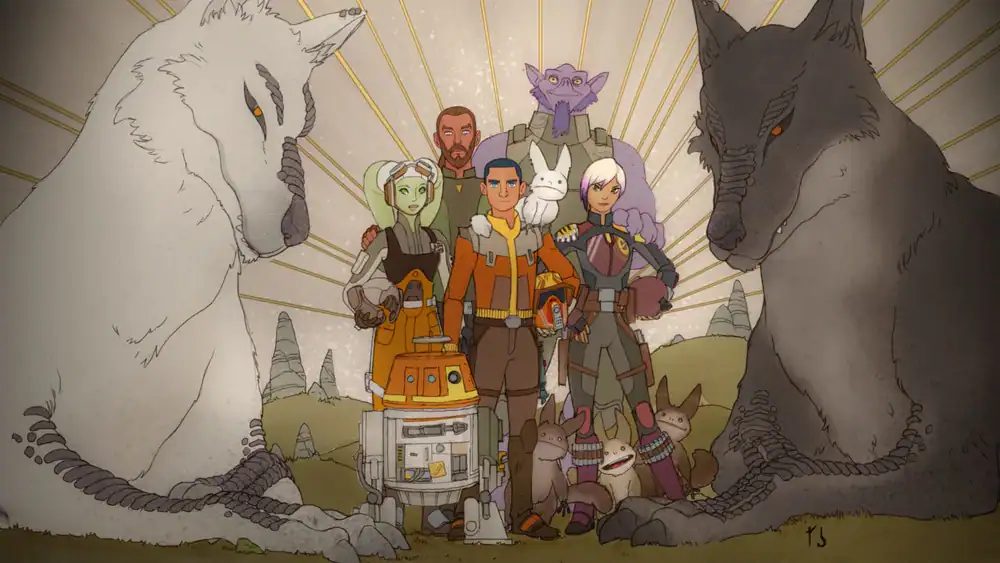
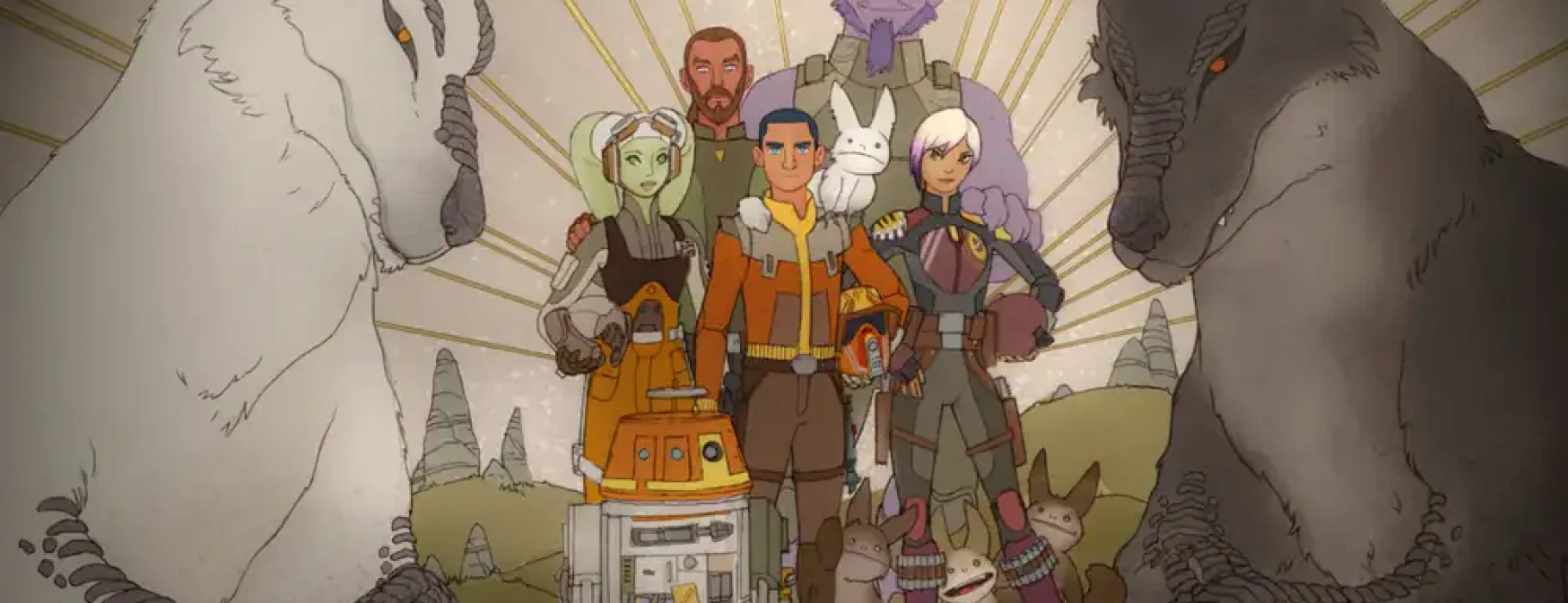
The composition of the mural illustrates the Spectres as more than humanoid: the group is framed by Loth-wolves, surrounded by Loth-cats, foregrounded by Chopper the droid, and backgrounded by the Krykna, who appear in their camouflaged form as rocks. Though Chopper and the Loth-cats radiate the kawaii/cuteness of traditional sidekicks, the wolves and the Krykna do not. They have their own agenda and represent the biosphere of Lothal taking action against human fascists.
The building of the relationship between the Spectres and the creatures of Lothal begins when Kanan uses the Force to contact the Krykna and show them respect despite the arachnophobia they inspire. Kanan’s behavior moves well beyond the traditional Jedi use of animals as tools, suggesting his transcendence of an institution that had become fatally anthropocentric. He teaches the Force to Ezra, making possible Ezra’s alliance with the Purrgil, who overwhelm Thrawn in a way the humanoids by themselves could not. The implication of Thrawn’s defeat is that the larger Rebellion could not have succeeded without the removal of the Empire’s most ruthless agent. What Cassian and his cell accomplished would have amounted to nothing without the planetary solidarity of Lothal. Rebels makes the case that all struggle against contemporary fascism is a struggle against ecofascism, and our notions of rebellion must grow into an ecology of liberation.16See Alexander Menrisky, Everyday Ecofascism: Crisis and Consumption in American Literature (University of Minnesota Press, 2025). Taken together with Andor, the rebels of Rebels transform the Alliance into a trans-species antifascism that connects the fate of particular places with the reconstruction of the Republic.
We Have Friends Everywhere
Rebels helps us understand how the imagery of the Rebellion has been taken as a tool for contemporary resistance to US fascism in the Trump era. Lothal is liberated, but Sabine creates an icon of rebellion that ensures the persistence of memory. Moreover, the mural creates a visual language for a heroism that can be imitated by other groups, much as the protagonists of Buffy the Vampire Slayer thought of themselves as a Scooby Gang. This effect overflows into the lives of fans in the primary world. Mimesis enables embodiment when you get the aesthetics right, a truth embodied in fan cultures from Doctor Who to Queer as Folk. This is one answer to Brown’s question about Andor leading to political action.
In the resistance to the 2025 ICE incursion in Minneapolis, protesters used the storyworld of Andor to create an augmented reality in which the plot and characters of the show accompany activists in real life to bind them together, to speak a common political language with viewers across the country and the world. In our hypermediated condition, the creation of a media event unleashes a torrent of content distributed through Instagram, TikTok, and even Facebook, which is where I encountered it first.
In the resistance to the 2025 ICE incursion in Minneapolis, protesters used the storyworld of Andor to create an augmented reality in which the plot and characters of the show accompany activists in real life to bind them together, to speak a common political language with viewers across the country and the world.
Though Star Wars imagery has been appropriated by activists and protesters since the first Trump term—including the display of the Rebel bird insignia and iconography of Princess Leia—the depredations of ICE in the second term have led to an explosion of quotations and imagery from Andor.17See, for instance, “The Rebel Loon Has Become a New Tattooed Symbol of Resistance during the Ongoing ICE Protests in Minnesota,” WHAS11 News, January 31, 2026. Minnesota is a case in point. This is a snapshot taken of a Facebook post on February 29, 2026, from the feed of Charles McBryde, a leftist media creator. It records a moment at the Minnesota United soccer team’s home opener in 2025 when fans displayed a banner recasting the insignia of the Rebel Alliance as a loon, a bird identified with Minnesota and Minnesotans.
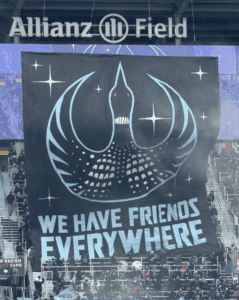
This is hardly the first instance of the Rebel Loon. Once ICE attacked Minneapolis/St. Paul, the loon appeared on protest signs, t-shirts, hats, hoodies, in social media, and in thousands of tattoos as people inscribed resistance into their skin. “I have friends everywhere” is the identification code for members of Luthen Rael’s network of conspirators, adapted as a sign of rebellion against the federal government, now branded as the Empire. Luthen’s line comes from two pivotal moments in season one, episodes nine and ten, when he shares the code with Lonni Jung, his mole, and Mon Mothma. The code serves as a means of authentication and a way of summoning aid.
In Minneapolis, the choice of this line speaks directly to the administration and its imperial hubris, modeling defiance of the world order Trump is trying to impose. To unfurl such a banner at a televised soccer match expressed the confidence of the mutual aid networks nurtured in the wake of George Floyd’s murder, proof that the resistance believed its friends would understand and act accordingly.18Rachel Leingang, “‘We’re Fighting for the Soul of Our Country’: How Minnesota Residents Came Together to Face ICE,” Guardian, February 1, 2026. In fact, material and monetary support for the victims of ICE has flowed through digital campaigns to these networks.
The evocation of Rael—who told Lonni that he had burned his life for a sunrise he would never see—signals a radicalized rebellion, not the hero’s journey but the hidden sacrifices and open defiance of whole communities. These communities know each other not as individuals, but as living nodes in the matrix of resistance. In this sense, the loon is the inverse and complement of Sabine’s mural, not the icon of an exceptional team, but a signal of solidarity from community to community, Minneapolis speaking back to Los Angeles and forward to New York and Maine. It is a fulfillment of The Last Jedi, in which a little boy, a nobody with no special lineage, picks up a sticksaber and starts to use the Force. Though Disney tried to retcon that ending by revealing that Rey Skywalker is a Palpatine, the Force of the demos is hard to erase.
Conclusion
The exploration of Brown’s argument reveals some important consequences to his analysis and an answer to the questions that ended his essay:
- In its desire to teach the histories, strategies, and tactics of rebellions in the primary world, Andor fulfills a traditional goal of Horatian rhetoric, “to delight and instruct” the audience. The current fad of dismissing popular culture as inherently nihilistic is a delusion of the right that Marxists should be wary of because it obscures what Andor has accomplished.
- Andor requires a transformation in our interpretive tools, one that allows us to recognize how products of a corporate culture machine exceed its control to the extent that fan agency asserts itself in the cycle of production and consumption, and in the ongoing reception of new narratives into the matrix of a fan world. We must remember that art itself is agentic, the cause of events beyond the intention of its creators.
- The conclusion that Brown might most resist is the claim that Disney is not a monolith, but a series of economic, institutional, and interpersonal structures that can be reshaped or disrupted to allow a show like Andor to be made. Expectations of ideological and material purity are the enemy of radical semiosis. The premise, which Brown rightly refuses, that revolutionary art should deliquesce to Battleship Potemkin is a form of nostalgia that must be overthrown.
- The representation of droid rebellion permits an allegory of the audience as empowered fans, but also points to a liberatory model of artificial intelligence that has been eclipsed by the artificial stupidity of large language models and their makers. How can we imagine strong AI as companion in the biosphere and an anti-imperial agent, a partner in a cyber-demos?
- The ecology of rebellion on Lothal in which the humanoid, animal, and droid community overthrows the Empire suggests a theoretical, narrative, and aesthetic path for feminist-ecosocialist rhetoric and politics. In this way, the heterotopian implications of Donna Haraway’s “A Manifesto for Cyborgs” might arise in the wake of merely dystopian visions.
- The current movement of Andor-based iconography and rhetoric from storyworld to activism reveals what is possible when storytellers shape political narratives informed by real histories of resistance. To paraphrase Marianne Moore, Andor provides an imaginary garden with real rebellions in it. We should expect more of this to come.
May the Force be with us all, always.