
Beyond the Labour Machine
Aotearoa, the Alliance, and the Question of Working Class Independence
September 8, 2026
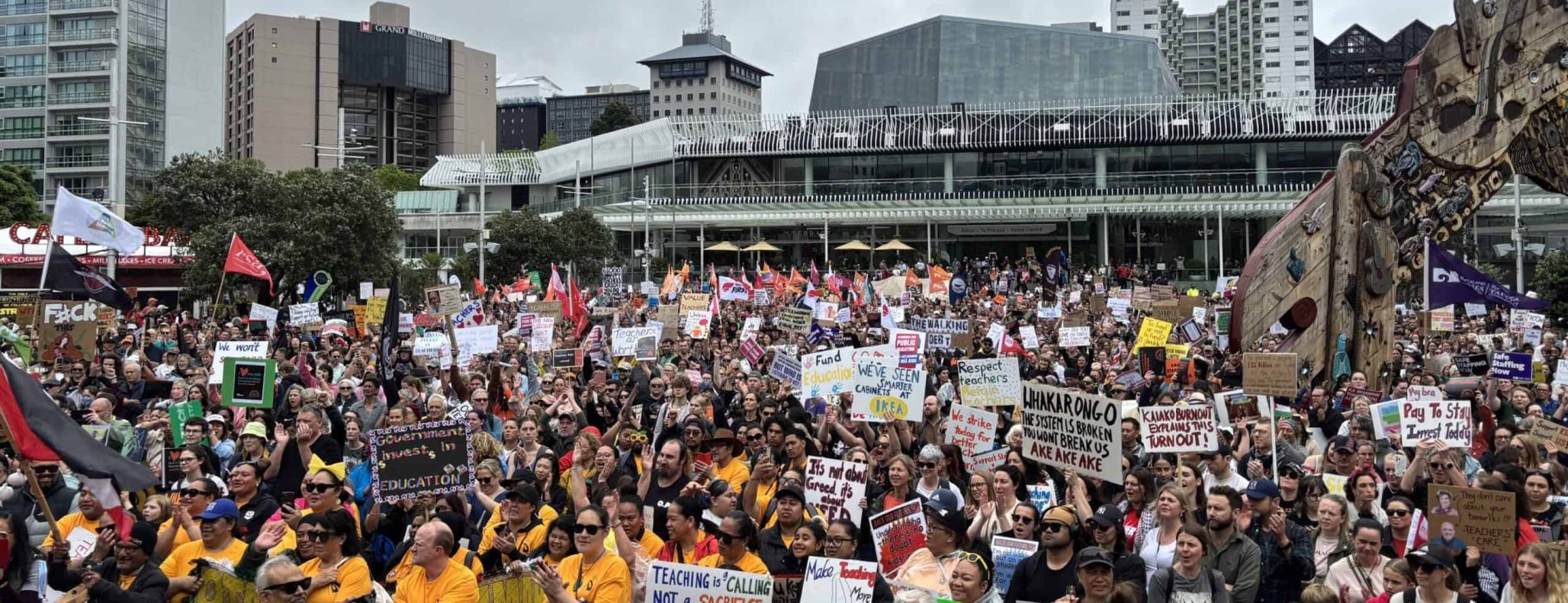
On October 23, 2025, more than 100,000 workers walked off the job in Aotearoa (the Māori-language name for New Zealand): 60,000 teachers, 30,000 nurses, 5,000 doctors, 20,000 allied health workers, firefighters, and public servants. It was the largest day of industrial action since the 1979 general strike—a forty-six year interregnum finally broken. 56 percent of New Zealanders told pollsters they backed the strikers.1Joe Hendren, “Mega Strike in New Zealand Demands Funding for Public Services, Raises,” Labor Notes, November 2025, https://labornotes.org/blogs/2025/11/mega-strike-new-zealand-demands-funding-public-services-raises; Tom Peters, “More Than 100,000 Join New Zealand’s Biggest Strike in Over 45 years,” World Socialist Web Site, October 24, 2025, https://www.wsws.org/en/articles/2025/10/24/crch-o24.html.
By the end of the year, that energy had been buried. The Post Primary Teachers’ Association—the secondary teachers’ union, and the more industrially assertive of the two teacher’s unions—accepted a settlement below inflation for its 20,000 members. In February, the over 12,000 allied health workers of the Public Service Association—New Zealand’s largest union of public sector workers, covering some 90,000 members across the state sector—voted for a similar deal. The New Zealand Educational Institute (NZEI), the country’s largest education union and the most rank and file in its internal structure of the major public sector unions, nevertheless pushed through a paycutting agreement for primary teachers over substantial member opposition. The Nurses , whose last collective agreement expired in October 2024, was presented in May 2026 with another subinflation offer, leaving frontline nurses with eighteen months of frozen pay amid 5 percent inflation. No further mass strikes were called; each section of the workforce was isolated, then squeezed.
This sequence—explosion, isolation, retreat—is the most important political fact in Aotearoa today, and understanding why requires knowing how New Zealand’s unions sit in relation to its Labour Party. Labour was founded in 1916 by the unions themselves, and a bloc of them (the maritime, rail, and manufacturing unions among them) remain formally affiliated to this day: they pay affiliation fees, send delegates to Labour’s conference, and vote in its internal processes. Others, including the two teacher unions, belong to the Council of Trade Unions but hold no party allegiance at all. What the affiliated relationship buys, in practice, is a standing institutional interest in Labour’s return to office, and therefore a standing reason not to escalate a fight that might make the opposition look unable to govern. This is the structural problem that the ruling right-wing three party coalition has bet on, the parliamentary opposition has refused to confront, and the official trade union leadership has been organizationally incapable of solving. And, in the first week of June 2026, it also produced an event whose significance should not be allowed to pass without notice: the Maritime Union of New Zealand (MUNZ), a small union covering seafarers, watersiders, and port workers, the unbroken successor to the Seafarers’ and Wharfies’ unions that helped build Labour in 1916, and an affiliate of that party ever since, voted unanimously to also affiliate with the revived Alliance Party, a democratic socialist formation that held thirteen parliamentary seats in the 1990s before collapsing in 2002.2Penny Smith, “Maritime Union affiliates with Alliance Party, keeps door open to Labour,” RNZ News, June 7, 2026, https://www.rnz.co.nz/news/political/597493/maritime-union-affiliates-with-alliance-party-keeps-door-open-to-labour. On MUNZ’s own affiliations, see Maritime Union of New Zealand, https://munz.org.nz/. By contrast, the Post Primary Teachers’ Association states explicitly that it is not affiliated to any political party; see “PPTA is not affiliated to the Labour Party,” https://www.ppta.org.nz/publication-library/ppta-is-not-affiliated-to-the-labour-party/.
The affiliation does not end the union’s century long relationship with Labour. National Secretary Carl Findlay was quick to insist that the wharfies “are not walking away from the Labour Party.” But neither does it merely add a second letterhead. For the first time in living memory, a major New Zealand trade union has openly named another political home, and identified it as socialist. The MUNZ vote is at once a symptom of Labour’s thorough failure towards the working class it claims to represent and a tentative beginning of the political reconstruction necessitated by that failure. It is not a workers’ party, but it might, if much else goes right, be the embryo of the conversation that produces one. What is promising is not the Alliance’s electoral prospects, which are slight, but the venue in which the question of independent working class representation is now being asked—inside a union’s own constitutional decision-making, rather than in the seminar room or the propaganda of a sect. A national council put it to a vote and carried it unanimously. That precedent is portable in a way that a manifesto is not; it can be tabled at the next union’s council, and the next. Crucially, the proposition it settles—that a union may hold more than one political allegiance at a time—counters the single party monopoly over labor that the Labour relationship has always depended on.
The Coalition’s Three-Year War
The National-led government was formed at the end of 2023, after the National Party’s Christopher Luxon stitched together a three-party coalition with David Seymour’s ACT and Winston Peters’s New Zealand First. ACT is a small right-libertarian party that has spent the past decade rebranding pro-market policy as anti-“woke” cultural warfare; under Seymour it has become the coalition’s ideological driver of privatization and the anti-Treaty agenda. New Zealand First is a nationalist populist formation trading on anti-immigration politics, hostility to Māori-directed spending, and Peters’s own considerable talent for keeping himself at the center of the country’s political climate. The division of labor between the three is itself a governing technique: ACT is permitted to introduce what National and New Zealand First would rather not own, and the senior partners then position themselves as moderating influences on a radicalism that they have in fact licensed. From its first week in office, the National-led government has launched the most aggressive offensive against working class living standards in a generation.
The Equal Pay Amendment Act, urgently rammed through Parliament in early May 2025 with the support of all three coalition parties, gutted the pay equity regime by raising the female workforce threshold (the proportion of employees who must be women for a role to legally qualify as work “predominantly performed by female employees”) from 60 to 70 percent, and requiring that a role meet that raised threshold for ten consecutive years.3Wendy Zeldin, “New Zealand: Controversial Changes to Pay Equity Legislation Enacted,” Global Legal Monitor, Library of Congress, June 26, 2025, https://www.loc.gov/item/global-legal-monitor/2025-06-26/new-zealand-controversial-changes-to-pay-equity-legislation-enacted/; NZEI Te Riu Roa, “Government changes to pay equity — May 2025,” https://www.nzeiteriuroa.org.nz/help-advice/knowledge-base/government-changes-to-pay-equity-may-2025. Finance Minister Nicola Willis’s NZ$12.8 billion figure is from her 2026 Budget announcement. The significance of that test is easy to miss from outside the jurisdiction. A pay equity claim in New Zealand is not an equal-pay-for-equal-work claim; it is an argument that an entire occupation has been systematically underpaid because it is done by women, and that its wages should therefore be compared against male dominated occupations of comparable skill and responsibility. The female predominance test is the gate through which any such claim must pass before it can be even heard. Raising the threshold and imposing a ten year historical requirement did not merely narrow future claims; it retrospectively disqualified live ones. And because the occupations in question (aged care, disability support, school administration, cleaning) are disproportionately staffed by Māori and Pasifika women in New Zealand, a change written in the language of gender lands with racialized force. Thirty-three live claims, representing tens of thousands of such workers, were dropped overnight. Finance Minister Nicola Willis told Parliament the changes would “save” the Crown an estimated NZ$12.8 billion over four years: the present value of the wages and back pay the state has decided to extract from women workers to fund tax relief for property owners.
The MUNZ vote is at once a symptom of Labour’s thorough failure towards the working class it claims to represent and a tentative beginning of the political reconstruction necessitated by that failure.
The 2026 budget announced eighty-seven hundred further public sector job cuts over three years—roughly 14 percent of the 63,000-strong public service workforce—sold as “fiscally responsible” management and quietly justified by ministers as a substitution of AI tooling for human labor.4Jamie Ensor, “Budget 2026: Nicola Willis’ public service cuts to save $2.4b, 8700 jobs to go,” New Zealand Herald, May 19, 2026, https://www.nzherald.co.nz/nz/politics/budget-2026-pm-christopher-luxon-promising-job-cuts-as-nicola-willis-to-unveil-public-service-shrink/ERIJHW5CHJDRTPZHNA7O6CAYVA/; see also “New Zealand budget 2026 raises concerns over jobs, public sector cuts and long-term unemployment,” People Matters Global, May 2026. Housing support spending was cut from $655.4 million to $576.5 million for the year, even as homelessness in Auckland more than doubled from 426 to 940 rough sleepers between September 2024 and September 2025.5Tom Peters, “Homelessness worsens in New Zealand,” World Socialist Web Site, January 5, 2026, https://www.wsws.org/en/articles/2026/01/05/cayx-j05.html. Electricity prices rose 12.2 percent in twelve months; gas 15.4 percent; insurance 10; dairy and eggs 9.9. Amid this increase in cost of living prices, the minimum wage rose only 2 percent.6“Cost of Living Crisis NZ 2026: Why Household Expenses Are Surging and What Families Need to Know,” Kalkine NZ, 2026, https://kalkine.co.nz/by-topic/economic-news/cost-of-living-crisis-nz-2026-why-household-expenses-are-surging-and-what-families-need-to-know; Stats NZ, “Household living costs increase 3.0 percent,” https://www.stats.govt.nz/news/household-living-costs-increase-3-0-percent/.
To these material attacks, the coalition added David Seymour’s Treaty Principles Bill, introduced in November 2024 as part of ACT’s coalition agreement. The bill sought to rewrite the principles of Te Tiriti o Waitangi (the Treaty of Waitangi)—the legal scaffolding that has supported decades of Māori claims—out of New Zealand jurisprudence. The response was the largest tangata whenua (Indigenous Māori) mobilization in living memory: the Hīkoi mō te Tiriti protest march, which spanned the length of the North Island and gathered more than 42,000 marchers to Parliament. When Te Pāti Māori Member of Parliament Hana-Rawhiti Maipi-Clarke tore her copy of the bill in two and led the chamber in Ka Mate, the image spread around the world. The bill was “annihilated” at its second reading in April 2025, but its intended political work continues. The National Party and New Zealand First voted for it at the first reading precisely so they could then disclaim it—the licensing manoeuver described above, and an act of choreographed cynicism worth remembering whenever those parties claim to be moderating their partner’s worst impulses.
The throughline is austerity as statecraft. The pay equity rollback alone constitutes a form of primitive accumulation, in which a particular fraction of capital—landlords, professional services, the rentier infrastructure of the New Zealand economy—is allowed to draw rents from a feminized public sector workforce whose recourse to law has been quietly amputated. The cuts to housing support and the public service are not separate ledger items. They are a single distributional decision, executed under the cover of fiscal seriousness.
Labour as Machine
Confronted with this offensive, the Labour Party has done two things: spoken against the cuts in general terms and deliberately refused to commit to reversing them. New Zealand Labour Party leader Chris Hipkins began 2026 with a speech denouncing coalition austerity and reminding the public that “working New Zealanders have always been integral to Labour’s purpose.” Within weeks, his shadow finance team was floating “tax relief”—presented as the party’s answer to household cost pressure, and thus as a substitute for reversing the cuts that produced it—as a 2026 platform plank. Labour has committed to repealing the Equal Pay Amendment Act if it wins office, but only conditionally, in coordination with the Greens, and if fiscal “headroom” is available. The shadow cabinet has, with characteristic discipline, declined to call for the immediate restoration of dropped claims, the rehiring of fired public servants, the restoration of housing budgets, or—and this is the test—any commitment to defend the right of unions to strike against any future government, including its own.
That reticence is structural rather than personal, and the affiliated unions know it. National Secretary of the Maritime Union of New Zealand Carl Findlay’s characterization of the party as “a big machine” with “different views from different people” is more revealing than he perhaps intended. The Labour Party today functions as a stabilizer of the New Zealand state. It administered austerity in government from 2017 to 2023, during which promises to address child poverty, the housing crisis, and the healthcare emergency were systematically diluted into policy gruel that delivered the 2023 landslide to National. In opposition, it offers verbal resistance while declining to commit the working class to any struggle it could not subsequently de-escalate from office. This is the historical role of social democracy in the imperialist core: a safety valve that converts working class anger into safe electoral expression in order to bleed it off.
Former prime minister and Labour Party leader Jacinda Ardern’s 2017 mandate was a working class mandate: housing, child poverty, healthcare. She left office, having handed the premiership to Hipkins, with housing prices at record highs, child poverty stalled, and the health system in worse condition than she had found it. The 2023 landslide was not a swing to the right, but a strike by the working class electorate against a party that had squandered its trust.
The New Zealand Council of Trade Unions (CTU), which represents 320,000 workers and is itself affiliated to no party, has nonetheless accepted the Labour relationship as nonnegotiable. The 2025 megastrike was magnificent, but the architecture of its follow up was incoherent: no indefinite stoppage, no coordination with the Hīkoi networks, and no organized challenge to the coalition’s legal regime. The strike was treated as a one-day “demonstration of strength” rather than the opening of a worker’s front in a class war the government had already unilaterally declared.
New Zealand readers will recognize the pattern from 1951, 1991, and every interval when the union bureaucracy treated parliamentary patience as the safer choice only to discover that capital does not wait. The Maritime Union has reason to remember. The 1951 waterfront lockout—22,000 watersiders and supporting workers locked out for 151 days by the First National government, while the Federation of Labour leadership refused to take solidarity action—is still remembered on the Auckland and Wellington wharves. In 2026, to affiliate with a party other than Labour is to act in light of that memory.
The Alliance, Revived
The formation MUNZ has affiliated to is not new—it is a resurrection. For readers unfamiliar with the Aotearoa left, the Alliance is the country’s most historically significant post-1984 attempt to build a socialist electoral force to the left of Labour. The Alliance was born in reaction to the Fourth Labour Government’s neoliberal turn. While briefly powerful in the 1990s, it catastrophically split in 2002 and deregistered in 2015. Its 2025 return is the direct outcome of a new generation of conclusions by activists that the Labour Party cannot be reformed at the speed the crisis demands. Its history is worth recovering in some detail, because it will be tested by the same temptations that destroyed it the first time.
A union of MUNZ’s weight—small in membership, but central by sector and capable of halting freight through the country’s ports—has voted to affiliate with an organization it knows it can shape. That is not a stunt; it is a calculation about leverage.
The Alliance was founded in December 1991 as a coalition of five formations—Jim Anderton’s NewLabour Party (a 1989 split from Labour over Rogernomics), the Green Party, Matiu Rata’s Mana Motuhake, the Democrats, and the Liberals—united against the neoliberal counterrevolution of both major parties.7For the Alliance’s foundational history, see the party’s official account at https://allianceparty.nz/about/; and “New Zealand: Alliance Adopts a Socialist Manifesto,” Green Left, January 14, 2004, https://www.greenleft.org.au/2004/566/world/new-zealand-alliance-adopts-socialist-manifesto. In the 1993 election (the last under first-past-the-post), the Alliance won 18.2 percent of the vote but only two seats. That result did more than any other to discredit New Zealand’s single winner voting system and to deliver the 1996 referendum for a mixed member proportional (MMP) system, under which voters cast two ballots: one for an electorate candidate and one for a party. Under proportional representation, the Alliance returned thirteen members of Parliament on 10.1 percent in 1996. In 1999, it entered coalition with Labour. Anderton served as Deputy Prime Minister, and the government established Kiwibank as a publicly owned competitor to the Australian-owned trading banks and introduced statutory paid parental leave. Both reforms survive.
The party then destroyed itself. In 2002, Anderton broke with the membership over the deployment of New Zealand troops to Afghanistan. Most of the membership opposed the war; Anderton did not, and took several members of Parliament with him into the Progressive Party. The Alliance left Parliament that year and never returned. It was deregistered in 2015. For a decade, it existed only as a name.
In 2025, it re-registered, contested local body elections, and in January 2026 announced candidates for the November 2026 general election. In February, it held a national conference at the Trade Union Centre in Christchurch—the venue choice is not incidental—at which Victor Billot (MUNZ’s National Communications Officer) was elected leader.8The Christchurch Trade Union Centre is the longstanding home of the city’s organized labor movement and a working union building rather than a conference venue. Holding the founding conference there, rather than in a hired hall, signaled the party’s intention to root itself in existing union structures, rather than in the activist milieu—a claim the MUNZ affiliation gave substance to four months later. The platform ratified at that conference is a socialist program of the social democratic left. Its constitution commits the party to public ownership of energy, transport, water, ports, rail, and shipping; free healthcare and education; a steeply progressive tax system; recognition of Te Tiriti o Waitangi as the constitutional foundation; an independent foreign policy grounded in Pacific solidarity; and—point ten, stated without embarrassment—the assertion that “global capitalism is not permanent or invincible” and that the party fights for “a socialist alternative.” It accepts no corporate donations.
This is not a revolutionary program. It is recognizably reformist in method: it conceives the path to socialism as passing through the parliamentary state and organized via a mass electoral party. Anyone who has read Charlie Post or Kim Moody on the limits of broad left party projects, from Syriza to Podemos to Die Linke, knows the catalogue of dangers.9See Kim Moody, Breaking the Impasse: Electoral Politics, Mass Action, and the New Socialist Movement in the United States (Chicago: Haymarket, 2022); and David McNally and Charlie Post, “Beyond Electoralism: Mass Action and the Remaking of the Working Class,” Spectre 2, no. 3 (2025): https://doi.org/10.63478/KGDTNGCS. The Alliance is not exempt, as its own history demonstrates. In 1999 it entered a coalition with a center-left Labour government, and that coalition’s commitments to war and the IMF-disciplined fiscal framework of the Helen Clark government were precisely what tore the party apart.
But the question is not whether the Alliance is the party we would write into existence. It is not. The question is what the Alliance currently is: a small organization with fewer than five hundred dues paying members at the time of the MUNZ vote that has begun to do two things: it provides an electoral vehicle through which the demands for nationalization, the restoration of the social wage, and a break with the neoliberal consensus can be voiced as a program rather than as moral protest; and it provides an institutional space outside the Labour Party in which trade union militants (beginning with the wharfies) can locate themselves politically without swallowing Labour discipline.
The under-five-hundred figure is being deployed, especially in left-of-Labour journalism that finds the Alliance embarrassing, as evidence that the affiliation is a stunt. This is upside down. The Alliance’s small size is precisely what makes MUNZ’s decision meaningful. A union of MUNZ’s weight—small in membership, but central by sector and capable of halting freight through the country’s ports—has voted to affiliate with an organization it knows it can shape. That is not a stunt; it is a calculation about leverage.
What the Maritime Union Did
The substance of the MUNZ vote warrants pause. Findlay was specific about what the union sees in the Alliance that it does not see in Labour: a commitment to halt asset sales, to keep ports in public ownership, to rebuild the national rail network and a New Zealand-flagged merchant fleet, and to treat coastal shipping as strategic infrastructure rather than a cost center to be auctioned to the highest bidder. He also named the immediate provocation: open speculation about the Dubai state-owned port operator DP World “sniffing around” the Lyttelton Port Company, which posted a record half year profit in February 2026 even as the coalition’s broader privatization agenda accelerated.10“Lyttelton Port posts record half-year profit,” RNZ News, February 4, 2026, https://www.rnz.co.nz/news/business/585958/lyttelton-port-posts-record-half-year-profit; “Maritime Union Vows To Fight Lyttelton Port Privatisation Plans,” Scoop News, June 5, 2026, https://business.scoop.co.nz/2026/06/05/maritime-union-vows-to-fight-lyttelton-port-privatisation-plans/.
These are not merely abstract considerations. The partial privatization of the New Zealand ports is already producing the conditions that led to the Ports of Auckland deaths in the early 2020s. Privatization is a direct attack on wharfies’ working conditions and on the union’s ability to enforce safety standards. The Maritime Union’s resistance is the basic union function of defending the social conditions of work.
That defense has led to a political conclusion that the union’s leadership has treated as taboo for over a century: the Labour Party cannot be relied on to do this work alone, and working class political representation must therefore be plural. This conclusion is being tested within an electoral architecture whose Mixed-Member Proportional voting system makes possible. Under first-past-the-post voting, dual affiliation would lead to vote splitting in marginal seats. Under MMP, every percentage point above the 5 percent threshold translates into seats, and electorate wins translate independently of the party vote. A union strategy of voting Labour in the electorate and Alliance in the party vote makes arithmetic sense. While MMP is insufficient to produce a workers’ party, it removes one of the structural defenses on which the Labour-union fusion has historically relied. In other words, it opens a door for dual affiliation.
Beginnings, Not Arrivals
We should be precise about what the affiliation does and does not constitute. Affiliation to the Alliance does not constitute a workers’ party in the sense used in Spectre’s recent debates on the rank and file strategy. The Alliance is not, currently, a vehicle for politically organizing and generalizing workers’ direct action on the job. It is an electoral party that has acquired the affiliation of a militant union. The distinction matters.
The MUNZ affiliation says: yes, we do—not in the sense that Labour is finished, nor that the Alliance is the party we need. But in the sense that the assumption of nowhere else to go is itself a piece of political infrastructure that can be dismantled vote by vote, affiliation by affiliation, union by union, and that this dismantling has now begun.
The danger of conflating the two is substitution—that is, the temptation to treat a parliamentary vehicle as a substitute for the slow, structural work of rebuilding workplace organization, training rank and file leaders, defeating concessionary contracts, and reconstructing the cross-sectoral solidarity that turns a one day megastrike into the beginning of sustained class confrontation. The CTU’s demobilization after October 23 was not caused by the absence of a workers’ party. It was caused by the active choices of union officials who treated each affiliate’s contract as a separate negotiation and refused to call strike action despite the clear invitation of both the moment and the polls.
A new party, even a good one, cannot fix that. David McNally and Charlie Post’s “Beyond Electoralism,” published in Spectre in November 2025, made the case bluntly: “revolutionary socialists have never rejected participation in electoral politics. What they have contested is the elevation of electoral campaigning to the strategic priority of the Left.”11McNally and Post, “Beyond Electoralism.” The argument applies on the south side of the Pacific. The Alliance can be useful, even necessary, but it cannot replace the work of rebuilding the unions from below. If the MUNZ affiliation is treated as the end of the political question rather than its beginning—as delegating to Billot the tasks that the wharfies and their allies should be doing themselves—it will become exactly the kind of substitution that has hollowed out broader left projects across Europe. Paul Ginsberg, writing in this journal on the United States, has put the same point in his engagement with electoralism. As opposed to substitution, Ginsberg calls for “hybrid tactics” in which the anticapitalist left works to defeat the right electorally while also building the mass force that can defeat it lastingly. As Ginsberg stipulates, “neither imperative can be sacrificed to the other.”12Paul Ginsberg, “For a United Front Against Neofascism,” Spectre, May 19, 2026, https://doi.org/10.63478/GOV3MM3W.
The way to prevent substitution is to use affiliation as an organizing lever. The most useful thing the Alliance can be over the next eighteen months is a meeting ground: a place where rank and file militants from the Nurses Organisation, NZEI, the Post Primary Teachers’ Association, the Public Service Association, First Union, E tū, Unite, and the dozens of smaller formations springing up around insecure work sectors can meet one another outside the disciplinary architecture of the Labour caucus. The model is recognizable in the Labor Notes network in the United States and in the rank and file traditions of the British trade union left. It is the work of building the infrastructure of cross-union solidarity that can independently call for action and sustain it alongside the electoral vehicle. Whether the Alliance can host that work remains an open question. Its 1999–2002 experience is a warning. Any party aspiring to be a working class formation in 2026 under MMP and in the face of both present geopolitical pressure and an Aotearoa state edging toward AUKUS Pillar Two and lifting defense spending past 2 percent of GDP for the first time since the early 1990s will have its principles tested early. Its constitutional commitment to “an independent foreign policy” and to “Pacific solidarity” will be tested by Washington’s first request for naval access, the first dispute over Chinese deep sea cable infrastructure, and the first port visit by a nuclear powered submarine.
Te Tiriti, Tangata Whenua, and the Class Question
A workers’ party in Aotearoa that does not understand itself, from the foundations up, as a party of Te Tiriti will reproduce the Labour Party’s settler colonial bad faith. This is not moral hygiene. It is the basic strategic recognition that the New Zealand working class has, since 1840, been structured along a color line; that Māori workers have historically been segregated into the most exploited sectors of the labor market; that Pasifika workers, recruited under the conditions of the dawn raids and their successors, have been used as a deliberate wedge against Pākehā labor; and that the very pay equity claims gutted by the 2025 Act were disproportionately filed by Māori and Pasifika women in care work. Any project of working class political renewal that does not put Te Tiriti at its center is, in practice, a project for the section of the working class the settler state most readily recognizes.
The Alliance constitution’s sixth principle—recognition of Te Tiriti, “redress of violation of Te Tiriti,” respect for Te Reo Māori and Māoritanga “as the first culture and language of this country”—is a starting point. On its own, it is merely words on a page. The party that emerges from this moment will be judged on whether it can build structural relationships with Te Pāti Māori, iwi authorities, the kohanga reo and kura kaupapa networks, and the urban Māori organizations that the Hīkoi mō te Tiriti revealed to be capable of mass mobilization. The 42,000 at Parliament in November 2024 were, for the most part, not organized by the existing Pākehā left. James Stout, writing in Spectre on liberatory movements from Spain to Rojava to Myanmar, argues that the fiercest struggles against oppression not only resist power but also build new ways of living together.13Shane Burley, “The Only Way Out Is Together: Interview with James Stout” Spectre, June 2, 2026, https://doi.org/10.63478/TUTGRB77. Te ao Māori has been doing that work in Aotearoa since 1840. A workers’ party worth the name will take its lead from it.
The Maritime Union has more institutional memory of this work than many other unions. Its history of solidarity with the 1981 Springbok tour protests, the Bastion Point occupation, and port based internationalism—most recently through its public backing of the Global Sumud Flotilla and recognition of Palestine—gives it a place to stand. But solidarity with tangata whenua at home, on the question of tino rangatiratanga, is harder and slower work. It is the work without which an Alliance-MUNZ axis will simply be the latest iteration of a Pākehā labor politics that mistakes its own horizon for the country.
What is the “Starting Point” For?
Is the Alliance’s revival and the Maritime Union’s affiliation a starting point for a working class government party in Aotearoa?
The honest answer is that it is the starting point for a conversation about such a party. The conditions for the party itself are not yet in place. If they are produced, they will be the product of what the working class itself does over the next two years, in the strikes not yet called, the workplace fights not yet won, and the cross-union infrastructure not yet built. In this project, the Alliance can be a useful interlocutor. It is not, at its current scale and program, the vessel into which the New Zealand working class should pour itself.
What the Alliance can be—and what the MUNZ vote has begun to make it—is a wedge: a small, deliberately placed instrument for prying open the union-Labour fusion that has contained New Zealand working class politics within a settler colonial social democracy and prevented its development of an organizationally independent expression for more than a century. The fusion is old and stronger than it appears, supported by a Labour bureaucracy whose first reflex when challenged is to remind workers—in the same tones used by the New South Wales right of the Australian Labor Party—that they have nowhere else to go.
The MUNZ affiliation says: yes, we do—not in the sense that Labour is finished, nor that the Alliance is the party we need. But in the sense that the assumption of nowhere else to go is itself a piece of political infrastructure that can be dismantled vote by vote, affiliation by affiliation, union by union, and that this dismantling has now begun.
We have watched too many “broad left” formations—from Corbynism to the Sanders movements to the various European left-populist projects—mistake a beginning for a destination. The Alliance, if it survives and grows, will face all those temptations: to soften its program to meet 5 percent thresholds, treat union affiliations as electoral assets rather than as sites of mutual political education, and discipline its own militants in the name of parliamentary respectability. The only guarantee against any of this is the existence, outside the electoral party, of a working class movement strong enough to hold it to account.
That movement is being built right now in Aotearoa—at the bedside, in the classroom, on the wharf, in the back of the ambulance, and on the picket lines of the next strike the CTU leadership will, at first, try not to call. It is being built in exactly the kind of workers’ experiments with new forms of politics that John Schultz has documented elsewhere in this journal: inchoate self-activity that, in its very doing, calls the class relation into question.14John Schultz, “Worker Experiments in New Kinds of Politics,” Spectre, May 1, 2026, https://doi.org/10.63478/AKAAIC11. The most that can be said for the affiliation at Lyttelton, the Alliance’s small founding meetings in church halls and union centers, Billot’s leadership, and Findlay’s careful framing of dual affiliation is that some of the country’s most experienced working class organizers have decided to stop waiting. In a country whose official left has been waiting since 1984, that is a beginning.