

After the Last Word

Review of Kevin B. Anderson's "The Late Marx's Revolutionary Roads"

December 3, 2025

doi.org/10.63478/TPSYWEDW
81pfWxdlh6L._SL1500_
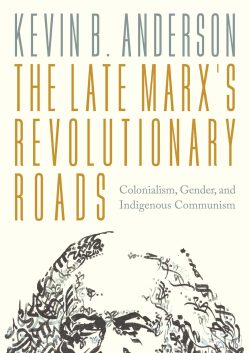
The Late Marx's Revolutionary Roads: Colonialism, Gender, and Indigenous Communism
by Kevin B. Anderson
Verso
2025

What, exactly, are we doing when we “read Marx”? Are we excavating a fixed doctrine from a canonical author documenting the intellectual itinerary of a nineteenth-century revolutionary? Perhaps we are constructing concepts along with him to meet the demands of our present. One particularly generative place to pose this question is when we confront the late notebooks and marginalia that have emerged in the second Marx-Engels-Gesamtausgabe (MEGA²). The authority of “Marxism” has so often rested on editorial and institutional decisions that narrowed the field of what counted as Karl Marx. Those decisions helped found a research program and a political tradition, but they also disciplined how generations approached the corpus.

Kevin B. Anderson’s The Late Marx’s Revolutionary Roads: Colonialism, Gender, and Indigenous Communism is a timely intervention in that larger story. It offers a capacious guide through the new materials and, just as importantly, invites us to ask what kind of interpretive work is called for when we bring a nineteenth-century thinker into twenty-first-century debates.

Following his death in 1883, Frederick Engels devoted himself to bringing volumes two and three of Capital to print, an editorial achievement that also saturated subsequent reception, while works like Anti-Dühring and Socialism: Utopian and Scientific helped form Marx’s thought into a system.1For more detailed accounts of the twists and turns Marx’s literary estate, see Marcello Musto, “The Rediscovery of Karl Marx,” International Review of Social History 52 (2007): 477–98, https://doi.org/10.1017/S0020859007003070; Jürgen Rojahn, “Publishing Marx and Engels after 1989: The Fate of the MEGA,” Critique 29, no. 1 (2009): 196–207, https://doi.org/10.1080/03017600308413467; Rolf Hecker, Manfred Neuhaus, Richard Sperl, and Hu Xiaochen, “MEGA (From the Historical-Critical Dictionary of Marxism),” trans. Kaan Kangal, Historical Materialism, accessed November 4, 2025, https://www.historicalmaterialism.org/article/mega-from-the-historical-critical-dictionary-of-marxism/. In an age enamored with science and Darwinian evolution, this lent Marx’s open-ended critique a deterministic cast. Under the influence of Karl Kautsky and the Second and Third Internationals, manuals and compendia eclipsed the texts themselves while editorial “tidying” and outright censorship spread.

Meanwhile, the plans for a complete forty-two-volume edition of Marx and Engels’ work began in the early 1920s in the Soviet Union under the editorial direction of David Riazanov.2Riazonov was dismissed from his post at the Marx-Engels Institute and condemned to deportation in 1931. The project was ultimately discontinued in the early 1940s after publishing just twelve volumes. While Riazonov and his team issued such major writings as the 1844 Manuscripts, German Ideology, and Grundrisse, they also tended to downplay Marx’s later research, with Riazonov himself suggesting that the elderly Marx’s exhaustive summaries on seemingly obscure topics were largely a “waste of time” and “inexcusable pedantry.”3David Riazonov, “Neueste Mitteilungen über den literarischen Nachlaß von Karl Marx und Friedrich Engels,” Archiv für die Geschichte des Sozialismus und der Arbeiterbewegung, 11 (1925), 399, cited in Anderson.

The turning point in assessments of Marx’s late work came gradually. In the 1970s and ’80s, heterodox currents began to read the late Marx against the grain of orthodoxy. Lawrence Krader’s publication of The Ethnological Notebooks (1972), Teodor Shanin’s Late Marx and the Russian Road (1983), and the recovery of Marx’s correspondence with Russian revolutionaries pried open the period and made it legible as a moment when Marx was wrestling with colonialism, communal forms, and nonlinear historical pathways. All of this has been cemented by the relaunch of MEGA², whose fourth section has made available the excerpt notebooks on anthropology, history, law, natural sciences, and agrarian relations—precisely the materials that Engels and Riazanov deemed marginal. As those notes have circulated, a wave of scholarship, from Heather A. Brown on gender to Kohei Saito on ecology, has reoriented debates around the late Marx’s significance for the present.4Although there are slight differences, most consider approximately the last decade of Marx’s life as his “late” period. This was a time in which Marx was consistently troubled by illness, published very little, and, until 1872, was preoccupied with his duties as part of the General Council of the International Workingmen’s Association. Here I follow Anderson in considering the years 1869-82, and particularly his notebooks, as the late Marx.

Anderson writes, as well as participates, in that context. For example, he notes his role in editing an English edition of these notebooks. Anderson’s earlier book, Marx at the Margins, made an influential case for the centrality of nationalism, ethnicity, and non-Western societies to Marx’s politics and theory. Anderson’s new book, The Late Marx’s Revolutionary Roads: Colonialism, Gender, and Indigenous Communism widens the lens, reconstructing, synthesizing, and contextualizing the late notebooks—primarily those from 1879 to 1882—in a set of thematic chapters. There is reflection on communal social formations; gender, kinship, and women’s empowerment; multilinear concepts of development; colonialism and resistance; Rome, India, and Russia as agrarian societies in flux; and new concepts of revolutionary change and alternatives to capitalism. One of the virtues of Anderson’s book is that it gives a reader who may never reach MEGA² IV/27 a reliable itinerary through a vast, difficult, and fragmentary terrain.

It is important to delineate Anderson’s development and his line of argument. The story begins with Marx’s intensified interest in social forms outside the European core. Chapter One tracks Marx’s notes on communal social formations across a staggering range: Iroquois and Aztec gentile organization; the matrilineal inheritance rules of clan societies; Roman gentes and their transformations under the Republic and Empire; Germanic and Celtic practices that survived feudalization; the Russian mir; and precolonial and colonial India and Algeria. The guiding thread is Marx’s insistence on seeing “communal social formations” rather than only communal property. In other words, Marx was centering the forms of social labor and reproduction that structured ownership, kinship, and politics. Anderson carefully draws out Marx’s dialectical sensibility here and showcases his recognition of the egalitarian and democratic elements in clan societies alongside the internal hierarchies and seeds of caste and class that grow within them.

Anderson largely resists the stronger claims made by others—Kohei Saito’s degrowth communism chief among them—about a kind of “epistemic break” in late Marx. But he does not sufficiently address the shared trend that encourages us to shoehorn Marx into our “good” positions on the basis of limited textual evidence.

Chapter Two turns to gender and kinship. Anderson contrasts Marx’s notes on Lewis Henry Morgan, Henry Sumner Maine, John Lubbock, and Ludwig Lange with Engels’s Origin of the Family, arguing that Marx’s late materials are subtler than Engels’s schematic “world-historical defeat of the female sex.” Marx underlines both the presence of women’s authority in Indigenous societies (for example, the Iroquois’ “female keepers of the faith,” senatorial “horn-knocking,” matrilineal descent) and the contradictions and limits of that authority (food provisioning as gendered labor, restrictions on women’s voice in councils). He treats Greek and Roman patriarchy in a dialectical register too, noting countermemory in Greek myth and dramatic choruses. Anderson’s aim is not to idealize prior forms of social labor or even “primitive communism,” but to recover the elements of women’s power and communal organization that persisted in transformed guises into later periods.

With these materials on the table, Chapter Three argues for Marx’s late adoption of a multilinear conception of historical development. For readers of Marx at the Margins, the details are familiar but worth rehearsing: in the French edition of Capital, Marx restricts the “historical inevitability” of the path he describes under so-called primitive accumulation to “Western Europe”; and in Marx’s letters to Vera Zasulich and the editors of Otechestvennye Zapiski he explicitly denies that Capital offers a “general historico-philosophic theory of the marche générale imposed by fate upon every people.” Anderson emphasizes as well Marx’s sustained rejection of feudalism as a universal category for non-European societies (Aztecs, India, Algeria), and his insistence that “Asiatic” forms cannot be assimilated to European sequences. The chapter’s conceptual center is that “Western Europe” is an exception rather than a model, and that modes of production—ancient, communal, “Asiatic”—are not temporal stages to be recapitulated but distinct articulations with their own logics.

Chapter Four connects this perspective to Marx’s evolving view of empire as a system that both pulverizes older communal arrangements and inadvertently incubates their renewal in struggle. Anderson traces Marx’s investigations of Spanish rule in the Caribbean (where annihilation and enslavement shattered Indigenous polities) and of French counterinsurgency in Algeria (where military repression was coupled with legal engineering to privatize land and eradicate “communal tendencies in people’s minds”). The analytical thrust is not simply to show that colonialism is violent, but that it is structurally invested in dissolving collective property relations because they anchor social solidarities capable of organized resistance. Marx reads these policies as continuous across metropole and periphery, suggesting that the same French “Assembly of Rurals” that crushed the Paris Commune codified land privatization in Algeria, revealing a single class project that operates at home and abroad. What emerges is a double movement: colonial domination seeks to make freeholding individuals, but its very disruptions generate the solidarities and grievances that fuel insurgency.

Anderson returns to Marx’s studies of India and Russia as rapidly transforming agrarian societies in Chapter Five, but the central focus of the chapter concerns the latter’s notes on ancient Rome. Marx traces the material levers of Rome’s shift from a gentile/clan order into a patrician aristocracy: long campaigns that left smallholders’ fields untilled while patricians kept production going with enslaved labor, indebtedness, and usury that deepened inequality as “safety valves” like colonization and soldiers’ pay muted plebeian unrest. He also follows the moral and legal degradation of the client–patron bond and the drift of many plebeians into an urban proletariat dependent on elite largesse, even as Rome’s waterworks and jurisprudence displayed remarkable technical advances. Against this backdrop both the enslaved and peasant revolts in Sicily and Pergamon and the Gracchan moment in Rome appear for Marx as genuine moments of potential revolutionary breakthrough, blocked by what he calls a plebeian animus toward slaves that functioned like a protoracial divide—an insight he sharpens by comparing Roman plebeians to “poor whites” in the US South. The analytical payoff Anderson draws from these writings are twofold. First, Rome’s highly “modern” legal and monetary forms served to stabilize rather than undermine its slave-based mode of production, which complicates any tidy, evolutionary trajectory toward capitalism. Second, divisions of status within the Empire’s exploited classes fatally undercut revolutionary alliances. In this reading, Marx is not only summarizing the class structure of Roman society, but also anticipating a broader theory of how division within the working classes can neutralize even widespread crisis and revolt.

Finally, Chapter Six threads these materials through “three new concepts of revolution” sketched by Marx in his last years. First, Anderson reconstructs the General Council’s 1870 “Confidential Communication on Bakunin,” drafted by Marx, which spells out with unusual clarity the strategic logic linking Ireland, England, and France. Here, Marx outlines the Irish question as the cleaver of the English landlord class, the necessity of breaking English workers’ quasiracist hostility toward Irish labor, and the notion that, while France would provide the spark of revolutionary initiative, England is the “metropolis of capital” whose transformation would reverberate throughout the world market. Anderson then moves to Marx’s comments on the Paris Commune, in which the commune is read as a political form that abolishes the state while preserving collective services—a form under which the economic emancipation of labor can be “worked out” beyond wage relations. Finally, in Marx’s Russian correspondence and the 1882 preface to the Communist Manifesto, we get the most succinct statement of the thesis: if a Russian revolution complements and is complemented by a Western proletarian revolution, the commune may be a point of departure for modern communism.

Still, the book may disappoint. The narrative Anderson traces is often suggestive—that Marx’s position changes from a Eurocentric, developmentalist model to a multilinear one—but does less than it could to establish what, within Marx’s theory, actually changed and why. The aggregative approach lends implicit support to one of the book’s central theses—we are meant to “see” the steps of development in the order of texts—but the account remains largely descriptive. It does not really broach which concepts (mode of production, value, class, state, social reproduction, and so on) were reworked, nor how changes in Marx’s problem-situation (the Commune, Russia, the global spread of capital) pressed on those concepts. What is missing is analytical work on the theories underlying the periodic expressions.

This shows up, too, in Anderson’s discussions of race and Eurocentrism. To his credit, he dismisses caricatures of Marx as an unredeemed Eurocentric Promethean and insists on the importance of the late materials for deepening Marx’s global horizon. He is right to note that Marx’s knowledge of India, Algeria, Latin America, and Russia was extensive and serious, and that in these notes Marx often rejected European categories (for example, feudalism) as misapplied. Yet Anderson’s treatment of race sometimes reads like a scorecard: instances of racist language are tallied, counterbalanced by antiracist conclusions, and filed. This tends to impose contemporary standards externally without reconstructing the conceptual role of race for Marx himself. When Anderson remarks that Marx “rarely” used “race” as an explanation and then cites “Slavonic race” as an exception, he has just shown that Marx attributes characteristics to “Slavic culture.” The distinction turns on the word race, but we do not get an account of the biological, ethnological, or cultural valences of that term in the 1850s and ’60s—indeed, before and after Charles Darwin—the ways it intersects with nation, language, and “people,” or how Marx’s categories of social domination and emancipation relate to it. Similarly, Anderson’s sensible observation that Marx sometimes used what we would call racist language to make antiracist points in writing about the American Civil War raises more questions than it answers: What are the limits of mapping “racist” and “antiracist” onto a nineteenth-century revolutionary whose own conceptual field did not include that modern opposition?

To give an account of change in an author’s work, it is not enough to present a sequence of expressions; one needs to present an account of the theory that underwrote and was altered by those expressions. Anderson’s reconstruction remains an indispensable contribution to this task…Yet, beyond that, it is best read as part of a contested process of theoretical reappropriation, not as a last word.

A related issue is the treatment of stagism and multilinearity. Anderson’s strongest textual case is the French edition’s qualification of “historical inevitability” to Western Europe and the letters to Zasulich and the editors of Otechestvennye Zapiski, which explicitly deny the universality of the “marche générale.” But the book sometimes lets a single sentence do more conceptual work than it can bear. The offending claim in Capital—“the country that is more developed industrially shows the less developed the image of its own future”—occurs in the preface that is oriented toward readers in England, France, the United States, and Germany; in the French revision, Marx inserts “those that follow it up the industrial ladder.” But it is not obvious that the clause changes the universe of discourse: the chronotope remains Western Europe. Indeed, as Christopher Araujo argued in his review of Marx at the Margins, where Anderson also draws on that passage, Marx’s comment that more industrialized countries show the “image” of the “future” for those “less developed,” he was explicitly referring not to precapitalist or non-industrialized countries, but to the “less developed” though still capitalist economies of Western Europe, above all Germany.5Christopher Araujo, “On the Misappropriation of Marx’s Late Writings on Russia: A Critique of Marx at the Margins,” Science & Society 82, no. 1 (January 2018): 74–77, https://doi.org/10.1521/siso.2018.82.1.67. A more sustained argument would situate these editorial interventions within Marx’s rethinking of primitive accumulation’s geography, his increasing insistence on the specificity of non-European formations, and his struggle to reconcile a theory of capital’s totalizing logic with histories that do not fit “succession.” To be sure, that argument is latent in the book’s materials, but it is not as well drawn out by Anderson as it might have been.

On Eurocentrism as such, Anderson wisely notes that the charge is often overblown, but he does not fully address the multiplicity of Eurocentrism’s dimensions. As both Amy Allen and Kolja Lindner have insisted, Eurocentrism is not only about replicating a teleological sequence based on European history (primitive-ancient-feudal-capitalist).6Amy Allen, “Universality, Necessity, and Progress: Marx and the Problem of History,” Emancipations: A Journal of Critical Social Analysis 3, no. 3 (2024): https://doi.org/10.55533/2765-8414.1104; Kolja Lindner, “Marx’s Eurocentrism: Postcolonial Studies and Marx Scholarship,” Radical Philosophy 161 (May/June 2010), available at https://www.researchgate.net/publication/46765988_Marx’s_Eurocentrism_Postcolonial_studies_and_Marx_scholarship; Kolja Lindner, Marx, Marxism and the Question of Eurocentrism (Palgrave Macmillan: 2022), https://doi.org/10.1007/978-3-030-81823-4. It also concerns the ways “Europe” is constructed as a subject of history, the occlusion of non-European contributions to “European” development, and the projection of European categories and horizons across difference. These are features that, as Lindner notes, are present in the sources Marx drew on and which he did not always subject to critique. Anderson’s critiques of “feudalism” and his reconstruction of Marx’s colonial dossiers do real work here. But one wishes for more engagement with these other dimensions—say, how Marx’s reconstruction of Roman law via Lange and Rudolf von Jhering might be read with materials on Indian law, or what it would mean to read “Europe” as an effect of global processes rather than as a preexisting actor.

A final caution concerns the temptation to make the notebooks do too much. Anderson largely resists the stronger claims made by others—Kohei Saito’s degrowth communism chief among them—about a kind of “epistemic break” in late Marx. But he does not sufficiently address the shared trend that encourages us to shoehorn Marx into our “good” positions on the basis of limited textual evidence. Saito’s reconstruction of Marx’s ecological notebooks has contributed enormously to eco-Marxist debates; it has also invited a whirligig of editorial moves whereby stray remarks take on the weight of doctrine. A restrained method would acknowledge that the late notebooks are rough, often ungrammatical records of reading. Their contents often oscillate between excerpt and comment, and that their intertextuality is not always reconstructible. For these reasons, the imperative for us is not to find a ready-made theory—in particular from a time in which Marx’s political practice was constrained—but to do the constructive work that would integrate these materials into a living critique of our present.

If the book has a unifying theme, it is that questions of method are inseparable from the politics that situate any interpretation. The question, then, is what reading practice we bring to these neglected late writings. Michael Heinrich’s “double historiography” [Historisierung] serves here as a useful model.7 “Karl Marx’s Monetary Theory of Value,” YouTube video, 1:58:51, posted by “Yale University,” November 14, 2020, https://youtube.com/watch?v=gmYFtpfdVn4. See also, Heinrich, How to Read Marx’s Capital: Commentary and Explanations on the Beginning Chapters (Monthly Review Press: 2021), especially pages 25–30. For a related approach to intellectual history as such, see Mikkel Flohr, “Toward a Materialist History of Ideas: History, Contradictions, and Possibilities,” Rethinking Marxism 37, no. 1 (2025): 113–33, https://doi.org/10.1080/08935696.2024.2435773. This entails reconstructing both the production process of the text and the production process of our reception of itthat is, we situate Marx’s arguments in their nineteenth-century context and, just as importantly, we make our own standpoint explicit as itself historically determined. At the same time, it means refusing to let a descriptive sequence of notes and drafts stand in for conceptual change; instead, we trace how shifts in Marx’s object of investigation-situation (Russia, Ireland, empire, the world market) reorganize his categories. And this entails, finally, stating the criteria by which we assess Marx and letting those criteria be open to revision through the encounter. The relevant standards here are not moral scorecards but theoretical ones: whether a reconstruction explains why particular interventions become necessary when they do; whether it can track how editorial and political interventions (from Engels to the early MEGAs) have shaped the “object” we call “Marx”; and whether it can show, concept by concept, how late inquiries into communal forms, empire, and gender press on, modify, or recompose his earlier categories of value, class, state, and social reproduction.

There are examples of this practice that Anderson’s book explicitly and implicitly endorses. Alongside Heinrich, Heather A. Brown’s work on gender and the family, William Clare Roberts’s republican reading of domination and the critique of Pierre-Joseph Proudhon in Capital, and the new work on the French edition of Capital that has reframed debates on primitive accumulation’s geography (Thomas Kuczynski, Jean-Numa Ducange). All show that descriptive care is indispensable, but neither it nor philological exactitude can substitute for specifying the problems and questions to which Marx’s concepts answer and showing how those concepts shift across conjunctures. On this view, the notebooks are not a reservoir of doctrines but materials for modeling conceptual dynamics—how, for instance, multilinear development follows from re-posing the question of primitive accumulation once the periphery is no longer read through Western Europe, or how inquiries into clan and communal forms reopen the scope of social reproduction beyond wage labor and the state.

To give an account of change in an author’s work, it is not enough to present a sequence of expressions; one needs to present an account of the theory that underwrote and was altered by those expressions. Anderson’s reconstruction remains an indispensable contribution to this task. It gives us, with clarity and care, the dossier we need as a basis for any argument about late Marx. Yet, beyond that, it is best read as part of a contested process of theoretical reappropriation, not as a last word. The question Anderson’s book poses implicitly is how we take up that object now. The answer cannot be to canonize a “new” Marx—protointersectional, protodecolonial, protodegrowth—extracted from notebooks. Nor can it be to retreat to a closed Capital and an ossified “maturity.” It is, rather, to continue Marx’s method of radical critique, especially when it leads us beyond the confines of Europe, the state, the factory, and even at times late Marx himself.

SHARE

HELLO, COMRADE

While logged in, you may access all print issues.

If you’d like to log out, click here:

NEED TO UPDATE YOUR DETAILS?

Support our Work

Gift Subscriptions, Renewals, and More