
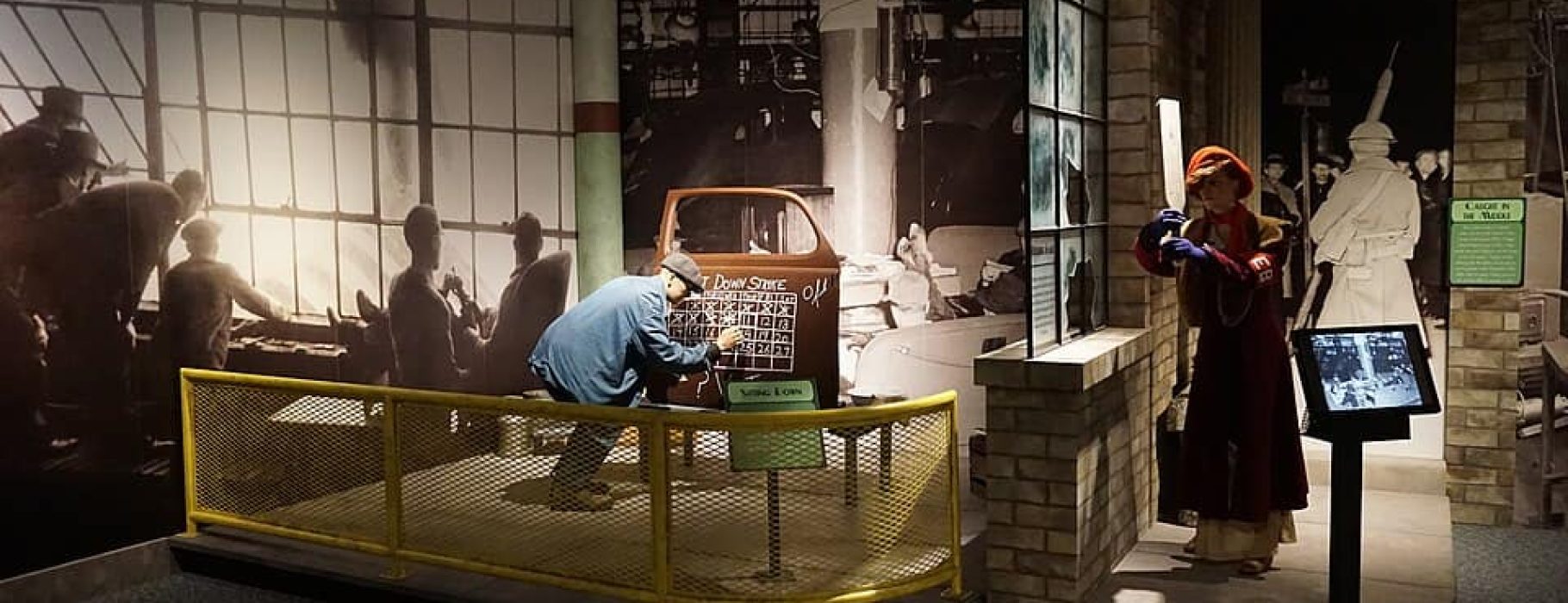
The dominant narrative today echoes the histories written by the first chroniclers of the CIO’s birth—that is, the functionaries of the CIO who wrote what we might call an “official” history. The first book-length version was written at the direction of the central leadership: 1937’s The CIO: What It Is and How It Came to Be.6Committee for Industrial Organization, The CIO: What It Is and How It Came to Be: A Brief History of the Committee for Industrial Organization (Washington, D.C., 1937). Those battling for worker politics independent of the Democrats are here erased entirely by those who feared and attacked them. The book polices a cordon sanitaire which will thereafter become standard, separating workers’ economic fights from politics. Workers, of course, leave politics to their betters. The CIO was shortly followed by Gaer’s 1944 The First Round: The Story of the CIO Political Action Committee. Gaer dedicates the book to the CIO’s executive committee. A New Deal bureaucrat later hired as a mid-level official in the CIO national office, Gaer narrates the dutiful march of the masses into the arms of the Democrats.
The documentary record of the 1930s resists this kind of capture. It contains traces of something else, like splinters or shards marking the locations of history’s sanitization. Contrary to the dominant tradition, the mass worker revolts were far from economic in any simple sense. Mike Davis gives a tantalizing hint when he points out that they were typically driven by demands for control of labor on the “shop-floor”—that is, a struggle over who gets to direct one’s labor—rather than a simple desire for better work conditions or representation.7Davis, “The Barren Marriage of American Labor and the Democratic Party,” 59, 60. The fight for autonomy at work, though, was only one dimension of this movement. The period is filled with new practices of self-organization, politicizing what it means to be a “worker” in the first place via new or reinvented institutions like worker-aimed lecture series, worker songbooks and poems, and—in workplace after workplace and town after town—a flood of newspapers.8In the words of the Millinery Workers’ paper, the point was to “serve as a clearinghouse for the expression of our sorrow and our joys, for the story of our day by day lives.” Elizabeth Fones-Wolf, “Industrial Unionism and Labor Movement Culture in Depression-Era Philadelphia,” The Pennsylvania Magazine of History and Biography, 109 (1985), 11. Also see studies like Nathan Godfried’s “Struggling Over Politics and Culture: Organized Labor and Radio Station WEVD during the 1930s,” Labor History 42(4), 2001, 347–69, https://doi.org/10.1080/00236560120085093; Lawrence W. Levine’s “The Folklore of Industrial Society: Popular Culture and its Audiences,” American Historical Review, 97 (1992), 1369–99, https://doi.org/10.1086/ahr/97.5.1369; and Colette A. Hyman’s Staging Strikes: Workers’ Theater and the American Labor Movement (Philadelphia: Temple University Press, 1997). Most were unregulated by any central bureaucracy; the labor bureaucracy would try to crush these in the coming years.9Kim Moody, An Injury to All: The Decline of American Unionism (New York: Verso, 1988), 47. Their content ranged from workplace agitation and coordination to gossip, including coded smirks aimed at bosses and emerging bureaucrats; from calendars of social events and advertisements for lectures on biology to calls for women’s caucuses—all conduits of rank-and-file mobilization.
In even more audacious experiments, many thousands of performances by hundreds of new worker-troupes flooded not just theaters but union halls, street corners, factory gates, and picket lines. The official history leaves almost all of these out of the picture; workers seem to have been mostly silent. But when workers began to speak in their own voices, they couldn’t stop. “More and more voices claimed attention….”10Margaret Beth Cherne, “Techniques for Changing the World: The League of Workers Theatres/New Theatre League” (PhD diss., University of Wisconsin, 2014) 16, available at https://minds.wisconsin.edu/handle/1793/69044. Cherne is here quoting the teacher of a Brookwood Labor College drama course in the late 1920s. Indeed, workers were not satisfied with acting; they experimented with collective writing and directing. And they produced hundreds of thousands of words of their own radical aesthetic theory. The slogans of this movement: “Each must be made a speaker and a fighter in the workers’ cause”; “WE MUST WRITE PLAYS.” This was “a threatre of the workers, by the workers, for the workers.”11“Ddecation,” Workers Theatre 1, no. 1 (April): 2, 17, 3, available at https://www.marxists.org/history/usa/pubs/workers-theatre/v1n01-apr-1931-Workers-Theatre-NYPL-mfilm.pdf Misspellings in original. As the authors of the dedication to the Workers Laboratory Theatre write: “In order to grow and develop these theatres need plays, and that means you workers, must write them. Do not be discouraged if you have never written before — playwriting may be learned just like any other trade. Once you master the tricks of the trade, everything is as easy as pie.”12“Ddecation,” 17.
In “It’s Funny as Hell” a group of angry workers—left waiting outside in silence —force their way into a meeting of corporate and church philanthropists. The do-gooders flee in fear. A worker takes over the stage to speak for himself:
McC.- If you don’t let the meeting continue, I’ll have you thrown out.
Jack- Not before I tell you what I have to say. …
Some in audience – Speach, speach!
Jack – I aint much of a speech maker, but I’d just like to tell you forks a story.13“It’s Funny as Hell,” Workers Theatre 1, no. 2 (May): a-5.
The play ends with a call for either revolution or, failing that, revenge. This irruption of a class voice and of revolution will be staged again and again. Stevedore (1934) ends with Black workers storming over barricades—after Binnie shoots down and kills a mob boss hired by a capitalist. She exults: “I got him! That red-headed son-of-a-bitch, I got him! I got him!”14Paul Peters and George Sklar, Stevedore: A Play in Three Acts (New York: Covici-Friede), 123. In 1938 the theater movement had been absorbed into the short-lived Federal Theatre Project. Yet many of the same radical dynamics are at play. Haiti: A Drama of the Black Napoleon stages and champions the successful slave-revolution, its self-articulation and its self-defense.15William Du Bois, Haiti: A Drama of the Black Napoleon (New York: Federal Art Project, 1938). It’s no coincidence that that same year, the new worker theater would be savagely attacked by both Democrats and Republicans.
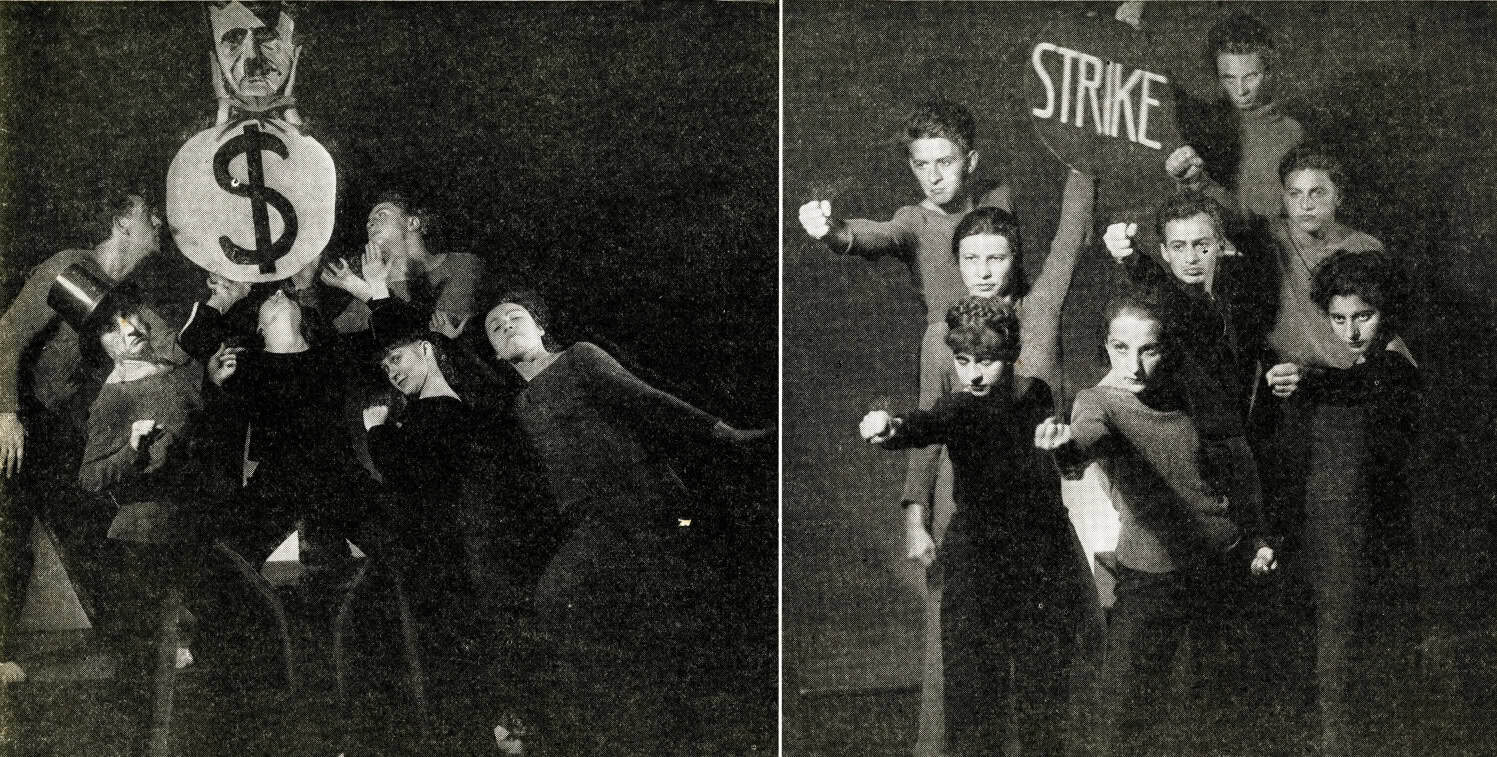
Photo Credit: Revolution Newstand
This is to say: the period was not just a series of strikes and new union formations. It was an emerging, spreading, inchoate hegemonic rupture, in which the working class spoke for and formed itself in new ways. To echo E. P. Thompson, we witness here a class remaking itself by growing new organs of self-awareness, expression, linkage, cohesion, and self-defense.
These organs had eminently practical roles. Creating unions, leading strikes, and defending gains required building common bonds and constant mobilization among workers from varied cultural, ethnic, racial, gender, and linguistic backgrounds.16Fones-Wolf, “Industrial Unionism and Labor Movement Culture,” 15–16. Yet they did more too. They often framed themselves as refusals of bosses’ ownership of the media or control of cultural venues. New unions and worker groups expropriated management’s schemes for worker well-being (sporting leagues and so on) to absorb them.17See Godfried, “Struggling Over Politics and Culture”; Levine, “The Folklore of Industrial Society.” We find here not just calls for union recognition or gentler exploitation, but challenges to who gets to control the worker’s labor and enjoyment, the quality and rhythm of her time, her forms of self-expression and self-formation. These calls question the class relation of domination itself. We should see the raucous fights for other political parties in this context: as one more dimension, and as conduit and “shell,” of the battles for self-organization in the class—what we might call, bastardizing Spinoza, various modes of the same substance.
Political Experiments
First, a glimpse at the scale: In the early 1930s, new worker-led political experiments blossomed in city after city.18To give some indication: in Cambridge, New Bedford, and Springfield, Massachusetts; Berlin and Lincoln, New Hampshire; Danbury and Hartford, Connecticut; Buffalo, New York as well as New York City; in Philadelphia and Scranton as well as Allentown, Pennsylvania; in Akron, Canton, and Toledo, Ohio; in Detroit, Hamtramck, and Port Huron, Michigan; in Chicago as well as Hillsboro, Illinois; in Sioux Falls, South Dakota, and in Everett and Goldbar Washington; in San Francisco, California; and beyond. Davin and Lynd, “Picket Line and Ballot Box,” 43. At least ten central labor unions endorsed the creation of a labor party by the mid-1930s.19Davin and Lynd, “Picket Line and Ballot Box,” 43. Even though Davin and Lynd, and others, see the party push largely dead by 1936, by that year labor parties had formed in twenty-six states, and were a “significant political force” in twenty. To take Akron, Ohio as an example, in 1936, “[m]ore than ninety Summit County organizations, including forty-two local unions and three central labor unions” supported and began to organize an independent Farmer-Labor Party. The effort wouldn’t be stomped out for decades.20Hugh T. Lovin, “The Fall of Farmer-Labor Parties, 1936-1938,” Pacific Northwest Quarterly, 62 (1), 16-17; John A. Tully, Labor in Akron, 1825-1945, 4, 2, 7. By that year’s AFL convention, eighteen different unions either submitted proposals for or endorsed some form of a workers’ party.21Davin and Lynd say thirteen. Davin and Lynd, “Picket Line and Ballot Box,” 43; Smith mentions fewer in the lead-up to the conference. A pamphlet from just after the convention cites this higher number. Given that the pamphlet was to be distributed to those who had attended, among others, it can likely be trusted. See “To Every Union Man and Friend of Labor,” in A Labor Party for the United States (The Social Economic Foundation, 1936), 7. By 1936 there were labor party conferences in Washington, DC; New York; and Chicago.22Davin and Lynd, “Picket Line and Ballot Box,” 44. See, too, Daily Worker: Central Organ Communist Party USA 13, no.85 (April 8, 1936), 1, 4, available at https://www.marxists.org/history/usa/pubs/dailyworker/1936/v13-n085-NY-apr-08-1936-DW-Q.pdf. Writes Tully: “The new class-based industrial unions” that would congeal into the CIO by the middle of the decade “only needed a small leap in consciousness for its members and supporters to see the need for complementary political organization.”23Tully, Labor in Akron, 241.
And the parties often put forth radical working-class demands. By 1935, the national movement called for nationalizing all banking, communication, and transportation firms; “militant opposition against wars in the interest of bankers and capitalists”; the right of immediate recall of any government official through popular vote; and free education, including college.24“The Principles for a Labor Party,” in A Labor Party for the United States (New York: The Social Economic Foundation, 1936), 50; “A Sample Platform,” in A Labor Party for the United States (New York: The Social Economic Foundation, 1936), 60-62; See also Lovin, “The Fall of Farmer-Labor Parties,” 16. It threw into the teeth of the AFL—which officially and unofficially had long espoused immigration quotas for “undesirable” countries in Latin America, Asia, and southern and eastern Europe; weaponized racism in the working class; and stoked race riots against Black workers—a program that demanded full racial integration of its movement as well as a struggle for “[e]qual pay for equal work, and equal rights for all regardless of race, color or sex” and “Brotherhood and co-operation with the workers of all nations.”25“A Sample Platform,” 61, 62. For examples of racism in the AFL, see Smith, Subterranean Fire, 34. (I’ll return to the crucial issue of race and racism, and its role in the fate of the party push, more fully below.)
The first period of this wave of political experiment spanned roughly 1929–33. The worker-led parties that popped up were largely local phenomena but spread like contagion. That contagion occurred against the backdrop of the nadir of the economic crisis, the downturn of work stoppages in 1929–30, and the slow recovery of both until 1932 or so. It also occurred amid the rise of organizations of the unemployed and their sometimes massive and disruptive actions. Clearly, worker parties emerged—spanning employed and unemployed alike—amid a sense of disgust or despair with the two main parties. It began to transform itself by 1934, apparently fueled by the recovering economic conditions, buoyed by a major increase in large militant strikes. The movement started to nationalize and congeal.26Kim Moody, “Worker Insurgency and the New Deal: The Inevitability of Hindsight,” Tempest, December 20, 2022, https://tempestmag.org/2022/12/worker-insurgency-and-the-new-deal/; Kim Moody, Breaking the Impasse: Electoral Politics, Mass Action, and the New Socialist Movement in the United States (Chicago: Haymarket Books, 2022), 119; Nelson Lichtenstein, State of the Union: A Century of American Labor, rev. and exp. ed. (Princeton: Princeton University Press), 24; Bureau of Labor Statistics, Work Stoppages Caused by Labor‑Management Disputes in 1945, Bulletin No. 878 (Washington, DC: U.S. Government Printing Office, 1946), 4–5, https://www.bls.gov/wsp/publications/annual-summaries/pdf/work-stoppages-1945.pdf.
Police and National Guard repression of worker organizing—under the watchful eye of Democrat and Republican mayors and governors alike—also helped drive this development. Examples abound: the police killing of communist party members in 1930 under New York’s mayor Jimmy Walker, leading to a march of fifty thousand in response; the 1932 police killings of communists in Detroit, led by Frank Murphy, in 1932, again summoning tens of thousands into the streets; the 1934 deployment of “over a dozen fully armed companies of the Ohio National Guard” by George White to suppress the Auto-Lite strike, “the largest peacetime deployment of troops in Ohio until the Kent State shooting of 1970.” They would fire indiscriminately into the crowd.27Michael Goldfield, “Worker Insurgency, Radical Organization, and New Deal Labor Legislation,” American Political Science Review 83, no. 4 (December 1989): 1270–71, https://doi.org/10.2307/1961668; David M. Savino, “How the Labor Movement and Labor Strife in Northwest Ohio in the 1930s shaped the structure of American Labor,” Journal of Economics and Politics 30, no.1 (2026), 8, https://doi.org/10.59604/1046-2309.1200. The developing political experiments became inseparable from a developing reflex of worker self-defense.
At this point, a key figure steps to the fore to help lead the political organizing, otherwise left out of almost every official account of the 1930s: Francis J. Gorman, vice president, and later president, of the United Textile Workers, part of the AFL.28Gorman figures in almost no histories of the 1930s. He is referenced by Davin and Lynd, and yet his fascinating writings and speeches on politics, history, and labor remain uncollected, scattered across archives in university libraries. See Eric Leif Davin, “The Very Last Hurrah,” 128. He said he was politicized by the brutality of the strike-breaking. Speaking at an artists’ congress called by the Communist Party: “We are beginning to discover in the trade-union movement that our trade unions, our economic organizations, are no longer sufficient protection for us. We cannot, indeed, even continue with our trade unions if we do not also band together in political unity.”29Cited in Davin, “The Very Last Hurrah,” 133. For the full speech, see Francis J. Gorman, “Artists and Trade Unions,” speech delivered at the First American Artists’ Congress, 1936, https://www.seekandspeak.com/2023/07/16/artists-trade-unions-by-francis-j-gorman/. In this he seems to be expressing an emerging “common sense.” Compare Gorman to Salvatore Camelio of the URW in 1936: “If [organized] labor is to survive, we must fight in the political field as well as the economic field.… We must take independent political action.”30Tully, Labor in Akron, 2.
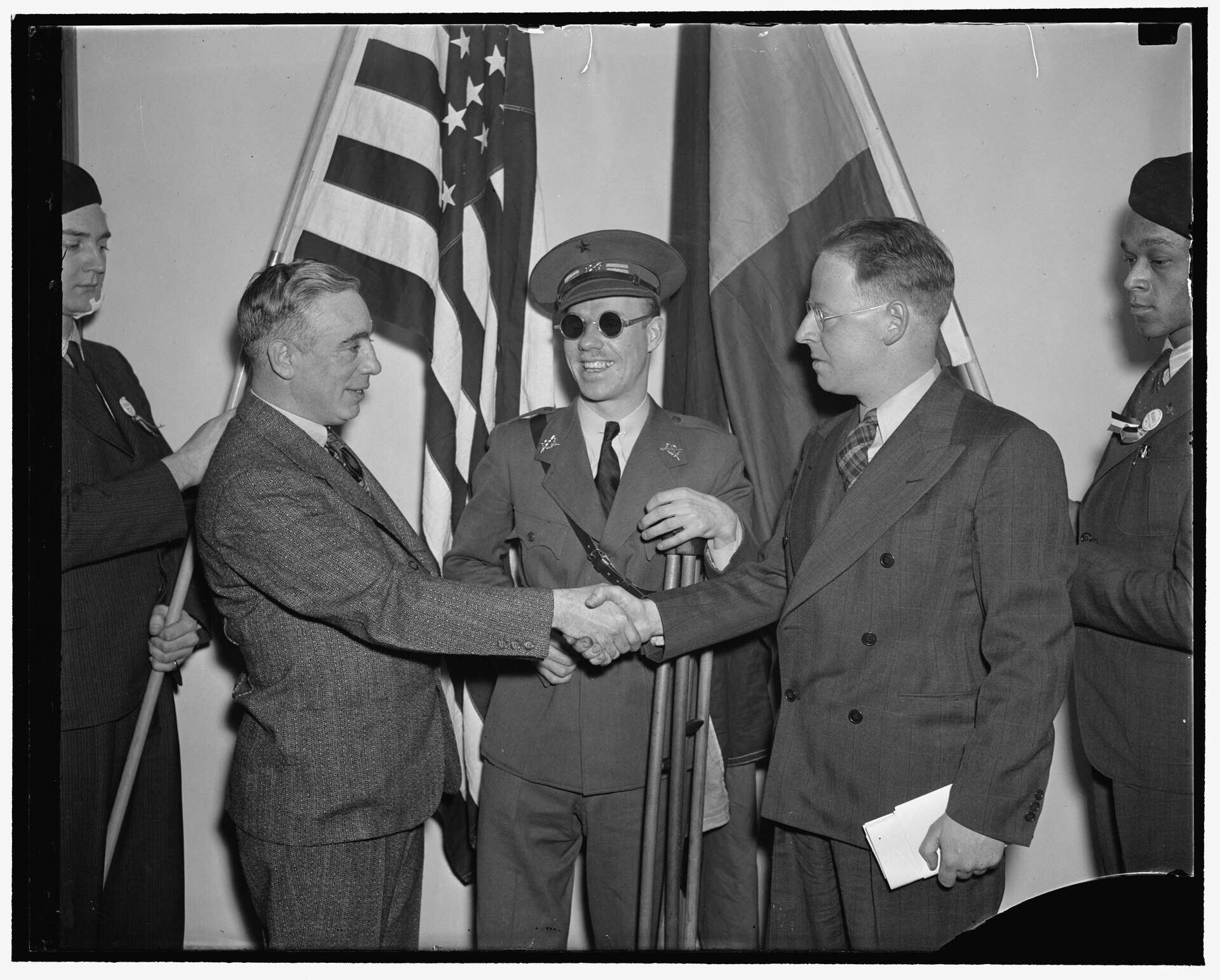
Photo Credit: Harris & Ewing via Wikimedia
For Gorman and his allies, even after the New Deal, the Democratic Party was no bulwark against the ruling class. Expanding strikes requires growing a political shell around the economic struggle to protect and advance it. The danger, he said, in the same speech I quoted earlier, is fascism. Gorman expressed a view becoming widespread in the movement. For example, The Microphone—a rank-and-file paper by electronics workers in Philadelphia—immediately followed its long article on the need for a labor party with a long installment on “social fascism.”31The Microphone: Voice of the Worker 2, no. 2, (May 1935):8–12; see also Fones-Wolf, 11. The violence against workers signaled an emerging threat of the kind of attack fascism brings. This logic will later be coopted and turned against the movement.
Experiments Congeal
By the time of the UAW’s founding convention in 1935, the AFL’s president (William Green) took the podium for an opening plenary. He devoted perhaps half an hour—several pages of the official minutes—to denouncing the political “experiments.” To the rank-and-filers sitting in the chairs, who had faced down the guns of police and National Guardsmen called by Democrats, this must have sounded rather odd. As Green exclaimed: “Don’t be misled by those who call upon you to follow some visionary program.… You cannot afford to experiment; you cannot afford to fail.… I urge you to forget a lot of things and to unite in a common cause, a common purpose…”32International Union, United Automobile Workers of America, Proceedings of the First Constitutional Convention of the International Union, United Automobile Workers of America, Detroit, Michigan, August 26-31, Inclusive, 1935, 19.
In October that year, Gorman led a prolabor party caucus in the AFL’s fifty-fifth convention. “‘Democracy,’” he began his speech,
means not “Democracy” for the workers, but the right of the financially mighty few to trample over the destitute majority. These Southern workers [in the land, that is, of the Southern Democrats] long schooled in the bitter traditions of slavery, have been taught, sometimes by death, that under the iron rule of the Kings of Southern Democracy there can be no justice for the workers.… We look with what now seems to us to be naïve faith to the proponents of a “New Deal” — believing, I guess, that it meant a New Deal for labor as well as a New Deal for industry. We have been sorely disappointed.33Francis J. Gorman, “Why a Labor Party? Address by Francis J. Gorman United Textile Workers of America before the 55th Convention of the American Federation of Labor,” in A Labor Party for the United States (New York: The Social Economic Foundation, 1936), 15, 16, 42.
His call for a new party nearly won the official endorsement of the AFL as a whole. It’s only narrowly defeated: largely, it seems, by bureaucratic maneuverings that delayed the resolution until just hours before the end of the convention.34The official vote: 104 for Gorman’s proposal (a number “including a majority of delegates representing central labor unions and state federations of labor”), and 108 against it. The resolution was one of thirteen on the labor party, but the only one to reach the floor. It’s true that the 108 votes against Gorman’s resolution represented more members of the AFL than the 104 for it. At the same time, the vote shows just how respectable, and pronounced, the idea of a national form of a new worker politics had become inside the worker movement. See Davin, “The Very Last Hurrah,” 131.
The splitting of labor into the AFL and the CIO in 1935 played a key role in weakening these political experiments.51Mike Davis, “The Barren Marriage,” 97. The AFL’s craft unionism emphasized maintaining the privileges of skilled workers. Its leaders had long chafed at the idea of organizing the masses of largely unskilled workers flooding into cities. Racism and xenophobia were inseparable from their stated and de facto policies, and played into the eventual break of the CIO away from the AFL. Though not without debate inside the federation, the AFL leadership—and especially Gompers—were championing national origin quotas on immigrants from Asia, Mexico, and Latin America by the first three decades of the twentieth century. These quotas were part of a strategy aimed to secure skilled workers’ economic position. By the same logic, AFL unions were de facto segregated.52Brecher, Strike! 61 Indeed, AFL local officials hounded an integrated union in the south for their racial policies and spurred members to attack a meeting; other officials stoked a race riot in St. Louis.53Robin D. G. Kelley, Hammer and Hoe: Alabama Communists During the Great Depression (Chapel Hill: University of North Carolina Press, 1990), 155; Smith, Subterranean Fire, 34. Gompers himself—a proud white supremacist—openly embraced “eugenicist principles of racial order,” and faithfully held to (in his own words) “the principle that the maintenance of the nation depended on the maintenance of racial purity and strength.”54Janice Fine and Daniel J. Tichenor, “A Movement Wrestling: American Labor’s Enduring Struggle with Immigration, 1866–2007,” Studies in American Political Development 23, no. 1 (2009): 94–96, https://doi.org/10.1017/S0898588X09000042; Smith, quoting Gompers’ autobiography, Subterranean Fire, 34. The CIO’s split from the AFL for a wider industrial unionism—embracing semi- and un-skilled workers in meatpacking plants and auto factories—meant adopting a kind of “race-blind” unionism that did not shy away from trying to organize Black workers (who formed major, and strategically placed, forces in those industries). However, in practice, the CIO’s recruitment of Black workers was often both uneven and contradictory and CIO leaders were very hesitant to focus explicitly on issues of race and racism.55Robert Zieger, The CIO: 1935-1955, 83–84.
The split meant a division, too, in the movement for a new worker politics. The national effort had congealed in the AFL; its leading tendency under Gorman called for labor internationalism and was explicitly antiracist and anti-imperial. Gorman, for example, demanded the creation of an international “brotherhood” of equality of all workers regardless of sex, race, and nationality.56For example: the movement for a labor party denounced colonial war as a necessary factor in the rise and maintenance of fascism. It saw the push for a new workers’ party as inseparable as a result from a championing of labor “brotherhood” across all borders on conditions of strict equality in defense. Francis Gorman, Alfons Goldschmidt, and Gaetano Salvemini, The Fate of Trade Unions under Fascism (New York: Anti-Fascist Literature Committee, 1937), 11; “A Sample Platform,” 62. In other words, the radicals behind the new party push were utilizing it, inside the AFL, as a rejection of the latter’s own profound limits. And yet the new CIO would take many of the most radical and sympathetic unions and organizers into a new organization. This exodus left the AFL relatively more homogenous in its nativism and conservatism and complicated coordination and development.
This split alone isn’t enough to explain the party push’s end. In Gorman and his allies, the movement for a new party had begun to precipitate a leadership body, cadres of organizers, local roots across dozens of cities, and means of communication and coordination. The bureaucracy of the fledgling CIO, it seems, played a more decisive role. The LNPL had created such confusion inside the rank-and-file and leadership of the new labor party push that, by 1938, both the CIO and UAW conventions barely mentioned a labor party. The Communist Party was decisive too. By the late 1930s, its leaders were closely following the dictates of the Soviet bureaucracy. And that bureaucracy was ordering the local leaders to hew close to Roosevelt and to the CIO bureaucrats who were supporting him. Later, when the CP had played its role, communists would be summarily purged from the CIO.57But there was another factor as well. The militants driving the movement for a new party were facing conditions without precedent. They were witnesses to the rise of a new phenomenon: a modern union bureaucracy coming into being in the United States, with all its bureaucratic trappings, snaring and taming militant struggle.
Here we must return our gaze to the field of struggle, the 1936–37 Flint sit-down strikes—a major victory, as the main tradition of history would have it, but now appearing in more ambiguous light. The sit-downs were the high-water mark of radical worker struggle of the 1930s, as strikes spiked sharply to their highest number of the decade, only to collapse amid a sharp fall in industrial production around mid-1937.58BLS, “Work Stoppages,” 4, 5.
The sit-down strikes were, by far, the most audacious experiment of the working class experimentation with self-organizing in the 1930s. They first appeared in Akron in 1934; seizing auto plants, workers essentially (if temporarily) ruptured the relation between management and labor. 59Daniel Nelson, American Rubber Workers and Organized Labor, 1900-1941 (Princeton: Princeton University Press, 1988), 139, https://doi.org/10.1515/9781400859450. This is the fuller development of the whirlpool of projects of self-organization that began to form in the early 1930s in the flood of newspapers, poetry, strikes, and theater performances.60See, for instance, Collette Hyman, Staging Strikes. After Flint, such sit-downs would surge briefly, before rapidly declining.61US Department of Labor, Division of Industrial Relations (May 1939), “Analysis of Strikes in 1938,” Monthly Labor Review. The NLRB, a crowning jewel of the new deal for workers, ruled them illegal. Why did they flame out, however, as quickly as they did?
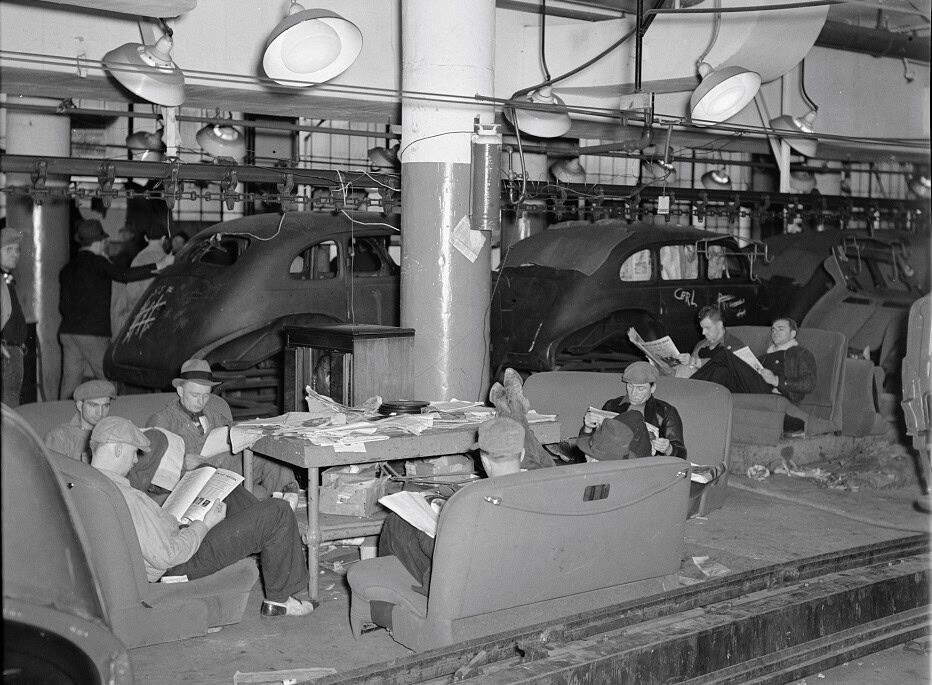
Photo Credit: Sheldon Dick via Wikimedia.
By 1937, as the economic situation began a rapid decline, Roosevelt, the champion of workers, had already begun to turn his back on the union movement; he called “a plague on both your houses”—that is, on both labor and management—that year.62Tully, Labor in Akron, 7; see also Eric Blanc, “Revisiting the Wagner Act & its Causes,” Labor Politics (Substack), July 28, 2022, https://www.laborpolitics.com/p/revisiting-the-wagner-act-and-its. It’s not hard to see the rationale behind Roosevelt’s turn, nor how disorienting it was to the labor movement. First, he was facing down the radical and qualitatively new disruption of the Flint sit-down strikes that the Wagner Act had aimed to tamp down. The economic situation stagnated, putting economic recovery in danger with the threat of a new war looming in the background. Second, all of the major unions backed his reelection. The danger to Roosevelt was passing, not just because he’d been reelected; union leaders had also shown they could marshal unions away from political independence. We discover here the material basis of what would become the official history’s cordon sanitaire: the division between workers’ economic struggle and politics, which was to be placed safely in Democrats’ hands—a cordon enforced violently and from above.
That separation—workers here, politicians there—played a central role in the period. The sit-downs meant that the struggle for self-organization entered a qualitatively new mode. And yet these projects in worker politics had already begun to be dismantled. The new radical tactic became isolated, lacking a means of transmitting and sustaining itself to other union locals in the face of its repression by bosses, bureaucrats, and Roosevelt.
Here, in the violence of the top-down attack on a new worker politics, one aspect of the movement—perhaps above all the others—pressed forward. The push for a worker party was far more than a mere political movement. It was a means of transmitting ideas about the necessity for militant struggle by stressing political independence as a means of cohering radical economic struggle, finding some of its most eloquent expressions in Gorman’s writings and speeches.63Gorman, “Why a Labor Party?” 14–47. Via the party push, workers developed their own press, conferences, and other networks of communicating and organizing. The linkage was on full display in the URW, where national and local labor leaders were uniting by 1936 against an extremely strong rank and file. Akron’s rubber workers virtually invented the sit-down strike in 1934; the “anarchic” wildcats were to be stopped from above. But the fight at the URW national convention in 1936 was one against both the wildcats and the labor party push. The battle pitted militant rank and filers, championing the sit-down and the new party on the left against a right led by labor leaders and their more conservative supporters. The defeat there required sophisticated bureaucratic maneuverings—not just red-baiting, but the constant silencing of those trying to speak through procedural rules.64Tully, Labor in Akron 6–8. This silence, too, would find its afterlife in official history.