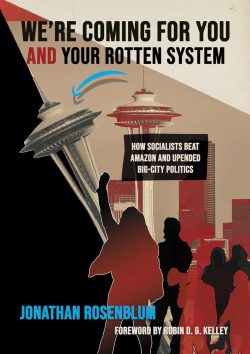
Whatever criticisms you have, there is no doubt that We’re Coming for You and Your Rotten System—Jonathan Rosenblum’s account of Kshama Sawant’s ten years as a socialist city council member in Seattle—is worthy of serious consideration. Rosenblum was directly involved in this long struggle and, understandably, offers a highly positive and often inspiring account. He also sets out the underlying strategies and draws up a balance sheet of the entire undertaking.
Rosenblum provides a bold characterization of the decade-long intervention in the camp of the enemy at Seattle City Hall. He writes of a “socialist political earthquake that struck Seattle in 2013.”1Jonathan Rosenblum, We’re Coming for You and Your Rotten System: How Socialists Beat Amazon and Upended Big City Politics (New York: O/R Books, 2025), https://orbooks.com/catalog/we-re-coming-for-you-and-your-rotten-system/, 1. Through three hotly contested re-election campaigns, against the combined forces of big-business and the Democratic Party establishment” Rosenblum tells us, this intervention empowered and facilitated social mobilizations that “won a $15 minimum wage, bans on evictions, limits on rent increases, and breakthrough renters’ rights protections,” among other victories.2Rosenblum, We’re Coming for You and Your Rotten System, 4.
The intervention was undertaken by “Socialist Alternative…according to a perspective that was based on ‘a complete rejection of capitalism and for working-class struggle to build socialist democracies worldwide.”3Rosenblum, We’re Coming for You and Your Rotten System, 8. Advancing strong demands that spoke to the grievances of working-class people, Sawant was able to secure a place on the Council.
This political upset created, in Rosenblum’s view, a situation where “the looming problem for the political establishment wasn’t one socialist council member. It was the growing movement of workers and students who, having sent their demand for change reverberating through City Hall, weren’t about to stop.”
In a similar spirit, pointing to the ways in which Sawant drew upon and helped to unleash community anger to make major gains in the fight for a fifteen-dollar-an-hour minimum wage, the book notes that “what Sawant and Socialist Alternative had accomplished in Seattle was a lot more than a wage hike. They had introduced a new theory of political insurgency, successfully breaking through the inertia and resistance of the political establishment.”4Rosenblum, We’re Coming for You and Your Rotten System, 33.
This claim can’t be dismissed as bluster. Though the forces arrayed against the movement were able to ensure major loopholes in the measure, “the first major US city to approve a $15/hour minimum wage would raise pay for 100,000 workers, transferring an estimated $3 billion in wealth from businesses to workers over a decade.”5Rosenblum, We’re Coming for You and Your Rotten System, 30.
Rosenblum stresses that the “political insurgency” in Seattle that he is detailing was rooted in the lessons of past working-class movements. He describes an electoral strategy that is subordinated to the needs of the class struggle and the fight for socialism. He references Alexei Badayev’s The Bolsheviks in the Tsarist Duma and quotes Lenin’s call for the Bolshevik deputies elected to that body to use it for “for agitation to help develop the revolutionary movement by exposing both the Tsarist government and hypocrisy of the so-called liberal parties.”6Rosenblum, We’re Coming for You and Your Rotten System, 58.
Sawant and the Bolshevik deputies were obviously operating under substantially different circumstances. Most strikingly, those working inside the Duma were directly answerable to mass movements and a deeply rooted revolutionary party. As I shall argue, Sawant’s situation was far more challenging when it came to creating an electoral initiative that served, rather than shaped, working-class struggles.
Guiding Principles
Rosenblum identifies “three pillars of Marxist insurgent politics that distinguish Sawant’s movement from other contemporary socialist and progressive political movements: a class struggle approach, bold movement building demands, and movement democracy.”7Rosenblum, We’re Coming for You and Your Rotten System, 58.
We are told that “(t)he first pillar, a class struggle approach, is born out of an understanding that the state is a hostile force that must be confronted by organized working-class power.”8Rosenblum, We’re Coming for You and Your Rotten System, 58. Rosenblum argues, with significant justification, that a mistaken view of this matter has undermined many progressive campaigns and political interventions in the United States, including those that hinged on electoral activity.