
This essay is part of an ongoing discussion concerning the relationship between Trumpism and fascism within the pages of this journal. For the other entries in this discussion, see Todd Gordon and Jefferey R. Webber’s “The Authoritarian Disposition: Capitalism, Liberalism, Fascism,” D. K Renton’s “Trump, Fascism, and the Authoritarian Turn,” and Gordon and Webber’s “Water on the Brain: Trump 2.0 and the Crisis of Liberal Rule,” Justin Reed’s “Fascism, Trump, and Trumpism: A Critique of Gordon and Webber’s Analysis of Trumpism.” and D. K Renton’s “Fascism Without a Mass Movement?”
I want to thank Todd Gordon and Jeff Webber for launching this discussion on what is, in my opinion, a very solid foundation. I agree with them on at least two key points. First, the current Trump administration (Trump 2.0) is not fascism. I would add that fascism is not an immediate, short term, or probably even medium term threat in the United States. In the current situation, Trump’s brand of authoritarianism provides a better basis than fascism for a broad ruling class alliance, defending both capitalist interests as a whole and the specific program of the far right.
I also agree with Gordon and Webber that we face a deepening threat of liberal authoritarianism. However, they seem to treat Trump 2.0 as a specific manifestation of liberal authoritarianism—that is, as a “gradual degradation of liberal democratic forms of rule characteristic of competitive authoritarianism.”1Todd Gordon and Jeffery R. Webber, “Water on the Brain: Trump 2.0 and the Crisis of Liberal Rule,” Spectre, June 24, 2025, https://doi.org/10.63478/XT55M7G4. That characterization, I think, underestimates Trumpism’s distinctiveness and its danger. Moreover, it underestimates the distinctiveness of the strategy and tactics needed to fight it.
Gordon and Webber’s category of liberal authoritarianism seems to cover a wide range of contemporary phenomena. It covers the authoritarian shifts under supposedly liberal administrations like Joe Biden’s from 2021 to 2025: suppressing the railway workers’ strike, deportations and other accelerating attacks on immigrants, and far-reaching military action (like backing Israeli genocide in Gaza) taken under exclusive presidential authority. It can also cover sharper moves toward authoritarian rule like those under Trump’s first administration from 2017 to 2021, which could be viewed as a coalition between the Trumpite far right and more neoconservative Republicans. Trump 1.0 could be called postfascist, by analogy with coalition governments between the far right and traditional right in some European countries (Sweden today and the Netherlands in 2024–25). These postfascist regimes have, in fact, followed a more “liberal authoritarian” course.2Peter Drucker, “Far-right Antisemitism and Heteronationalism: Building Jewish and Queer Resistance,” Historical Materialism, no. 32 (2024), https://doi.org/10.1163/1569206x-bja10045, available at https://www.historicalmaterialism.org/article/far-right-antisemitism-and-heteronationalism/.
Yet Gordon and Webber stretch the category of “liberal authoritarianism” or “competitive authoritarianism’” even further (citing Steven Levitsky and Lucan A. Way) to cover Trumpism’s second run in power since 2025. They anticipate under Trump a “more gradual degradation of liberal democratic forms of rule characteristic of competitive authoritarianism.”3Gordon and Webber, “Water on the Brain.”
This extends the category of liberal authoritarianism beyond its true usefulness. Trumpism today—together with a wide range of regimes around the world such as Orbán in Hungary, Erdoğan in Turkey, Modi in India, and Milei in Argentina—poses a specific, relatively stable threat. It is not fascist in the strict sense, but neither is it truly “liberal authoritarian.” It preserves the outward forms of bourgeois democracy, while steadily emptying them of substance. This degradation is not gradual, but rapid. In this sense, at the risk of confusing them with full fledged fascism, Trump’s regime and its counterparts in other countries can reasonably be grouped together as “neofascist.” And fighting neofascism is an urgent priority that requires specific tactics, distinct from both those needed against fully fascist regimes and those needed to resist creeping liberal authoritarianism.
Why Not Fascism?
I agree with Gordon and Webber that as “long as there is capitalism…the fascist threat remains alive.”4Todd Gordon and Jeffery R. Webber, “The Authoritarian Disposition: Capitalism, Liberalism, Fascism,” Spectre, No. 8 (2023), http://doi.org/10.63478/RPBJ9W3D. But as they say in their 2023 article, fascism only actually manifests itself fully in “a severe and sustained crisis of capitalism,” with the rise of a mass movement of the radicalized petty bourgeoisie.5Gordon and Webber, “The Authoritarian Disposition.” Once in power, as Trotsky explained in 1932, fascism “directly and immediately gathers into its hands…the executive administrative, and educational powers of the state: the entire state apparatus together with the army, the municipalities, the universities, the schools, the press, the trade unions, and the co-operatives…[and] the workers’ organizations are annihilated.”6Leon Trotsky, What Next? Vital Question for the German Proletariat (New York: Pioneer Publishers, 1932), available at https://www.marxists.org/archive/trotsky/germany/1932-ger/index.htm.
I agree with Gordon and Webber’s statement in their 2023 article that there is always “an authoritarian disposition at the core of capitalism.” This authoritarian disposition has indeed grown more pronounced since the outbreak of the 2008 financial crisis, even under “liberal” governments. It does not follow, however, that the Trump administrations—and especially Trump 2.0 since 2025—is simply a manifestation of this “liberal authoritarianism.”
As against DK Renton, I agree with Gordon and Webber that no such movement is in power today: “Fascists have not captured state power anywhere in the world, and nor are they likely to do so in the immediate future.”7Gordon and Webber, “The Authoritarian Disposition.” More specifically under Trump 2.0, as Gordon and Webber explain in their more recent 2025 article, while Trump’s Republicans “rig the game by deploying the machinery of government to attack opponents and co-opt critics,” “there is no fundamental rupture with American constitutionalism.”8Gordon and Webber, “Water on the Brain.” Moreover, “fascist street movements do not [even] pose an immediate threat to our side’s existence—to our very lives—which was the situation faced by antifascists in the interwar period.”9Gordon and Webber, “Water on the Brain.” Far right mobilizations (like the one in Charlottesville in 2021) contribute to radicalizing the right in power and serve to intimidate movements and the left, so countermobilization is vital. But today’s far right mobilizations do not completely or directly take over and transform the state.
There are good reasons why, outside times of intense crisis, capitalist ruling classes generally prefer to rule through constitutional states and regimes in which different procapitalist forces and even sometimes the anticapitalist left have leeway to organize and compete. This reflects Marx and Engels’ assertion in the Communist Manifesto that the “executive of the modern state is but a committee for managing the common affairs of the whole bourgeoisie.”10Karl Marx and Friedrich Engels, “The Communist Manifesto,” in Marx/Engels Selected Works Vol. One (Progress Publishers: Moscow, 1969), available at https://www.marxists.org/archive/marx/works/1848/communist-manifesto/ch01.htm. This means that, besides ensuring the conditions of capital accumulation and defending capitalism against working class threats, the capitalist state has to manage and resolve contradictions and conflicts between different components of the capitalist power bloc (to use Nicos Poulantzas’s term).11Nicos Poulantzas, State, Power, Socialism (London: New Left Books, 1978). Fascism—whose violence, repression, and terror are particularly effective in warding off revolutionary threats in times of crisis—is particularly ineffective at managing intercapitalist contradictions due to the built in rigidity of autocratic, single leader rule.
I agree with Gordon and Webber’s statement in their 2023 article that there is always “an authoritarian disposition at the core of capitalism.”12Gordon and Webber, “The Authoritarian Disposition.” This authoritarian disposition has indeed grown more pronounced since the outbreak of the 2008 financial crisis, even under “liberal” governments. It does not follow, however, that the Trump administrations—and especially Trump 2.0 since 2025—is simply a manifestation of this “liberal authoritarianism.”
In the absence of any major revolutionary threat, neofascism is both more effective than fascism in holding the capitalist power bloc together and quite effective (unfortunately) in repressing labor and the left. Capital also does not welcome the political disenfranchisement that fullblown fascism would entail. This makes neofascism a lastingly preferable option for the capitalist class in times like these, when it badly needs tools to reconfigure its power bloc and manage its internal divisions, but does not much need tools to coopt or outflank powerful, progressive mass movements.
Nationalism, Racism, Transphobia, Antisemitism
Neofascism is also proving effective (so far) in carrying out a transition away from the “hyper-globalization” (to use Dani Rodrik’s term) that prevailed from the mid 1990s to the beginning of the twenty-first century under the supremacy of multinational corporations and banks and the international financial institutions (IMF, World Bank, WTO).13Dani Rodrik, The Globalization Paradox: Democracy and the Future of the World Economy (New York and London: W.W. Norton, 2011). oday the far right (and not only the far right) is consolidating a shift toward more protectionist and nationalist economic policies, reflecting the interests of different fractions of capital. Yet it is stopping short of the more autarchic policies typical of pre-World War II fascism.
There is an ideological affinity between the economic nationalism of neofascist regimes and the racism that, as Enzo Traverso has pointed out, centrally characterizes the far right. This includes both the anti-Black, anti-Latino and anti-Asian racism dominant in the United States for centuries and an anti-Muslim racism with deep roots in European “civilization.” In a relatively new, culturalized permutation of racism in today’s neofascism, “fear of multiculturalism and hybridity… brings up to date the old anxiety about ‘blood mixing.’”14Enzo Traverso, The New Faces of Fascism: Populism and the Far Right (London: Verso, 2019), 69. This is distinct from the biological racism of classical fascism. At the same time, through far reaching purges of racialized people from the state apparatus and rollbacks of decades long, though limited policies of “diversity and inclusion,” it goes well beyond the “dog whistle racism” of the Republican right in the Nixon, Reagan, and Bush eras.
At the same time, neofascism is strikingly and unprecedentedly active on the terrains of gender and sexuality. The attack on trans people that features prominently on the far right agenda—both under Trump and in many countries across several continents—confirms the far right’s sense of itself as the defender of men’s and women’s “natural” identities and roles. The far right’s “femonationalism” also purports (unlike classical fascism) to enlist the cause of women’s rights in the fight against allegedly patriarchal Muslim, Black, and Latino men, while serving the interests of capital by incorporating the cheap reproductive labor of immigrant and racialized women into the waged workforce.15See Sara Farris, In the Name of Women’s Rights: The Rise of Femonationalism (Durham: Duke University Press, 2017), https://doi.org/10.1215/9780822372929. Yet the Trumpite crusade against feminism goes much further than the Republican right went in past decades.
The neofascist assault on trans rights often coexists (in the United States and other imperialist countries) with forms of “homonationalism,” which instrumentalize gay rights in global Islamophobic crusades.16The original and classic study of homonationalism is Jasbir Puar, Terrorist Assemblages: Homonationalism in Queer Times (Durham: Duke University Press, 2007). This has enabled Trump’s Republican Party to reconcile itself to same sex marriage, to the point that Republican votes in Congress have ensured the preservation of same sex marriage rights at the federal level even in the event that they are struck down at the state level. This is another striking divergence from classical fascism. The presence of right wing gay men like Richard Grenell and Scott Bessent in the Trump administration’s top ranks epitomizes this shift on the far right. At the same time, the no holds barred attacks on trans people constitute a break with policies of Republican and Democratic administrations since the 1990s.
…in the current relationship of forces, fascism is not the main danger in the United States. The main danger is the intensification of the hollowing out of bourgeois democracy that characterizes neofascism. The steps Trump has taken so far in his second term have mimicked (sometimes consciously) the measures taken by longer established neofascist regimes (notably those taken over the sixteen years by Orbán’s).
As Gordon and Webber note in their 2023 article, “The renewed strength of the far right… poses a very serious and immediate threat to queer and trans communities, Muslims, immigrants, and the Left, all of whom have been on the receiving end of their violent rage.”17Gordon and Webber, “The Authoritarian Disposition.” Marxist feminist analyses of capitalist social reproduction can help explain why the far right today, despite its abandonment of classical fascist dogmas, still viciously attacks trans people and champions gender essentialism and why antisemitism remains widespread among neofascists, though often in conjunction with Zionism. “In very different ways, Jews and LGBTQI people play distinctive roles in the mutating social reproduction of contemporary capitalist societies: Jews disproportionately in cultural and ideological sectors, and LGBTQI people in shifts from “biological” to market-oriented families.”18Drucker, “Far-right Antisemitism and Heteronationalism.” This makes LGBTQI people and Jews abiding targets of the far right.
It is true that not just the far right, but liberal authoritarianism too, poses a threat to racialized communities, labor, progressive movements, and the left. But neofascism poses a qualitatively greater threat. This threat needs to be understood and fought.
Growing Neofascist Dangers
While I agree with Gordon and Webber that fascism remains a threat if working class challenges greatly increase, in the current relationship of forces, fascism is not the main danger in the United States. The main danger is the intensification of the hollowing out of bourgeois democracy that characterizes neofascism. The steps Trump has taken so far in his second term have mimicked (sometimes consciously) the measures taken by longer established neofascist regimes (notably those taken over the sixteen years by Orbán’s). In this sense I largely agree with Justin Reed’s conclusion that Trump 2.0 has shown an “overarching neofascist trajectory.”19Justin Reed, “Fascism, Trump, and Trumpism: A Critique of Gordon and Webber’s Analysis of Trumpism,” Spectre, March 6, 2026, https://doi.org/10.63478/WYICINFC.
For example, Trump has swept away many of the restraints that the courts could impose on his often blatantly unconstitutional acts by appointing right wing Republican and, in some cases, neofascist judges. Justice Ketanji Brown Jackson summed up the trend of recent Supreme Court decisions in one of her dissents. There are only two rules: “There are no fixed rules… and this administration always wins.”20National Institutes of Health v. American Public Health Association, 606 U. S. 17 (2026), https://www.supremecourt.gov/opinions/24pdf/25a103_kh7p.pdf; Madiba K. Dennie, “Ketanji Brown Jackson Stops Just Short of Saying the Supreme Court is Breathtakingly Full of Shit,” Balls and Strikes, August 22, 2025), https://ballsandstrikes.org/scotus/nih-cuts-ketanji-brown-jackson-calvinball/. Through the theory of the “unitary executive” (dating back to the Reagan years, as Gordon and Webber point out), Trump has been able to install his puppets and impose his will on one executive agency after another, while largely bypassing Congress.
This means that even Democratic majorities in one or both houses of Congress after 2026 would probably be ineffective in restraining the neofascist presidency, although Democrats mostly fail to acknowledge this reality. Thanks to the Supreme Court, Trump’s fiat is largely the legal status quo. Undoing it would require an act of Congress—and because Trump would presumably veto any such act, it would have to pass both houses of Congress by a two thirds majority. As long as a solid 35 to 40 percent of the US electorate is in the neofascist column, this is a virtual political impossibility.
This makes the 2028 presidential election crucial—and the extent to which the neofascist regime is consolidated by 2028 can be decisive in determining its outcome. There are analogies here with sharp reactionary turns around presidential elections in past US history. George H.W. Bush’s installation as president in 2021 was due to a 5-4 Supreme Court majority, in a period when mass movements were at a relatively low ebb and had little impact on the outcome of that disputed election. Even more under Trump 2.0, court rulings are visibly important in shaping electoral results. So Trump’s success in installing reliably neofascist (as opposed to merely conservative Republican) judges will matter. And the stakes in 2028–29 will be higher than they were in 2000–01. To give a sense of an equivalent level of danger, one may need to look back to the disputed election of 1876–77, whose “compromise” resolution by a congressional committee ended Reconstruction and ushered in over a half century of reaction.
Control of the media will also matter in 2028. Trump has already taken several pages from Orbán’s and Erdoğan’s books by swinging formerly oppositional media like the Washington Post and Los Angeles Times more or less to his side. Big tech’s Trumpward swing is even more important, since it means that social media are largely neutralized, if not eliminated, as a restraint. But Trump can do more. Short of banning or buying the New York Times and similar critical media, the administration (again imitating neofascist regimes elsewhere) can work to cut off their advertising revenues and deny their access to sources.
Neofascist attacks on the academic left could also go beyond what Trump has already done. For example, Orbán’s purge of Central European University has been replicated by Ron DeSantis at New College of Florida. This could be repeated elsewhere. Given the disproportionate role of academics on the US left, this could wreak havoc among radicals.
These are potential threats not only to Trump’s ruling class rivals, but also to the left. The defeat of Orbán’s Fidesz party in the April 12 Hungarian elections, despite its gerrymandering and media dominance, could help convince Trump that he needs to resort to more drastic, illegal means to ensure Republican victories in the United States over the next couple of years.
Hybrid United Front Tactics
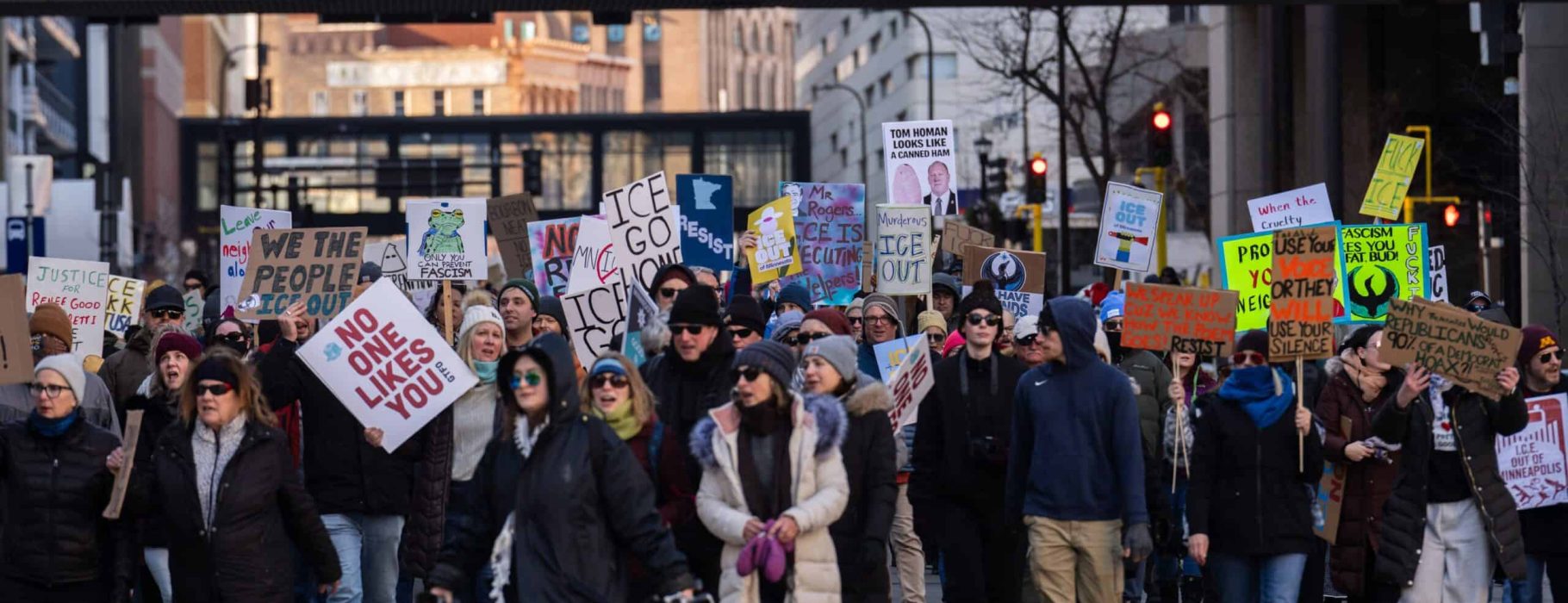
I assume that everyone in this Spectre discussion agrees that grassroots, extraparliamentary movements are essential to defeating Trumpism. This obviously includes the massive No Kings demonstrations. It obviously includes the battles against ICE attacks on immigrants, with Minneapolis as a shining example. And grassroots mobilizations need to go much further. They need to link up more with the fight against ant-Black, anti-Latinx, anti-Indigenous and anti-Asian racism in all their forms. And labor opposition to Trump, which has so far been uneven and inconsistent, needs to be much broader and more militant, in conjunction with everyday working class fights against attacks by capital on workers’ living standards and rights.
Anticapitalist electoral tactics against neofascism therefore need to obey two imperatives: the immediate need to defeat neofascism electorally, and the need to build a strong, mass, anticapitalist political force that can defeat neofascism lastingly. Neither imperative can be sacrificed to the other.
I agree with Gordon and Webber that, unlike fascism, neofascism should not be fought simply with direct confrontation on the streets. But it also can’t be defeated by primarily electoral means. This is because the power neofascism has accumulated in the state apparatus (courts, ICE, and so on) create a serious danger that it could falsify or neutralize election results through a whole range of measures—as has been done in, for example, Erdoğan’s Turkey. So hybrid tactics are needed, combining tactical flexibility around elections with mass mobilizations, militant direct action, and strikes. Otherwise, as events in other countries have shown, opposition electoral victories can be effectively nullified behind the scenes. Mobilization and direct action are needed before, on, and after election day.
At the same time, the radical left cannot afford to surrender the domain of politics narrowly defined—the realm of the state—to the competing forces of the far right and the neoliberal center. Although it is the broader societal relationship of forces that determines whether neofascism wins or loses power, its immediate victory or defeat are generally manifested today through elections. So it has to be defeated electorally. Given the weakness of the anticapitalist left, this means the left needs some degree of unity with forces with reformist illusions, not just at specific moments, but for a whole period. Because as long as an anti-neofascist movement doesn’t develop into an anticapitalist movement, neofascism can survive defeats, preserve bulwarks in the state (as we see today in Tusk’s Poland, Magyar’s Hungary and Lula’s Brazil), retain its mass base, and potentially return to power in a couple of years. This danger is all the greater when left wing voters massively desert the left for a right wing “lesser evil,” as they just did in Hungary.
The anti-neofascist left therefore needs to have sophisticated electoral tactics without electoralist illusions. In the long and even middle run, only anticapitalist breakthroughs can lastingly defeat the far right. Experience has shown repeatedly (most recently in the United States with Biden) that the policies followed by the electorally victorious neoliberal center(-left) quickly fuel the bitterness and rage that lead too many voters to back neofascism. While “it would make more sense for voters to blame capitalism for their troubles than Muslims [or racialized people], [t]he weakness of labor and other social movements, and therefore of a left alternative to neoliberalism, is one more central factor behind the rise of the far right.”21Peter Drucker, “Europe’s political turmoil (Part I),” Against the Current, No. 197 (2018), https://againstthecurrent.org/atc197/europes-political-turmoil/.
Anticapitalist electoral tactics against neofascism therefore need to obey two imperatives: the immediate need to defeat neofascism electorally, and the need to build a strong, mass, anticapitalist political force that can defeat neofascism lastingly. Neither imperative can be sacrificed to the other. If a strong anticapitalist politics is not built, short term victories over neofascism will be in vain. If neofascism consolidates its strength on the terrain of the state, the already daunting task of building an anticapitalist political force will become even harder, even if there are strong mass social upsurges.
The anticapitalist left needs to find ways to combine these two imperatives in each country, depending on the vagaries of each country’s political system. In the United States, the left needs to take account— and, where possible, advantage—of major antidemocratic features of the US state, such as the electoral college in presidential elections and “first past the post” elections in legislative races. In general, these features buttress the capitalist political order. But they offer the independent left the option of backing non-neofascists in the roughly dozen swing states that are decisive in presidential elections, while running independent anticapitalist campaigns elsewhere. Independent left campaigns are called for in big cities where Republicans are often politically negligible.22 Kim Moody, Breaking the Impasse: Electoral Politics, Mass Action, and the New Socialist Movement in the United States (Chicago: Haymarket, 2022). They are possible even in right wing dominated regions in areas where African Americans, Latinxs, Indigenous people, and other specially oppressed people are both concentrated and attracted to radical left programs.
To be clear: I have stuck for decades to the anti-Stalinist revolutionary left’s position that support for Democratic candidates so seriously undermines the independence of labor and other progressive movements that it must be ruled out. That argument is still as strong and valid as ever in any election where a Democrat (even a “progressive” or a “democratic socialist”) faces a moderate, conservative or traditional hard right Republican. Where the survival or intensification of a neofascist regime is at stake, however, the situation changes.
In that case the survival of the left can require a vote for the anti-neofascist candidate, even if and when —as will unfortunately very often be the case—this means supporting a Democrat. But even when a neofascist Republican looks reasonably sure of winning in a particular state or district—or reasonably sure of losing—the radical left is better off helping to build an independent progressive political force. Only when the race looks close should the radical left support an anti-neofascist Democrat.
This does not mean that the neofascist threat can be averted just by denying neofascism a majority at the polls. As early as January 2021, Trump and his forces made clear that they were prepared to overturn a democratic electoral result by all available means. The means at their disposal have increased manyfold since then. All sorts of postelectoral scenarios are conceivable in 2026–27 and 2028–29. It could be fatal to rely entirely on state election officials and the courts to ensure respect for a democratic outcome. The repeated mobilizations of millions of people in the No Kings demonstrations show that the base for mass resistance to skullduggery is there, possibly going beyond peaceful marches if necessary.
It is clear by now that the struggle against neofascism will be key for the anticapitalist left during this whole historical period. Only carefully crafted strategy and tactics, both flexible and radical, can enable us to survive this period and emerge from it victorious.