
Feminist Struggles for Life
The Imperial War on Iran, the Matrix of Oppression, and the Question of Solidarity
September 18, 2026
The scene unfolds with a Native American man looking to the sky. A child amid Hiroshima’s smoldering ruins, a Vietnamese farmer in Napalm-scorched lands, a Yemeni man in front of destroyed homes all lift their eyes upwards. They trace the launch of an Iranian missile as it targets the Statue of Liberty. But the statue no longer looks like Lady Liberty and instead bears the head of Baal, the Canaanite deity synonymous with corruption and conspiracy. Etched into the sides of the missile is a promise to the children of Gaza, Hiroshima, Nagasaki, Epstein Island, and Iran’s Minab elementary school: One vengeance for all. This video—one among many Iranian propaganda videos—connects Iran’s military struggle to that of prior victims of US imperial violence.1Tweet by RT (@RT_com), X, March 25, 2026, 2:41 a.m., https://x.com/RT_com/status/2036694973408567567?s=20. Viral across social media, these representations of Iranian missiles have stood in as instruments of anticolonial justice, striking back on behalf of the world’s oppressed. The videos are effective, not only because of the Iranian Revolutionary Guard Corps’ (IRGC) savvy grasp of US social media culture, but because they pierce through Western imperial hypocrisy, stitching together a coherent narrative of resistance against corrupt power elites commandeering the US war machine.2Narges Bajoghli, “In the Room With Iran’s Social Media Savants,” New York Magazine, April 7, 2026 https://nymag.com/intelligencer/article/iran-revolutionary-guard-social-media-behind-the-scenes.html. Following Israel’s ongoing genocide against Palestinians carried out with virtual impunity, the postwar liberal order lies buried in the rubble of Gaza. In the context of this destruction and deceit, Iran has emerged as the United States’s and Israel’s most astute adversary, positioning itself globally as the vanguard fighting on behalf of past and present victims of imperialism.
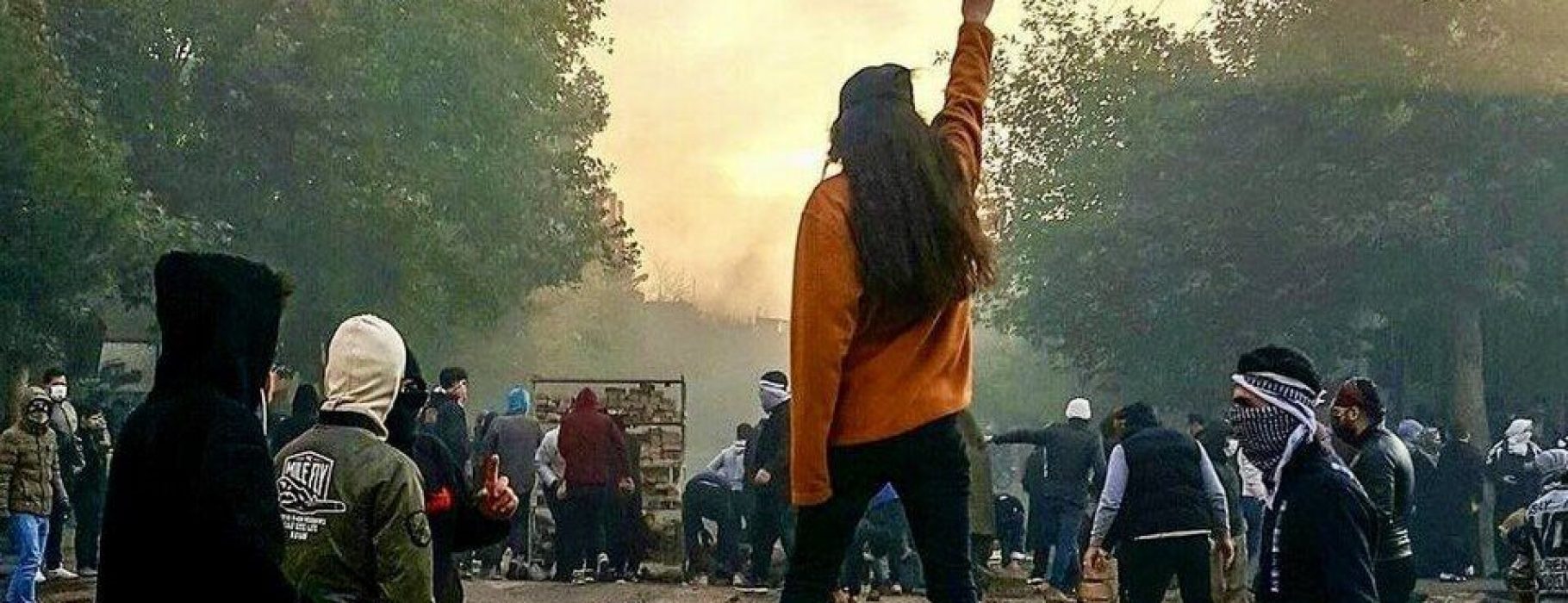
Internally, the picture is very different. The Islamic Republic has ruled domestically through a system of political repression and subjugation centered around a theocratic, militarized, and patriarchal ideological core. Time and again, everyday Iranians have risen in protest. These mobilizations have been led by and variably brought together distinct social groups, from workers and middle classes to students and Gen Z activists. Such movements initially aimed at reforming the system seeking to make it more democratic and inclusive, as was the case with the 1999 student protests and then the massive 2009 Green movement which confronted electoral fraud. But the state met these attempts with violence and suppression, closing any avenue for meaningful change through reform. As a result, demands became more radical. Often sparked by seemingly disparate incidents, protests tended to grow rapidly and began to target the Islamic Republic as a whole. Whether in recurrent waves of labor struggles, such as amidst surging fuel prices in 2019, or the multiethnic woman-led “Women, Life, Freedom” movement which spread globally, the latest wave of social movements aimed for systemic change.
Long-standing imperial subjugation combined with internal political repression created a matrix of oppression that defines the lived experience of ordinary Iranians. Iranians have long experienced the Islamic Republic’s crushing of dissent, coloring the emancipatory rhetoric of anti-imperialism in a hue of irony at best or sinister instrumentalization at worst. Yet, parsing through the entanglements of these structures of violence has posed a dilemma for the global left and anti-imperial movements. Often, protests inside Iran have led to a paralysis in expressions of global solidarity for fear that any critique of the Iranian state would feed further into US imperial domination and its war machine. As a result, many on the left have either refrained from critique of the Islamic Republic or, at its most extreme, aligned themselves with the Islamic Republic, allowing it to constitute itself as a leader in the struggle against and alternative to Western imperialism.
This posture of withholding solidarity with popular movements carries the legacy of the Cold War, which divided the world into blocs, at times leading to defenses of states for their opposition to the West, irrespective of their internal repressive political records. As Manijeh Moradian has laid out, Iran constitutes an especially complicated case for feminists on the left, who have been hesitant to stand shoulder to shoulder with the struggles of Iranian women.3 Manijeh Moradian, “Feminist Uprising in Iran and the Politics of Solidarity,” Meridians 25, no. 1 (2026): 156–80, https://doi.org/10.1215/15366936-12207141. Feminists on the left are keenly aware of how patriarchal oppression in Muslim contexts has all too quickly fed into imperial feminism: Too many wars have been started, bombs dropped, and troops mobilized under the guise of “saving Muslim women.”4Lila Abu-Lughod, Do Muslim Women Need Saving? (Cambridge, MA: Harvard University Press, 2015). As a result, in an attempt to refuse anti-Muslim racism and paternalistic imperial alignments, the left has often chosen to say nothing at all. Even at the height of the Women, Life, Freedom movement, when there was no active threat of war, much of the global left responded with silence.
Often, protests inside Iran have led to a paralysis in expressions of global solidarity for fear that any critique of the Iranian state would feed further into US imperial domination and its war machine. As a result, many on the left have either refrained from critique of the Islamic Republic or, at its most extreme, aligned themselves with the Islamic Republic, allowing it to constitute itself as a leader in the struggle against and alternative to Western imperialism.
This view has produced a profound vacuum of solidarity. In dismissing the legitimacy of struggles and political expression of Iranians, or in treating them as pawns in a larger geopolitical alignment, the global left has alienated many Iranians. Throughout the last year, the argument that one must choose a side between two warring states has grown louder and many on the left have deprioritized the multidecade struggle of Iranians in exchange for geopolitical strategy. But given the absence of a strong global anti-imperialist tenor that recognizes the political expression of the Iranian people, this space has been filled by the political right. Monarchists and outright fascist organizations within the Iranian diaspora, supported by powerful Western right-wing and Zionist organizations, have swooped in to provide an outlet for Iranians’ frustrations with the Islamic Republic. As a result, the global left’s hesitancy to express its solidarity with the Iranian people’s struggle against imperialism and domestic repression has been a strategic failure. At its core, dismissing Iranians’ predicament of facing both imperial bombs and state violence risks missing the chance to forge an antiwar movement premised on genuine popular solidarity.
What is more, accepting and often parroting the Islamic Republic’s posture as anti-imperialist belies a core principle of the anticolonial tradition: its insistence on reclaiming a radical humanism against colonial modernity’s dehumanization. Merely defining anti-imperialism by the enemy one fights sidesteps calls for a radical imagination and silences actual political visions for a different, more equitable and just world. In fact, one need not look far to find an alternative. The activists who have been central to Iran’s 2022 Women, Life, Freedom movement have refused false and politically convenient binaries and continue to forge a road that neither plays into imperial interventionism nor domestic systems of oppression. These groups have produced a firm anti-interventionist stance that is also oriented towards a new future, seeking to remake a world beyond the Islamic Republic’s totalizing grip. As such, rather than falling prey to an alignment with the Islamic Republic, the global left can build a strong and principled antiwar movement following the path being forged by many within the Women, Life, Freedom movement.
Colonial Modernity and Imperial Wars
Current imperial wars have not emerged in isolation. They came on the heels of decades of colonialism, enslavement, and capitalist accumulation, propped up by institutions, discourses, and practices of dehumanization. Political modernity instituted what sociologist W. E. B. Du Bois termed the “color line”—a veil that bifurcates humanity, separating those granted full personhood from those cast as nonhuman.5 Colonial powers stripped the colonized of their humanity, gradually enshrining racialized discourses of “the brute,” “the uncivilized,” or “the savage.” This worldview has laid the path for colonial violence and material extraction, rendering some lives valuable and others inherently unmournable. Empires positioned Indigenous peoples as disposable for the sake of land theft, reduced African captives to chattel within plantation capitalism, and cast the world’s nonwhite populations as justified targets of imperial bombing campaigns. The language of the “savage” also marks contemporary political attacks. Earlier this year, when asked why striking Iran’s bridges and power plants would not constitute a war crime, US President Donald Trump responded: “Because they are animals,” a rhetoric that echoes the declaration made by Israeli Defense Minister Yoav Gallant on October 9, 2023, announcing a complete siege on the Gaza Strip, stating, “we are fighting human animals, and we are acting accordingly.”6“Trump vows at news conference to obliterate Iran’s power plants and bridges if there’s no deal on ending the war,” NBC News, April 6, 2026, https://www.nbcnews.com/politics/trump-administration/live-blog/trump-defense-budget-gallego-taxes-congress-dhs-shutdown-live-updates-rcna266652; Emanuel Fabian, “Defense minister announces ‘complete siege’ of Gaza: No power, food or fuel,” Times of Israel, October 9, 2023 https://www.timesofisrael.com/liveblog_entry/defense-minister-announces-complete-siege-of-gaza-no-power-food-or-fuel/.
Many observers have made sense of the war on Iran as a continuation of Israel’s and—by proxy, the United States’s—assault on Gaza and Lebanon. For years, the world watched as Israel pounded hospitals, as women underwent c-sections without anesthesia due to an all-encompassing siege, and as children celebrated birthdays amidst the rubble, only to be killed weeks later.7“Gaza crisis: Babies being born ‘into hell’ amid desperate aid shortages,” UN News, January 19, 2024, https://news.un.org/en/story/2024/01/1145677. Gaza’s bookshops, libraries, mosques, churches, and universities were reduced to ashes. This consistent onslaught on human life has been increasingly normalized. On the first day of the war on Iran, the US military struck a girls’ primary school in Minab, killing 121 schoolchildren and 26 teachers. That assault deployed a “double-tap” strike, a tactic frequently used by the Israeli army, in which initial bombing is followed by a second strike minutes later, specifically designed to kill the paramedics and journalists who arrive to aid victims and document the crime.8“Airstrikes on Minab primary school,” Forensic Architecture, https://forensic-architecture.org/investigation/airstrikes-on-minab. “The children are always ours,” James Baldwin once said, “every single one of them, all over the globe; and I am beginning to suspect that whoever is incapable of recognizing this may be incapable of morality.”9James Baldwin, “Notes on the House of Bondage,” Nation, November 1, 1980, https://www.thenation.com/article/archive/notes-house-bondage/.[ From Gaza to Lebanon and Iran, these wars point to a widespread and gaping moral bankruptcy at the heart of our global order.
Imperial warfare has also brought with it widespread ecocide. The US military’s carbon footprint is larger than that of many industrialized nations, including Portugal and Denmark, while evading all scrutiny.10Lorraine Mallinder, “‘Elephant in the room’: The US military’s devastating carbon footprint,” Al Jazeera, December 12, 2023, https://www.aljazeera.com/news/2023/12/12/elephant-in-the-room-the-us-militarys-devastating-carbon-footprint. More than seven hundred US military installations are contaminated with forever chemicals, spilling over into neighboring communities.11 “Persistent Chemicals: DOD Needs to Provide Congress More Information on Costs Associated with Addressing PFAS,” US Government Accountability Office, February 25, 2025, https://www.gao.gov/products/gao-25-107401. The war on Gaza has produced more than thirty million tons of carbon emissions.12Benjamin Neimark et al., “Israel-Gaza conflict carbon emissions exceeded 30 million tons,” One Earth 9, no. 3 (2026): https://doi.org/10.1016/j.oneear.2026.101648. Even more, war strategists have deliberately engineered an unlivable biosphere through continuous and systematic assaults on ecosystems. Across Palestine and Lebanon, Israel has used white phosphorus bombs, decimating vegetation and poisoning the land, while inflicting third-degree burns, organ dysfunction, and neurological damage on its victims.13“Israel: White Phosphorus Used in Gaza, Lebanon,” Human Rights Watch, October 12, 2023, https://www.hrw.org/news/2023/10/12/israel-white-phosphorus-used-gaza-lebanon. Similarly in Iran, US-Israeli forces struck fuel storage depots in Tehran—a city of ten million people—creating apocalyptic scenes and making clear that this war has been a war on life and nature. When gas burns it releases a toxic chemical cocktail while hurling fine soot particles into the atmosphere. Acid rain fell across Tehran, its residue entering water streams and irrigation canals. Exposure to smoke and oil particles causes damage to the skin and lungs, induces headaches, and irritates the eyes.14Oliver Holmes, Damien Gayle, and Tural Ahmedzade, “Tehran’s toxic cloud: satellite images show oily fires burned for days,”Guardian, March 23, 2026, https://www.theguardian.com/world/2026/mar/23/tehran-toxic-cloud-satellite-image-oil-fires. Similar attacks on gas, oil, and petrochemical infrastructures were carried out almost daily across the country.
Imperial interventionism in interaction with a repressive, unequal system has produced a matrix of oppression whose interlocking forces cannot be easily disentangled.
Imperial interventionism in Iran preceded the current war, manifest particularly in the devastating, decades-long sanctions that have crippled Iran’s economy. Yet the current war has exacerbated this attack, wiping out livelihoods in an already disastrous economic climate and leaving deep scars in Iran’s biosphere. While the war was initially presented as a liberating effort for the people of Iran, it has left countless families in mourning. Far from targeting only the upper echelons of Iran’s political class, its scientists or industrialists, relentless bombing has produced death and destruction for ordinary Iranians. In a concerted attack on civilian infrastructure, the United States and Israel have struck bridges, railroads, health and educational institutions, and other civilian sites.15Paul Brown, Shayan Sardarizadeh, and Matt Murphy. “Iranian schools, hospital and landmarks among civilian sites hit during US-Israeli strikes,” BBC, March 6, 2026, https://www.bbc.com/news/articles/cpw004xqxnjo; “US strikes destroy key bridges, tower in southern Iran,” Al Jazeera, July 17, 2026, https://www.aljazeera.com/video/newsfeed/2026/7/17/us-strikes-destroy-key-bridges-tower-in-southern-iran; Ameneh Dehshiri, “Healthocide? Why the attack on the Pasteur Institute of Iran is more than a war crime,” New Humanitarian, April 21, 2026, https://www.thenewhumanitarian.org/opinion/2026/04/21/healthocide-why-attack-pasteur-institute-iran-more-war-crime. And, amid a continued threat of civilizational annihilation, Iranians continue to live in deep uncertainty.16Tweet by Donald Trump (@realdonaldtrump), Truth Social, April 7, 2026, 8:06 a.m., https://truthsocial.com/@realdonaldtrump/posts/116363336033995961.
Matrix of Oppression
These imperial subjugations have long intersected with internal repression in Iran. But it is crucial to understand that the former does not fully determine the latter. The Islamic Republic’s political project is rooted in its own theological and patriarchal social order. In the first decade after the 1979 Revolution, the Islamic Republic carried out mass executions, intensified social repression, and silenced political and intellectual dissent. Central to this consolidation of power were crackdowns targeting anti-imperialist, left intellectuals, and organizers who had had an essential role in bringing about the revolution. Justifying these atrocities, the state utilized anti-imperialist language alongside religious categories, such as the “counter-revolutionary” (zedde enghelab), the “hypocrite” (monafegh), and the “terrorist,” and began to delegitimize any political opposition as imperial conspiracy. Ever since, the continuous threat and manifestation of US imperial intervention further helped the Islamic Republic intensify its domestic crackdowns.
This ideological project has operated with particular intensity through its control of women’s bodies. Women’s bodies became a crucial site through which the Islamic Republic asserted both its Islamic moral authority and its resistance to “Western values.” The state institutionalized and enforced mandatory hijab laws first through the Islamic Revolutionary Committees (Komiteh) and later through the so-called “morality police” (gasht-e ershad). The enforcement was carried out with varying intensity over time, frequently imposing public violence against women. More recently, the government has deployed technologies like surveillance cameras for hijab enforcement, thus executing even tighter social control. As a result, the compulsory hijab has come to signify more than adherence to Islamic values: it functions as a broader symbol of the Islamic Republic’s social control.
The politics of symbolism extend beyond the hijab. Symbols of anti-imperial resistance have similarly been appropriated as markers of state loyalty and control. For many Iranians, the keffiyeh, for instance, has come to signify the violence and oppression of the Islamic Republic. During the 1979 Revolution, the keffiyeh was adopted as a symbol of solidarity with the Palestinian cause and broader anti-imperialist struggles in the region. Its footprint expanded dramatically during the Iran–Iraq War, when volunteer forces on the frontline used it as field gear, later making it a mark of sacrifice. But over the following decades, members of the Basij, the IRGC’s volunteer paramilitary militia, adopted it as part of their uniform and ideological identity. As a result, today, to many Iranians the keffiyeh no longer evokes neither solidarity with the oppressed nor wartime resilience, but rather the state sanctioned violence and political oppression of the Islamic Republic.
The reliance on symbolic assertions of ideological purity and social control attained particular importance as the Islamic Republic retreated from many of the social and economic promises of the 1979 revolution. By 1981, the state had initiated its crackdown on worker organizing, which continued with great intensity for decades and significantly weakened labor organizations and trade unions. Just ten years after the revolution, as Shirin Kamangar notes, the Islamic Republic began to gut essential welfare programs, including state-run programs for healthcare, education, housing, food, and fuel.17Shirin Kamangar, “Popular Protest and Labor Insurgency in Iran,” Spectre, August 22, 2023, https://doi.org/10.63478/51IAH6VP. An increasingly neoliberal economy accompanied by systemic resource consolidation favored those close to political and military power. Despite the country’s enormous resource wealth, its gains have largely bypassed the working population.
Imperial interventionism in interaction with a repressive, unequal system has produced a matrix of oppression whose interlocking forces cannot be easily disentangled. Economically, devastating imperial economic sanctions destroyed the Iranian economy. These sanctions then also created a justification for the lack of economic transparency and further consolidation of resources, leading to ever deteriorating living conditions for ordinary Iranians, particularly the poor and working classes. Across critical sectors ranging from healthcare to automotive manufacturing, international trade restrictions produced structural supply shortages that made life prohibitively expensive for already precarious populations.
Politically, the interaction of imperialism and state repression has had equally devastating effects. For example, for years, the government has deployed jamming signals to block access to satellite TV under the guise of filtering out “anti-system propaganda” and a “Western way of life.” These transmissions have persisted despite credible warnings regarding their harmful, potentially carcinogenic impact. Although Iranian activists, physicians, and even state officials have launched campaigns to end this practice, their efforts have largely failed.18“Government Committee To Review Satellite Jamming Signals’ Effects on Public Health,” Center for Human Rights in Iran, February 5, 2014, https://iranhumanrights.org/2014/02/satellite-jamming/. To be sure, several of these satellite channels targeted by the state are in fact tied, directly or indirectly, to imperialist actors seeking to weaponize Iranians’ discontent for geopolitical gain. But it is precisely this convergence that has left ordinary Iranians without a channel for political expression and hemmed in from all sides.
The United States cannot stand for human rights and democracy or position itself as the “leader of the free world” while backing genocides and bombing nations and peoples into annihilation. Similarly, the Islamic Republic cannot legitimately claim the mantle of the oppressed while murdering and subjugating its own people. These forces are not true opposites but have coalesced into a deadly matrix of oppression.
This vicious interaction reached its apogee in January 2026. Over the course of two days, the Islamic Republic unleashed the full force of its carceral apparatus. What began as protests against a dire economic reality caused by external sanctions and internal resource consolidation quickly transformed into a demand for the complete overthrow of the system.19 “What Happened at the Protests in Iran?,” Amnesty International, January 28, 2026, https://www.amnestyusa.org/blog/what-happened-at-the-protests-in-iran. Uprisings spread to hundreds of cities.20Raffi Berg and David Gritten, “Why are there protests in Iran and what has Trump said about US Action?” BBC, January 14, 2026, https://www.bbc.com/news/articles/cgjw8wxl3d6o. Simultaneously, Mossad declared its assistance to and presence among the protestors, providing the Islamic Republic with the pretext for even greater brutality.21Mossad Farsi (@MossadSpokesman), X, December 29, 2025, 9:39 a.m., https://x.com/MossadSpokesman/status/2005649986504237381. Sensing an existential threat, the state systematically opened fire on demonstrators, murdering thousands under the cover of a total internet blackout.22The official number of deaths, according to the Islamic Republic, is 3,117. HRANA, a US-based Human Rights organization puts the figure at 6,842 confirmed cases, with 11,000 cases still under review. “Day Thiry-Six of the Protests; Government Releases List of Names and State TV Insults Those Killed,” HRANA, February 1, 2026, https://www.en-hrana.org/day-thirty-six-of-the-protests-government-releases-list-of-names-and-state-tv-insults-those-killed/.As a result, the legitimate grievances of the Iranian people were foreclosed, and their political expression was once again crowded out by and trapped between two dominant forces: US and Zionist interventionism that weaponizes popular revolt to advance their imperial agenda, and a brutal state that deploys its pervasive police apparatus under the guise of combatting imperial and foreign agents.
While the Islamic Republic’s ability to withstand US-Israeli aggression is often celebrated as a geopolitical triumph, it is also clear that it is incapable of producing a genuine alternative to colonial modes of being. Its modus operandi—defined by policing, pervasive surveillance, ecological devastation, economic injustices, and ever-present state violence—does not challenge colonial modernity’s death drive. Rather, it exists in symbiosis with it. The Islamic Republic has used the discourse of “anti-imperialism” to further enshrine its power, preserving the carceral, exploitative, and dehumanizing practices it claims to oppose. The United States cannot stand for human rights and democracy or position itself as the “leader of the free world” while backing genocides and bombing nations and peoples into annihilation. Similarly, the Islamic Republic cannot legitimately claim the mantle of the oppressed while murdering and subjugating its own people. These forces are not true opposites but have coalesced into a deadly matrix of oppression.23The Islamic Republic’s destructive engagement spreads outside Iran’s borders, including its support of the Assad regime in Syria.
Iranian Feminist Struggles for Life
In 2022, following the state-sanctioned murder of Jina/Mahsa Amini, a 22-year-old Kurdish woman, at the hands of the “morality police,” Iranians rose in protest. This political mobilization transcended historically entrenched divisions between urban centers and peripheral regions, drawing together a cross-class coalition in a joint struggle against the Islamic Republic. At the heart of the movement were women and populations most violently targeted by state control, including those oppressed in regions like Kurdistan, Jina’s birthplace, Sistan and Baluchistan, and Khuzestan. Led by women and youth, but joined by men and elders across the country, the movement demanded a fundamental restructuring of society around the principles of Jin, Jiyan, Azadî (Women, Life, Freedom). Inspired by the Kurdish freedom struggle, this vision called for a reclamation of human dignity, life, and ecological connection.24Khaled Sheykholeslami, “Jin, Jiyan, Azadî (Women, Life, Freedom): A Transnational Social Movement,” Australian Feminist Studies 41, no. 128 (2026): 278-305, https://doi.org/10.1080/08164649.2026.2654862; Nazan Üstündağ, “Imagining Freedom in the Kurdish Women’s Freedom Movement,” Democratic Modernity 1 (2026), https://academyofsocialscience.org/2026/06/22/imagining-freedom-in-the-kurdish-womens-freedom-movement/. Spreading rapidly across Iran and the globe, Women, Life, Freedom demanded not merely the end of the Islamic Republic but put forth an expansive vision for a new future.
Far from an isolated eruption, Women, Life, Freedom came at the heels of a rich lineage of labor and popular struggles that had shaken Iran over the preceding years, from water-rights protests led by farmers in Isfahan and Khuzestan, to strikes by bus drivers, teachers, petrochemical workers, and retirees protesting worsening living conditions, to the 2019 “Bloody November” (Aban-e Khunin) uprising sparked by rising fuel prices. The connection to these prior movements, and particularly the state’s brutal crackdown in Bloody November, remained present throughout the Women, Life, Freedom movement. Shortly after Jina’s murder, workers at the Asalouye and Abadan petrochemical plants initiated strikes in solidarity.25Elham Hoominfar, “The main losers of 1979, the creators of the new revolution in Iran,” MRonline, October 12, 2022, https://mronline.org/2022/10/12/the-main-losers-of-1979-the-creators-of-the-new-revolution-in-iran/. A few months later, in November 2022, activists called for another nationwide strike, honoring the anniversary of Bloody November, and linking the Women, Life, Freedom movement to years of labor uprisings.
Central to Women, Life, Freedom was a contestation of the mandatory hijab. In Western media coverage, Women, Life, Freedom was frequently flattened into a narrow liberal demand for individual freedom, systematically delinked and decontextualized from its broader antisystemic significance. But the struggle over the hijab must be seen as more than a liberal protest for greater bodily autonomy. Given how the Islamic Republic had transformed the mandatory hijab into one of its central instruments of ideological enforcement and social control, resisting it became a direct challenge to state power and a unified struggle across lines of class, ethnicity, religion, ability, gender, and generation. This stance was made especially clear when many women who choose to wear the hijab participated in the uprising, and when women who wear the hijab for religious reasons chose to remove it in front of the morality police to prove a point. These actions showed that the struggle was not directed against religious expression per se, but against theocratic domination and oppression.
Women, Life, Freedom, like any popular uprising, contained a multitude of visions for a renewed future.26Some factions of the Women, Life, Freedom movement had carceral elements, others failed to see the entanglements highlighted here. But most of those factions, like the monarchists, stopped being associated with the movement or became one of its adversaries in short order. Amongst them, one central yet often obscured vision offered an expansive model for reimagining social and political relationships, articulating the entanglements between patriarchy, economic oppression, and environmental destruction. An Iranian Kurdish feminist collective expressed this in September 2022, explaining that “liberation from patriarchy, the state, and capital are deeply intertwined.”27Somayeh Rostampour, “Jin, Jiyan, Azadi (Woman, Life, Freedom): The Genealogy of a Slogan,” Crimethink, March 8, 2023, https://crimethinc.com/2023/03/08/jin-jiyan-azadi-woman-life-freedom-the-genealogy-of-a-slogan; see in Moradian, “Feminist Uprising in Iran and the Politics of Solidarity.” This strand of Women, Life, Freedom’s vision for a new social order begins with the liberation of women from state power and patriarchal structures, and is grounded in an understanding that liberation for the most marginalized creates the conditions for freedom for all. Emancipation also extends beyond the liberation of human beings from political domination to a renewed relationship between humanity and nature. It rejects the life-destructive logics of imperial, colonial, and patriarchal power in their pursuit of domination through extraction and violence. Instead, it put forth a humanistic imagination of freedom grounded in the preservation and flourishing of life—human and nonhuman alike.
The feminists who have been central to Women, Life, Freedom in Iran and across the diaspora, continue to demonstrate that it is possible to think, organize, and exist beyond the false choice forcing us into allegiances of the US-Israeli war of aggression on the one hand and the Islamic Republic on the other.
Social media users articulated this political imagination through the viral #Baraye (“for” or “because of”) trend, naming and connecting the grievances at the heart of their political mobilization. Artists across Iran and the diaspora transformed these grievances into a rich body of artistic expression. Two of the movement’s most iconic songs, “Baraye” and “Avaz-e Leylaha,” captured the breadth of this vision, bringing together the struggles for gender and economic justice, political freedom, ecological survival, and the dignity of marginalized communities, even beyond the borders of Iran:
for my sister, your sister, our sisters;…
for the shame of poverty;…
for this authoritarian economy;…
for this polluted air;
for the drying trees of Valiasr Street;
for the anticipated extinction of the Asiatic cheetah;…
for imprisoned intellectuals;…
for Afghan children;…
for the sunrise after long nights;…
***
for the drying Lake Urmia;…
for coughing Khuzestan; for wounded Baluchestan; Tabriz is in tears, long live Kurdistan;…
from the Hyrcanian forests to the Karun river,
Aleppo, Shalamcheh, Khan Shaykhun;
we put an end to this line of blood; here and now.28“Shervin – Baraye | شروین – برای,” YouTube video, 2:11, posted by “Shervin,” Sep 27, 2022, https://www.youtube.com/watch?v=z8xXiqyfBg0; For the English translation and verse by verse reference to original social media posts see “Baraye: Understanding Iran’s Song of Protest and Compassion,” Ajam Media Collective, February 9, 2023, https://ajammc.com/2023/02/09/baraye-irans-song-of-protest/; “Avaz-e Leylaha” was first circulated anonymously on Telegram, without a title, and was credited to the students of the Faculty of Fine Arts at the University of Tehran. For the lyrics, translation, and further details, see Lyricstranslate, “آواز لیلاها (Avaaz Leilaha) lyrics,” Lyriscstranslate, accessed September 22, 2026, https://lyricstranslate.com/en/unknown-artist-persian-avaaz-leilaha-lyrics.html. In “Avaz-e Leylaha” the references to Aleppo and Khan Shaykhun are significant. They were major sites of violence during the Syrian civil war. Assad’s government carried out a chemical attack on Khan Shaykhun and seized and destroyed Aleppo with support from the IRGC and its allied forces.
In placing women’s liberation, economic deprivation, environmental destruction, oppression of ethnic groups and opposition to state power in the same frame, the movement weaved together a demand for complete social transformation.
The contemporary legacy of Women, Life, Freedom has opened the doors for a solidarity politics beyond state-centric binaries. The feminists who have been central to Women, Life, Freedom in Iran and across the diaspora, continue to demonstrate that it is possible to think, organize, and exist beyond the false choice forcing us into allegiances of the US-Israeli war of aggression on the one hand and the Islamic Republic on the other. Elaheh Mohammadi, one of the journalists whose reporting on Jina’s death helped spark the movement, came out of prison in January 2024 wearing a keffiyeh. Despite the keffiyeh’s weaponization as a symbol of state-aligned ideology, Mohammadi’s gesture reclaimed it as a true expression of solidarity with global struggles from Kurdistan to Palestine.29After her appearance with the keffiyeh, there were discussions on social media regarding whether this was a Palestinian or Kurdish symbol. Later when Mohammadi and Nilufar Hamedi received the José Couso Press Freedom Award, she dedicated it to “Wael al-Dahdouh and all Palestinian journalists,” again powerfully signaling that it is possible to reject both domestic state repression and Zionism and imperialism at the same time.30“Iranian Elahe Mohammadi, winner of the José Couso Prize, manages to express her gratitude for the distinction,” SEI2, May 10, 2024, https://cadenaser.com/galicia/2024/05/10/la-irani-elahe-mohammadi-galardonada-con-el-premio-jose-couso-logra-agradecer-la-distincion-radio-ferrol/. This stance demonstrates that the struggle for Iranian freedom and the struggle for Palestinian liberation are not mutually exclusive, but part of a singular, principled resistance against all forms of dehumanization.
Many of the institutions and activist groups that emerged from the Women, Life, Freedom movement now lead the way in articulating an antiwar, anti-Islamic Republic stance, thereby opposing the matrix of oppression weighing on Iranians holistically. While monarchists and some other factions of the Iranian diaspora may have identified with Women, Life, Freedom in prior years, their allegiance to the movement has faded rapidly and at times even turned into attacks on bearers of the Women, Life, Freedom flag and signages.31Post by Radio Hambastegi, (@radiohambastegi), Instagram, February 2, 2026, https://www.instagram.com/reels/DUQqa7AjFWJ/. Additionally, many Women, Life, Freedom activists have been active in solidarity movements with Palestine, opposing Israel’s genocide in Gaza, and challenging broader structures of colonial violence and imperial domination.32“Power To The People Means People’s Revolution For Regional Liberation,” Feminists For Jina, October 2024, accessed September 22, 2026, https://feminists4jina.net/archives/1784. Their opposition to the war on Iran emerges from a longer commitment to resisting all forms of state violence, rather than from geopolitical strategizing and too convenient statecentric analysis. Even though these critical voices are routinely marginalized by the loudest factions of the diaspora and monarchist propagandists, they continue to wage a multifaceted resistance against domestic oppression, fascistic alternatives, and imperial destruction.
Towards Popular Solidarity
The US-Israeli war on Iran along with exacerbated state executions, brutal crackdowns, and oppression have produced lively debates within left, anti-imperial groups.33This piece was drafted in July 2026. More debates followed in subsequent weeks, especially in the wake of the Guardian open letter, “To Iran’s Political Prisoners, trapped ‘between two blades of a scissors,’” Guardian, August 20, 2026, https://www.theguardian.com/commentisfree/ng-interactive/2026/aug/20/iran-political-prisoners. Some have insisted that within the context of metropolitan political struggle, critique of the Islamic Republic is inappropriate, as it can be coopted for justifying further imperial interventionism. Others expressed a variant of this sentiment, namely, that the left’s task, particularly in the metropole, should be to get the imperial boot off Iranians’ necks, while refraining from taking a stance on popular struggles for self-determination. Still others are energized by the Iranian military’s ability to hold the United States in a stranglehold, which could finally push back against US imperial ventures. While understandable, all these positions reproduce a longer-standing problem—a void on the left when it comes to unequivocally standing in solidarity with Iranian liberatory struggles.
Given the destructive matrix of oppression that Iranians are up against, a cherry-picked anti-war-only solidarity disregards the predicament of Iranians struggling for a better future. At worst, it risks erasing a people’s struggle and devaluing Iranians’ lives only to create a narrative that fits convenient geopolitical alignments. Such an approach has real consequences. First, selective solidarity that is disconnected from popular struggles fails to center the oppressed, build a broad base, and hence forge a true and powerful antiwar movement. Second, focusing solely on anti-imperial struggle and celebrating the Islamic Republic without addressing its repression will encourage a more militarized and oppressive state, thus sacrificing Iranians’ future at the altar of larger geopolitical victories. Third, it signals to Iranians—and all others fighting for liberation—that a significant segment of the left refuses to uphold the liberatory values it advocates when those are violated by states within its own camp, ultimately undermining its moral credibility.
Avoiding such one-sided analysis, Women, Life, Freedom activists have chartered an alternative path. They have put forth a strong anti-interventionist, antiwar position, while at the same time imagining and seeking to build a world beyond the Islamic Republic’s repression. There is much we can learn from this position. It calls for a horizontal, anti-imperial solidarity that can create networks and linkages across borders in a global struggle beyond state-centric alignments. This means closing the space for invocations of anti-imperialism that manifest themselves fully detached from that very tradition’s humanistic core, and it makes room for liberatory political expressions that reject interlocking systems of oppression, instead embracing a politics of life.
Such horizontal solidarity is possible. In fact, not all global anti-imperial groups have stayed silent at moments of Iranian state suppression. After the January massacre, the Zapatistas in Mexico voiced their rejection of state-aligned positions and strongly supported Iranians in the streets. They proclaimed: “There are those who, from the outside, look upwards and not downwards: those who justify the Iranian regime in the name of supposed anti-imperialism, ignoring that this same regime applies logics of occupation, apartheid, plunder, and neoliberalism against its own people.”34“For the Life and Dignity of the People of Iran,” Enlace Zapatista, January 29, 2026, https://enlacezapatista.ezln.org.mx/2026/01/29/for-the-life-and-dignity-of-the-people-of-iran-statement-from-groups-collectives-and-individuals-from-different-corners-of-the-world-expressing-resistance-and-rebellion/. The focus away from geopolitical strategy and towards popular solidarity and a vision for humanistic anticolonialism of course also has much deeper roots, including throughout the Cold War. Recall the Martinican writer Aimé Césaire, who, in his resignation letter to the French Communist Party reflected on the ghosts of Stalinism: “Khrushchev’s revelations concerning Stalin are enough to have plunged all those who have participated in communist activity, to whatever degree, into an abyss of shock, pain, and shame (or, at least, I hope so). The dead, the tortured, the executed—no, neither posthumous rehabilitations, nor national funerals, nor official speeches can overcome them.”35Aimé Césaire, “Letter to Maurice Thorez,” Social Text 28, no. 2, (Summer 2010): 145-52. https://doi.org/10.1215/01642472-2009-072 We do not need to be locked into convenient strategic alignments, but rather build on insights that center opposition to such matrices of oppression, refusing to sacrifice either struggle. Following these visions might open the door for a global, liberatory imagination, led by those subjugated by power: for life, and for freedom.