
The Loyalism of the Belfast Riots

September 22, 2026

Things escalate rapidly in Belfast. But in the era of social media outrage, any politically volatile image will tear through the city in mere minutes. On June 9, a video spread of an alleged asylum seeker from Sudan standing over a white man bearing the wounds of a knife attack that ultimately left him blind in one eye. Within hours, anti-immigrant rallies appeared around the North of Ireland, followed by marches that evolved into hostile riots where immigrant homes and businesses were attacked and set on fire.1Stephen Castle, “Anti-Immigrant Riots Leave Belfast on Edge: ‘Everyone Is Afraid,’” New York Times, June 12, 2026, https://www.nytimes.com/2026/06/12/world/europe/belfast-stabbing-riots-anti-immigrant.html.[ Several homes were ultimately burned to the ground, and around five dozen fire-related incidents were reported to emergency services.2Alex Caraco, “UK: Belfast Violence Leaves Homes Burnt and Families Displaced,” AOL, June 10, 2026, https://www.aol.co.uk/articles/uk-belfast-violence-leaves-homes-130508000.html.

Media outlets roundly admitted that these riots were overwhelmingly in Loyalist neighborhoods like Shankill Road, East Belfast, and Tigers Bay. Photos of the demonstrations show a sea of Union Jacks, a flag that in Belfast is used by the Loyalist political community. There were no republican tricolors in sight. The rally fliers, created and spread at lightning speed, were peculiar, including calls for businesses in the surrounding neighborhoods to close.3Tweet by Shane Burley (BlueSky Edition) (@shaneburley.bsky.social), BlueSky, June 12, 2026, 12:36 p.m., https://bsky.app/profile/shaneburley.bsky.social/post/3mo46dvzn6k2p. This is how Loyalist paramilitaries direct—or coerce—communities under their ostensible control.  The same areas where immigrants were forced from their homes and a bus was set ablaze are covered in murals celebrating balaclava-masked members of the Protestant British ultranationalists of the Ulster Defense Association (UDA) and Ulster Volunteer Force. These are assailants who earned their stripes by murdering Catholics (who mostly see themselves as Irish rather than subjects of the British crown).

These murals are tokens of a history of Loyalism that has continued through a grotesque parody of evolution. Loyalism is a radical, working-class form of Unionism—the pro-British status quo that believed loyal British subjects, defined as Protestant, should run the affairs of the North. The legacy of militant Loyalism—while somewhat dimmed since 1998’s Good Friday Agreement ended the guerilla war—is still present and has increasingly cathected around anti-immigrant white nationalism in the aftermath of Brexit. Historically, Loyalism was a reaction to the militant demands for Irish freedom and autonomy and reflected the same British nationalism that brought about the rise of parties like the National Front and the Islamophobia of the English Defence League and Reform UK. In a world where the guerilla war between Irish Republicans, Loyalists, and the British state has cooled, the same energy that fueled Loyalism’s cruelty is now being directed at a different kind of “dangerous” minority threatening their community’s British identity: immigrants.

The British far-right’s history reaches back long before the Second World War, but the last fifteen years have seen what were previously fringe politics found in the papers of the National Front or British National Party reproduced large swathes of the Kingdom. This led to the Brexit referendum that struck a blow to the fragile Northern Irish peace and then to an insurgent anti-immigrant political movement that, as with Trumpism in the United States, has now become a major political force among the UK working class.

In a post-Brexit and post-Good Friday Northern Ireland, the lines of the conflict have expanded, and the British model of anti-immigrant xenophobia has reenergized the networks that anti-Catholic hysteria had built. The Loyalist cause in Ulster remains a radical version of Protestant Unionism at its core. But it is increasingly committed not only to Protestantism as a religion and Britain as a nation, but to a whiteness that can only be preserved through fortified borders.

Anti-immigrant riots have now become a summer ritual alongside the Orange Parades (Protestant supremacist parades in which Unionists march near Catholic neighborhoods to celebrate their subjugation). This mirrored the history of Loyalist and Republican conflict, where summer months brought Protestant gangs into Catholic nationalist neighborhoods to burn out homes and terrorize residents. With few exceptions, nearly all of the twenty riot neighborhoods this past May were in Loyalist strongholds. On Shankhill Road, the same Loyalist neighborhood where the 1969 riots began, demonstrators attacked immigrant homes. One minority woman desperately pled with masked assailants to not hurt her young children as they kicked in the front door shouting “local homes for local people.”4Hannah Al-Othman and Rory Carroll, “ ‘There’s Wee Girls Inside’: Panic as Masked Men Storm House in Belfast,” Guardian, June 9, 2026, https://www.theguardian.com/uk-news/2026/jun/09/theres-wee-girls-inside-panic-as-masked-men-storm-house-in-belfast.

There was an attempt by Loyalist leaders—those who spent years running operations for the lasting remnants of Loyalist paramilitaries—to deny responsibility and suggest that Loyalist decline allowed for the violence. “The chickens are coming home to roost,” Jamie Bryson, a Belfast Loyalist leader, said during the riots.5Rory Carroll, “Belfast Riots Triggered Renewed Scrutiny over Loyalist Paramilitary Influence,” Guardian, June 12, 2026, https://www.theguardian.com/uk-news/2026/jun/12/belfast-riots-scrutiny-Loyalist-paramilitary-influence-northern-ireland.   “You don’t want Loyalists to play any part in society?…Be careful what you wish for because you’re going to create a vacuum.” Bryson’s comment has a certain logic to it: white nationalism is filling the vacuum left by militant Loyalism’s shrinkage, but only insofar as it’s flooding the sewers that Loyalism built around the Scots-Irish colony they call Northern Ireland. Reporters identified Loyalist paramilitaries in the anti-immigrant crowds, while others pointed to the fact that only Loyalist leaders had the ability to shut down commerce that quickly in their neighborhoods.6Sam McBride, “NI’s Snarling Serpent Isn’t Migrants, but Mob Rule of Thugs Who Assaulted Me Under Nose of Police,” Belfast Telegram, June 14, 2026, https://www.belfasttelegraph.co.uk/comment/nis-snarling-serpent-isnt-migrants-but-mob-rule-of-thugs-who-assaulted-me-under-nose-of-the-police/a/157171147.html; Editor, “WE SAY: Why Is the PSNI So Shy About Loyalist Paramilitaries?,” Belfast Media, June 18, 2026, https://belfastmedia.com/a-week-on-and-psni-still-can-t-name-and-shame-paramilitaries-behind-racist-pogrom?fbclid=IwY2xjawSgsSNleHRuA2FlbQIxMQBzcnRjBmFwcF9pZBAyMjIwMzkxNzg4MjAwODkyAAEeSkehsOdEOE_Pn3njJOMIv0rG_9Pf0HDAbRuVIIXnlr4ellMxEZeQWMVtv7U_aem_metTF8cqKj4C72VWj0s6JQ.

Far-right podcasters around the world repeated with glee, “rioting is in Northern Ireland’s blood.” But what they view as “rioting” endemic to North Ireland as a whole is actually the Loyalist history of mob attacks against anyone they see as a threat. They call it rioting, but it’s actually a pogrom.

The racist riots were, from everything we can see, Loyalist networks pulled into action.7Carroll, “Belfast Riots.” Loyalist paramilitaries—which are still active, if only a as shadow of what they were before the Peace Process—embody a militant pro-British nationalism developed from the “defense associations” that gave way to the militias that waged a guerilla war of torture and terror across the North of Ireland during “the Troubles.” That siege mentality remains operative because it was built around the preservation of ethnic and religious supremacy; in a more globalized world, the “Fifth Column” targeted by that mentality has expanded beyond the Loyalists’ Catholic neighbors.

The 2026 summer riots were predictable and could have been prevented if they weren’t stoked by the far right and picked up by the waiting hands of Loyalists. Last summer, a Romanian immigrant was accused of sexually abusing a child, and racist pogroms followed.8Rory Carroll, “Ballymena Riots Six Months on: Fear, Formidable Obstacles and Official Silence,” Guardian, January 4, 2026, https://www.theguardian.com/uk-news/2026/jan/04/ballymena-northern-ireland-riots-immigrants-homes-attacks. Dressed like their paramilitary ancestors, Loyalist youth stormed the Belfast neighborhood of Ballymena, terrorizing local residents and demanding British native sovereignty. Something similar occurred in 2024, when the Loyalist housing estate of Sandy Row, blanketed with murals of the Queen and King William of Orange, exploded with xenophobic fury. Republicans I spoke with as I set up interviews in Belfast still refused to walk within several blocks of Sandy Row: it was just too dangerous. Far-right podcasters around the world repeated with glee, “rioting is in Northern Ireland’s blood.” But what they view as “rioting” endemic to North Ireland as a whole is actually the Loyalist history of mob attacks against anyone they see as a threat. They call it rioting, but it’s actually a pogrom.

The Fires of History

Next, Unionists were preparing for this year’s Eleventh Night bonfires, an annual July 11 prelude to the Orange Order’s Twelfth of July marches commemorating the Protestant William III’s victory over the Catholic James II at the 1690 Battle of the Boyne. There is a sense in which the Troubles began with an Orange parade, when—in the wake of Loyalist and police assaults on Northern Irish civil rights protesters advocating for Catholic equality in 1969—the Protestant Apprentice Boys parade was met with three days of rioting and Loyalist pogroms through Catholic neighborhoods of West Belfast. The “loyal orders” are Protestant marching groups that prohibit Catholic membership or their members marrying Catholics. The loyal orders largely controlled the Unionist political establishment in the North, acting as the aboveground version of the Loyalist paramilitaries’ underground war. They would tear through Catholic neighborhoods with their symbols of Protestant superiority, ensuring that Catholics would have to smile as they faced discrimination in housing, employment, and representation.
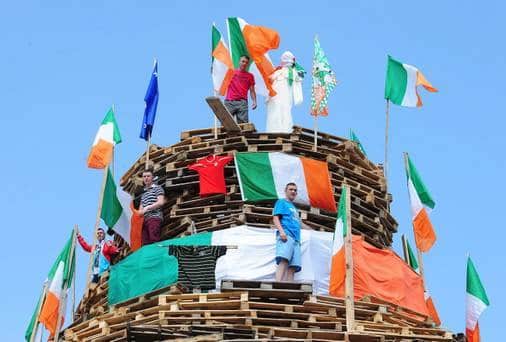
Bonfire for the Eleventh Night in Northern Ireland, July 12, 2016 Photo Credit: Jtcorscadden via wikipedia
Bonfire for the Eleventh Night in Northern Ireland, July 12, 2016
Photo Credit: r Jtcorscadden via wikipedia

The Unionist bonfires are frequently surrounded with Loyalist paramilitary flags while Irish tricolors, portraits of Sinn Féin leaders, and effigies of the pope—or more recently, the Irish-language rap group Kneecap—are ignited in the towering inferno. Recently, symbols of immigration have joined those of Irish unification in the flames, including a miniature recreation of a mosque, whose inclusion, despite drawing controversy, bonfire organizers adamantly defended as their political right of protest. The bonfires have historically been a violent threat Catholics, even listing “Taigs” (an anti-Catholic slur) on signs placed on the structures to be burned. But the targets now encompass anyone considered an outsider to British Northern Ireland, including mannequins with dark skin and life jackets like those seen on one County Tyrone bonfire in 2025. This display included signs that read, “Veterans before Refugees” and “Stop the Boats” in front of a giant rendition of a migrant boat burning in effigy.9“Burning of Migrant Boat Effigy in Northern Ireland Triggers Police Investigation,” AP News, updated July 11, 2025, https://apnews.com/article/northern-ireland-bonfire-migrants-effigy-fa590eb31b67fd97a4350ce2aae1e95c.

Loyalist Muscle Memory

Racism has not bypassed nationalist neighborhoods, and there has even been some shameful collaboration between Irish anti-immigrant xenophobes and Loyalists against refugee resettlement. There are even white nationalist groups who, erroneously, claim Republican origins. Irish nationalism has existed for a century and has often encompassed more moderate demands. But the Republican movement was built on the much more radical idea of equality and democracy for all who inhabit Ireland, regardless of ethnicity or religion. When racism seethes in nationalist enclaves, it is more of a bug than a feature of those politics, given that Republicanism challenged ethnic models of inclusion. For Republicans, an Irish person is someone who contributes to Irish society, not someone with some assumptive genetic admixture.

The modern form of the conflict between the Loyalists and Republicans has roots going back centuries to Britain’s first colonization of Ireland. After centuries of anticolonial conflict, the North of Ireland was partitioned away in 1921 when the South became free. The Northern six counties of Ulster were overwhelmingly held by British Protestants, who built a political structure to enforce their majoritarian position and disenfranchise the Catholic minority. The Unionist political elite’s failure to deliver affluence and social mobility to its Protestant base opened the door to the formation of a national populist ideology that, while often critical of the British government, remains aligned with the Crown

The ethnic and colonial roots of the conflict were projected onto religion. Far-right politicians like the Presbyterian minister Ian Paisley would flood Loyalist enclaves with anti-Catholic conspiracy theories that today read like the Protocols of the Elders of the Vatican. Loyalist tracts represented British Protestants as the true embattled minority, trying to hold off the forces of the Pope, the IRA, or the Communists (depending on the newsletter). According to this ideology, Irish Catholics were trying to replace British Protestants. By the 1960s, Catholic nationalists were disproportionately living in squalor, unemployed, and gerrymandered out of voting rights. They faced pogroms from their Unionist neighbors, who saw them as a Fifth Column itching to revive the Irish Republican Army (IRA)—the insurgent force that fought British occupation and which had, by the early 1960s, become largely inactive.

But amid this chaos, Unionist workers weren’t faring much better. Instead of tossing off the British ruling class, their populism adopted UK ultranationalism and anti-Catholic bigotry. Things exploded in 1969 amid a Northern Irish Civil Rights Movement when Loyalists rioted and burned out Catholic homes, turning thousands into refugees in their own homeland. This was an established pattern for Loyalists, and anti-Catholic pogroms sent families fleeing across the 1920s and 1930s before the families of their sons and daughters faced the same fate in the 1960s. And while the conflict was always painted with a religious tone, religion remained a thinly veiled code for ethnicity. Racial identity ultimately sat underneath’s Britain “civilizing” colonial mission in Eire.10On the relation between ethnicity and religion in Northern Irish Anti-Catholicism, see Brewer and Higgens. John D. Brewer and Gareth I. Higgins, “Understanding Anti-Catholicism in Northern Ireland,” Sociology 33, no. 2 (1999): 235–55, https://doi.org/10.1017/S0038038599000152.

Loyalism was a colonial ideology that defends its chosen insiders against all others.…Nothing else could have paved the way for the notion that refugees are now colonizing their British colony as effectively as Loyalism.

Those Loyalist networks became paramilitaries, and The Troubles commenced, leaving over 3500 dead, with some estimates even higher.11“Malcolm Sutton: An Index of Deaths from the Conflict in Ireland,” CAIN Web Service, accessed September 14, 2026, https://cain.ulster.ac.uk/sutton/tables/Year.html.  The North of Ireland remains split along sectarian lines: Nationalists and Unionists live in different neighborhoods, vote for different political parties, go to different schools, and certainly attend different churches.

But as the Good Friday Agreement settled much of the violence, the Loyalist far-right became less distinguishable from the rest of the British nativist movement. White nationalism always had deep connections to Loyalism, from the National Front’s intentional recruitment of Loyalist militants to the skinhead past of some of the most prolific Loyalist killers. But as fearmongering about IRA violence had less purchase, the Protestant far right became distinctly more British and took on the anti-immigrant and Islamophobic model of the “refugee crisis” and Brexit-era populist upsurge.

Loyalism’s Children

The Loyalist youth who led the charge in East Belfast were specifically recruited and mobilized by US fascist gangs like the Active Clubs—white supremacist crews focused on fighting and fitness distinctly similar to the Loyalist boxing clubs many of these kids’ fathers had joined when entering the UDA and UVF a generation prior.12David Gilbert, “A White Supremacist Youth Group Helped Orchestrate the Belfast Riots,” Wired, June 12, 2026, https://www.wired.com/story/a-white-supremacist-youth-group-helped-orchestrate-the-belfast-riots/. And in a culture of fear, where online rumor can lead to real-world cruelty, this violence was accelerated by high profile figures like Elon Musk and British anti-immigrant influencer Tommy Robinson, who set the rhetorical groundwork for the insurrection.13Alexander Smith, “Elon Musk Under Fire for Stoking Anti-Immigrant Riots in Belfast,” NBC News, June 11, 2026, https://www.nbcnews.com/world/united-kingdom/belfast-riots-elon-musk-anti-immigrant-violence-stabbing-rcna349384.

Just as during the Troubles, much of the international press framed this as an “Irish problem.” However, for those who lived through Loyalist violence, it was clear where the violence was coming from. Michael McCann, who fled his home in West Belfast during the 1969 pogrom, wanted to make it clear what the racist riots were: Loyalism. More than anything else, Loyalism was a colonial ideology that defends its chosen insiders against all others meaning “anyone will do as long as you’re not a Loyalist,” as McCann put it. It only makes sense that Loyalists would turn on a different set of outsiders as their political framework evolved. Loyalism was forged out of a siege mentality, the idea that invaders were at their doorstep and that Protestants are the spearhead of a threatening minority. Nothing else could have paved the way for the notion that refugees are now colonizing their British colony as effectively as Loyalism.

People exceptionalize the experience of the North of Ireland—and to a degree, they should. A guerilla war persisted in the middle of one of the most developed countries in the world between two peoples who most outsiders could scarcely distinguish. But this is exactly what has allowed Loyalism’s longevity. Loyalist bigotry was projected at a particularly white other, so as Romanian and Polish immigrants entered the statelet, they were never invited into an “American” model of whiteness. Similarly, when those immigrants were people of color, they often attended Catholic Church or—perhaps worse for modern British nationalists—were Muslim. Both these minorities are presented as a cultural threat to the Protestant British subject. But, just as with Rhodesians before them, it’s their militancy that ultimately defines Loyalists: when the colony is threatened, they will become more British than Britain.

This fits with what former Provisional IRA member Tommy McKearney explained to me as the evolution of the “Orange State” into the “Sectarian State.” From its start, Northern Ireland was established as what Unionist leader James Craig called “a Protestant Parliament and Protestant state.” Its sense of identity was built on the exclusion of outsiders through their presentation as a militant threat. According to this logic, Catholics were a subservient class whose dispossession was justified by their lack of patriotism and the internal threat they supposedly posed. (This is why Unionist leader Basil Brooks called Catholics “99% disloyal” in 1934.)  The Loyalist mentality is the working-class and militant outgrowth of this exclusionary thinking. Like fascist movements across the world, Loyalism takes its constituents’ feelings of economic and social precarity and projects them onto the ruling class’s preferred target. But today, in a world of the Good Friday Agreement’s power-sharing model, Orange supremacy has been replaced with a sectarianism that is now built into the model of government. The North remains segregated: neighborhoods and schools are segregated and residents are even required to declare themselves “nationalist” or “Unionist” when voting. Instead of overcoming these barriers as Marxists like McKearney would have wanted, by the 1990s, the best Sinn Féin could hope for was a stalemate between both communities and, if demographics allowed, a future nationalist majority would vote the island into unity.

Sectarianism never disappeared and instead evolved into the defining feature of the Loyalist right’s sense of itself. Once those communal lines are drawn it is easier to simply replace one minority with another than break down the barriers between working people struggling through neoliberalism. With the possibility of a Border Poll (a vote on Irish reunification) looming and the aftereffects of Brexit creating instability in Northern Ireland’s border regime, their thirty years of peace is starting to appear fragile.14Pat Leahy, “Support for Irish Unification Growing in Northern Ireland, Poll Finds,” Irish Times, February 7, 2025, https://www.irishtimes.com/ireland/2025/02/07/support-for-irish-unification-grows-but-unity-vote-would-be-soundly-defeated-in-north-poll-shows/; Adam Taylor and Erin Cunningham, “Why Britain’s Plan to Scrap Part of the Brexit Deal Is so Controversial,” Washington Post, June 14, 2022, https://www.washingtonpost.com/world/2022/06/14/brexit-northern-ireland-protocol/.

Building the Irish Republic

Loyalism was a fight for the future of Ulster. If they are able to mobilize white identitarianism to both maintain their reactionary community infrastructure and subvert commitments to Irish sovereignty, then the Loyalists really have won the war. Republicanism offered its own vision for unity: an Ireland by and for the people who live there without regard for ethnicity, national identity, or religious faith. Republicanism evolved from the demand for self-governance and still hopes for a world past imperialism. While the North of Ireland remains the most religious region of Western Europe (comparable to the American Bible Belt) and among the most divided societies in Western Europe, things have changed: religious orthodoxy holds less sway, both intermarriage and integration are closer to the norm than they have ever been, and the Republican ideal of unity remains compelling for those looking to build an Irish identity upon participation and equality rather than blood and soil.15 For analysis of recent polling data on the importance of religious identity in Northern Ireland, see Gladys Glaniel’s article for RTÉ. Gladys Ganiel, “What New Surveys Reveal About Religion and Identity in Northern Ireland,” RTÉ, February 27, 2024, https://www.rte.ie/brainstorm/2024/0227/1434591-northern-ireland-religion-evangelicalism-identity-survey-feb-2024/; For a report on the shape of Irish-British divisions after Brexit, see the Cox, Guelke, and Gillespie’s 2018 report for LSE Ideas. Michael Cox, Adrian Guelke, and Paul Gillespie, Ireland-UK Relations and Northern Ireland After Brexit (London: LSE Ideas, 2018), available at https://www.lse.ac.uk/ideas/Assets/Documents/reports/LSE-IDEAS-Ireland-UK-Relations-and-Northern-Ireland-after-Brexit.pdf. Loyalists complain that Sinn Féin is buying votes from immigrants with their policies, but they forget that the Republican vision of Ireland has a place for immigrants, while Loyalism demands conformity to the English mean.

If it is to have any meaning, Republicanism must authenticate its history of defense, support the most marginalized in the North, and offer a sense of Irish democracy for all those that live there today. This does not mean ignoring reactionary moments in Republicanism’s history or its present, but locating what was distinct and revolutionary in the Republican idea.

As the riots commenced, a number of Republican socialist organizations sent members to defend immigrant homes, particularly as Loyalist networks looking for a fight passed around the addresses of alleged immigrant families.16John Breslin, “List of Belfast Addresses Being Circulated with Claims They Are Homes of Migrants,” Irish News, June 10, 2026, https://www.irishnews.com/news/northern-ireland/list-of-belfast-addresses-being-circulated-with-claims-they-are-the-homes-of-migrants-WXTTQHQZOFFKZDHPD4TZBHJI6A/. Many of these groups—like the Irish Republican Socialist Party (IRSP) or Saoradh—have either histories or allegations of connections to paramilitaries, which adds weight to their statements of defense. Republican militancy may be one of the reasons that illicit racial violence never took hold in nationalist communities, both because their structures of internal policing would never allow for it and because this was not the pathway they offered for Irish self-determination. Lasair Dhearg, known for maintaining a vocal support for the armed struggle, mobilized on the ground to halt Loyalist advances. “No one will be leaving our communities as a result of these visits. Racism, and racists, will not be tolerated in our communities,” they said in a statement.17“Republicans Respond to Intimidation, Reject Racism,” Irish Republican News, June 11, 2026, https://republican-news.org/current/news/2026/06/republicans_respond_to_loyalis.html. “There is and will be a response to any such incidents.” The Socialist Republican Front, which drew headlines in November for allegedly bombing white supremacists inside of nationalist neighborhoods, publicly aligned themselves with immigrant defense, saying they “stand in solidarity with all workers, regardless of race, religion or nationality.”18Ciarán Dunbar and Allison Morris, “Socialist Vigilantes Linked to Pipe-Bomb Attacks on Belfast Far Right,” November 24, 2025, https://www.belfasttelegraph.co.uk/podcasts/socialist-vigilantes-linked-to-pipe-bomb-attacks-on-west-belfast-far-right/a/123572315.html.

And while the British far right has actually suggested that their anti-immigrant movement has united Protestant and Catholics, it’s actually the antiracist response that shows where the real numbers were. On Saturday, June 13, thousands flooded downtown Belfast for a mass “Together Against Hate” demonstration in front of City Hall.19Darran Marshall, “Thousands Gather for Anti-Racism Rally in Belfast After Disorder,” BBC News, June 13, 2026, https://www.bbc.com/news/articles/c20ygdde4djo.[ They were joined by trade unionists and organized by United Against Racism, an antiracist coalition project formed amidst antirefugee attacks in 2022. These demonstrations embody some of the mass character of earlier protests movements like the Anti-Nazi League. In London and Glasgow, thousands joined them chanting, “Nazi scum off our streets,” with a show of force the racists were never able to muster.20“Thousands Rally in Belfast to Condemn Anti-Immigrant Rioting that Followed Stabbing,” AP News, June 13, 2026, https://apnews.com/article/belfast-stabbing-riot-racism-immigrants-5c0e74588be3473370ad360081401a54.  

The only way to address the racist upsurge is to address its foundations in Loyalism, and the underlying politics of colonialism and British nationalism that fuel it. Loyalism, just like all forms of nativism, feeds on the desire for identity in communities left culturally and materially destitute by the ravages of neoliberalism. These communities are easy targets for those with national chauvinist answers for who those enemies are and how to fight back.

Republicanism provided a different answer to these problems, in as much as it broke past the limits of Irish nationalism and tried to envision what could unite all people: a post-monarchical Republic in service of social, economic, and religious equality. The Republican Movement never widely broke through with Unionist Protestants, but as Ireland’s demographics and identity have shifted, so does the opportunity to reimagine the collective. We see the growth of Unionist communities teaching their kids Irish, of joining Gaelic sports, or, even more importantly, letting the barriers of identity dissolve with the integration of multiple histories into their communal sense of self.21Cormac Fitzgerald, “‘A Boiling Pot’: Growing Pains of the Irish Language in Northern Ireland,” Journal, March 20, 2022, https://www.thejournal.ie/irish-language-northern-ireland-status-5713154-Mar2022/; Mark Hennessy, “Irish Unity Must Let Protestants Stay British if they Want,” Irish Times, April 17, 2026, https://www.irishtimes.com/politics/2026/04/17/irish-unity-must-let-protestants-stay-british-if-they-want-says-gaa-president/.

If Loyalism more fully adopts the politics of white nationalism, then Republicanism’s future is in acting as its foil. Two days before the riots, the IRSP posted that workers “must be allowed to have their say on immigration” on their social media. This caused huge consternation, as it was at odds with their political history and threatened to prove Loyalist allegations that Republicans were a sectarian force all along. When I asked Gary Mason, who works on community dialogue in the North, he said that while the riots were “unquestionably” in Loyalist areas, working-class Irish neighborhoods—including in the Republic—have also started voicing concerns about immigration. Even if its natural home is within Loyalism, xenophobia can spread easily without a strong commitment to diversity. The inroads xenophobic politics have made in previous Republican areas have showed that this holds no matter the political history surrounding it, even though Republican history has acted as a protectorate. Today, there are right-wing groups—even neofascist ones—that claim to be Republicans, sometimes even pointing to embarrassing moments in Republican history where they took on far-right ideas. These groups demand Irish autonomy and unity while reproducing the same bigotry that constructed the complicity of the British right in the empire’s colonialism. If it is to have any meaning, Republicanism must authenticate its history of defense, support the most marginalized in the North, and offer a sense of Irish democracy for all those that live there today. This does not mean ignoring reactionary moments in Republicanism’s history or its present, but locating what was distinct and revolutionary in the Republican idea.

This also means holding the Republican movement accountable for more than just Sinn Féin’s tepid collaborationism. Just before the riot, the West Belfast IRSP chapter made sympathetic posts on Facebook with those complaining about immigration. While this was quickly eclipsed by the left Republican response after the riots, it shows a weak capitulation to conservative elements in the community unwilling to maintain the implications of Republican politics. The questions Republicanism has to answer today are different than those of the 1920s and ’60s: any vision of an Irish Republic not founded on the total inclusion of those building Irish society has abandoned the principles that led to an uprising in Dublin’s streets in 1916. Those fighters didn’t just want freedom from the British; they demanded freedom from oppression.

As inequality continues to grow and economic and ecological crises increasingly define the experience of those living in the United Kingdom, there will be no shortage of populist demagogues directing working people’s attention away from the wealthy running society and towards some scapegoat. Everyone needs to answer that angst with a coherent and practical vision of economic and social equality and an identity that finds connection in its diversity. That shift is happening as many Republican groups, including the IRSP’s youth wing, become increasingly dedicated to antifascist organizing—a trend visible in the near blanketing of the nationalist neighborhoods of Derry and Belfast with antifascist graffiti and murals. We get to choose which part of these histories should be remembered, and it’s not the moments when hurt people hid behind the exclusionary veneer of ethic or religious nationalism, but when they redefined identity to create a new type of inclusivity.

The far-right’s growth is not unique to Belfast, nor to the United Kingdom, and neither is the adaptation of new hatreds to old divisions. Brexit has created more issues along the North-South Irish border, particularly with the creation of the Irish Sea trade border that Loyalists accused of punishing British businesses. These accusations led to sectarian riots where Loyalist youth tried to break through the peace lines in ways familiar to those who lived through the generational pogroms of the past. The difference then was that these riots were met by a community that was both ready and willing to fight back. While things could always return to a Catholic-Protestant, Irish-British conflict—particularly with the increasing potential of a border poll on Irish reunification—the reality is that it is different neighbors who are being burned out today. The Republican answer is to defend them too.

SHARE

HELLO, COMRADE

While logged in, you may access all print issues.

If you’d like to log out, click here:

NEED TO UPDATE YOUR DETAILS?

Support our Work

Gift Subscriptions, Renewals, and More