


“…to build socialist democracies worldwide”

A Review of We're Coming for You and Your Rotten System

April 17, 2026

doi.org/10.63478/2T2HX1FJ
81GhpAAYyDL._SL1500_
We're Coming for You and Your Rotten System: How Socialists Beat Amazon and Upended Big-City Politics
by Jonathan Rosemblum
OR Books
2025

Whatever criticisms you have, there is no doubt that We’re Coming for You and Your Rotten System—Jonathan Rosenblum’s account of Kshama Sawant’s ten years as a socialist city council member in Seattle—is worthy of serious consideration. Rosenblum was directly involved in this long struggle and, understandably, offers a highly positive and often inspiring account. He also sets out the underlying strategies and draws up a balance sheet of the entire undertaking.

Rosenblum provides a bold characterization of the decade-long intervention in the camp of the enemy at Seattle City Hall. He writes of a “socialist political earthquake that struck Seattle in 2013.”1Jonathan Rosenblum, We’re Coming for You and Your Rotten System: How Socialists Beat Amazon and Upended Big City Politics (New York: O/R Books, 2025), 1. Through three hotly contested re-election campaigns, against the combined forces of big-business and the Democratic Party establishment” Rosenblum tells us, this intervention empowered and facilitated social mobilizations that “won a $15 minimum wage, bans on evictions, limits on rent increases, and breakthrough renters’ rights protections,” among other victories.2Rosenblum, We’re Coming for You and Your Rotten System, 4.

The intervention was undertaken by “Socialist Alternative…according to a perspective that was based on ‘a complete rejection of capitalism and for working-class struggle to build socialist democracies worldwide.”3Rosenblum, We’re Coming for You and Your Rotten System, 8. Advancing strong demands that spoke to the grievances of working-class people, Sawant was able to secure a place on the Council.

This political upset created, in Rosenblum’s view, a situation where “the looming problem for the political establishment wasn’t one socialist council member. It was the growing movement of workers and students who, having sent their demand for change reverberating through City Hall, weren’t about to stop.”

In a similar spirit, pointing to the ways in which Sawant drew upon and helped to unleash community anger to make major gains in the fight for a fifteen-dollar-an-hour minimum wage, the book notes that “what Sawant and Socialist Alternative had accomplished in Seattle was a lot more than a wage hike. They had introduced a new theory of political insurgency, successfully breaking through the inertia and resistance of the political establishment.”4Rosenblum, We’re Coming for You and Your Rotten System, 33.

This claim can’t be dismissed as bluster. Though the forces arrayed against the movement were able to ensure major loopholes in the measure, “the first major US city to approve a $15/hour minimum wage would raise pay for 100,000 workers, transferring an estimated $3 billion in wealth from businesses to workers over a decade.”5Rosenblum, We’re Coming for You and Your Rotten System, 30.

Rosenblum stresses that the “political insurgency” in Seattle that he is detailing was rooted in the lessons of past working-class movements. He describes an electoral strategy that is subordinated to the needs of the class struggle and the fight for socialism. He references Alexei Badayev’s The Bolsheviks in the Tsarist Duma and quotes Lenin’s call for the Bolshevik deputies elected to that body to use it for “for agitation to help develop the revolutionary movement by exposing both the Tsarist government and hypocrisy of the so-called liberal parties.”6Rosenblum, We’re Coming for You and Your Rotten System, 58.

Sawant and the Bolshevik deputies were obviously operating under substantially different circumstances. Most strikingly, those working inside the Duma were directly answerable to mass movements and a deeply rooted revolutionary party. As I shall argue, Sawant’s situation was far more challenging when it came to creating an electoral initiative that served, rather than shaped, working-class struggles.

Guiding Principles

Rosenblum identifies “three pillars of Marxist insurgent politics that distinguish Sawant’s movement from other contemporary socialist and progressive political movements: a class struggle approach, bold movement building demands, and movement democracy.”7Rosenblum, We’re Coming for You and Your Rotten System, 58.

We are told that “(t)he first pillar, a class struggle approach, is born out of an understanding that the state is a hostile force that must be confronted by organized working-class power.”8Rosenblum, We’re Coming for You and Your Rotten System, 58. Rosenblum argues, with significant justification, that a mistaken view of this matter has undermined many progressive campaigns and political interventions in the United States, including those that hinged on electoral activity.
 

Even a highly critical reader will accept that these shook the political establishment and won tangible gains under conditions that were often enormously challenging. However, acknowledging this achievement should not preclude a critical appraisal of the movement’s relative success at generating popular movement democracy.

This lack of clarity on “the adversarial nature of the struggle” has been, he suggests, a key factor in producing no end of retreats and rotten compromises that have undermined working-class struggles.9Rosenblum, We’re Coming for You and Your Rotten System, 61. He makes clear that tensions on this front emerged throughout Sawant’s years in City Hall as other municipal politicians and trade union leaders tried to limit the demands she advanced.

The second pillar, “a movement building approach, is taking the struggle around bold material demands outside the halls of power, explicitly connecting them to the call for broader societal change.”10Rosenblum, We’re Coming for You and Your Rotten System, 61–62.[/mfn ]Sawant used her “council seat to educate and mobilize workers into action [which] corresponds closely to how Alexei Badayev and his Bolshevik comrades employed the Duma more than a century ago.”10Rosenblum, We’re Coming for You and Your Rotten System, 63.

Finally, Rosenblum argues that the work of Sawant and her allies was guided by an effort to generate “popular movement democracy, the ongoing engagement of community members in setting demands and in deciding strategies for how to wage the struggle.”11Rosenblum, We’re Coming for You and Your Rotten System, 63.

Pointing to earlier models of dynamic, participatory forms of organized struggle, including the Paris Commune, the book seeks to show how “Sawant’s popular movement democracy drew inspiration from this history, inviting community members into forums where they would discuss and decide what demands to place before City Council and how to wage the fights for those demands.”12Rosenblum, We’re Coming for You and Your Rotten System, 65.

The book offers a detailed look at a number of the key struggles that marked Sawant’s time in office. Even a highly critical reader will accept that these shook the political establishment and won tangible gains under conditions that were often enormously challenging. However, acknowledging this achievement should not preclude a critical appraisal of the movement’s relative success at generating popular movement democracy.

Record of Struggle

There is no question that Sawant and her allies entered City Hall determined on a political methodology that would clearly distinguish itself from that of the Democratic Party establishment that had long dominated the place.

With some pride and relish, Rosenblum notes that “long-time Democratic Councilmember Jean Godden was appalled when Sawant set up shop. “As soon as she moved [in]…her office quickly was turned into a party headquarters.… At the council’s Monday morning council briefings, Sawant treated colleagues to rapid fire anti-establishment rhetoric, backing rent control, millionaire taxes, and state takeover of Boeing, Microsoft and Amazon.”13Rosenblum, We’re Coming for You and Your Rotten System, 71.

After gains on the minimum wage front had been achieved, it was clear that “the majority of their paychecks would continue to go to one place: their landlords’ pockets”14Rosenblum, We’re Coming for You and Your Rotten System, 73. Thus, housing struggles were a necessary front in the battle that was underway.

In this context, “public housing tenants were among the first to reach out to the new councilmember. They were facing the threat of mass evictions, and wanted help.”15Rosenblum, We’re Coming for You and Your Rotten System, 73. The Seattle Housing Authority (SHA), in the context of “woefully underbuilt public housing,” developed a brutal plan, cynically misnamed “Stepping Forward,” “to push tenants into the private housing market, thereby making room for others languishing on the waitlist.”16Rosenblum, We’re Coming for You and Your Rotten System, 73, 74. Some of those driven out would face 400 percent rent increases at the hands of private landlords.

In charting the successful fight to defeat this initiative, Rosenblum shows how “Sawant’s Council office staff went door-to-door with public housing residents…to talk with neighbors about the threat and organize a response.”17Rosenblum, We’re Coming for You and Your Rotten System, 75.

Though City Hall could not order the SHA to drop this initiative, the power of the fightback was enough to force them to retreat and the Stepping Forward attack was officially called off. Rosenblum considers this “another example of Sawant’s new Marxist insurgent politics.”18Rosenblum, We’re Coming for You and Your Rotten System, 80.

In this relatively early skirmish, you see an assessment of class forces at work. The Democrats on Council were considered agents of a hostile state power, while their desire to preserve their ill-deserved progressive credentials and electability was played upon skillfully.

Bold demands were also a feature of the fight and, following the victory, Sawant urged tenants to press forward “to build an even stronger affordable housing movement and win rent control and a massive expansion of quality publicly owned affordable housing.”19Rosenblum, We’re Coming for You and Your Rotten System, 80.

Challenging Amazon

Amazon’s main headquarters are located in Seattle and its economic power and influence in the area is enormous. Rosenblum describes how Amazon flaunts its sumptuous wealth and how it contributes to inequality and the scarcity of affordable housing in Seattle.

The Democrats who dominated City Hall were ever anxious to appear ready to take positive housing initiatives. At the same time, the thrust of their political activity was to serve the needs of Amazon. This contradiction found sharp expression in the ability of the corporation to avoid paying taxes in the midst of a housing crisis it was significantly responsible for.

Faced with Sawant’s efforts to obtain a “tax on big business to fund affordable housing,” the Democrats diverted her proposed legislation, which had been narrowly defeated at City Council, “into a broad-based study group, the Progressive Revenue Task Force.”20Rosenblum, We’re Coming for You and Your Rotten System, 114. What followed was a sad attempt by liberal politicians to avoid reprisals from capitalist interests, while Sawant and her comrades did all they could to maximize community mobilization and pressure for meaningful action. When the Task Force reported, it “proposed a tax rate that would bring in $75 million a year for housing and services—half of what Sawant had called for in the fall.”21Rosenblum, We’re Coming for You and Your Rotten System, 117.

When you consider the wretched antics of many avowedly progressive politicians linked to the Democrats, Sawant’s record is highly commendable. The intervention in Seattle also leaves some positive lessons on how socialist political officeholders might advance the vital working-class struggles necessary in the harsh context of the second Trump administration.

The response to even this watered-down proposal was a massive corporate-driven counterattack involving a capital strike by Amazon and a campaign by trade union bureaucrats to label the initiative a “job killer.” The measure was defeated and the Democrats on Council “acted as if the tax proposal had never happened,” while turning sharply to the right.22Rosenblum, We’re Coming for You and Your Rotten System, 142.

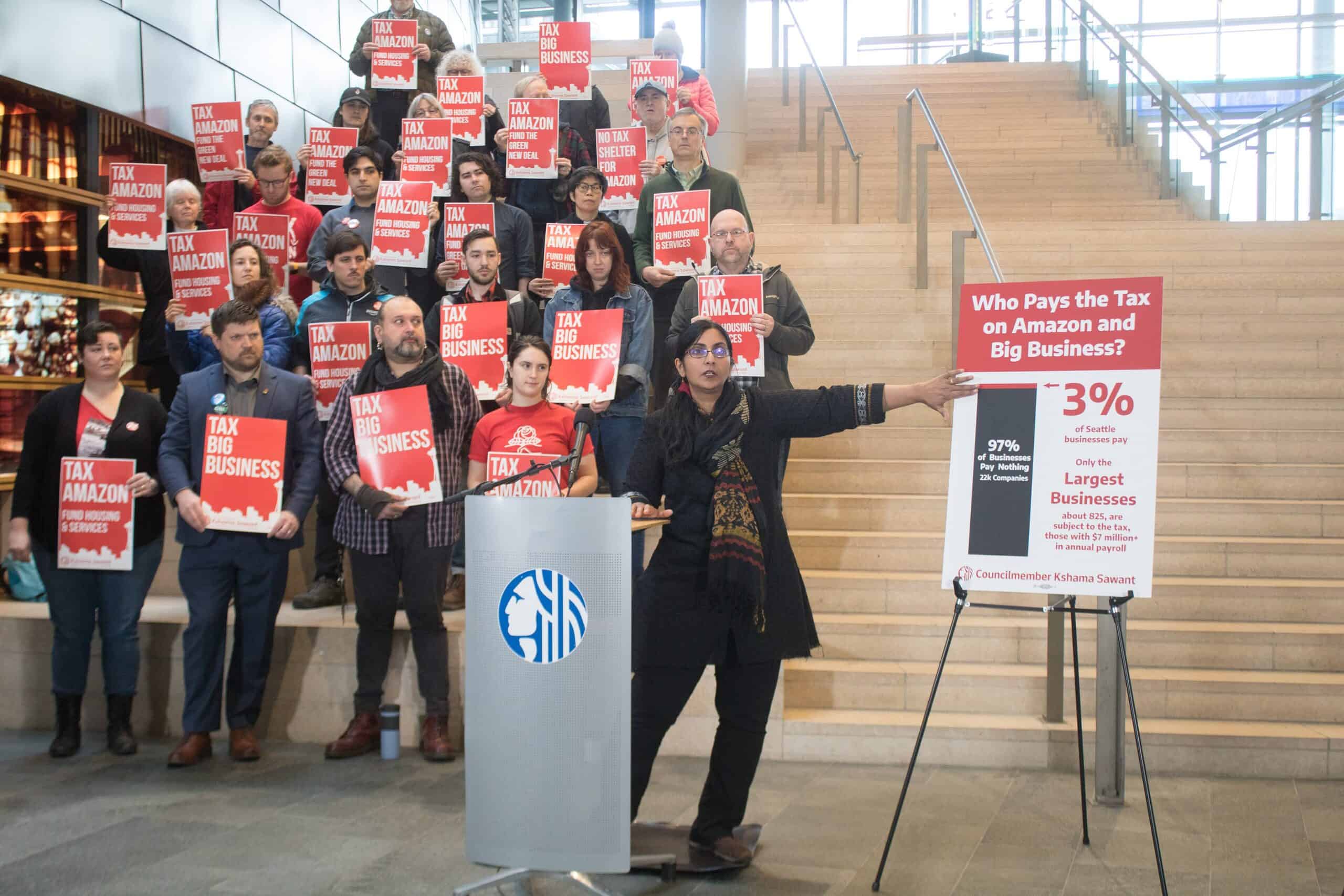
Obtaining reelection in 2019, in a highly unfavorable political climate, Sawant resumed the fight for a tax on business to meet housing needs. This time, however, “the movement would pursue a two-track approach: Legislation that she would introduce in Council, and simultaneous signature-gathering for grassroots ballot initiative in case City Council failed to act.”23Rosenblum, We’re Coming for You and Your Rotten System, 177.

In community-based gatherings, a bill was formulated that “called for an excise tax on the payrolls of the largest 3 percent of businesses in Seattle, raising about $300 million a year beginning in 2021.”24Rosenblum, We’re Coming for You and Your Rotten System, 191.

Sawant-Tax-Amazon-Legislation Photo Credit: Seattle City Council via wikimedia
Sawant-Tax-Amazon-Legislation
Photo Credit: Seattle City Council via wikimedia

This time “…the Amazon tax passed…just 25 months earlier, the movement had been badly beaten, a modest $47 million tax repealed, politically buried. Now, we had just won a tax on Amazon 4 ½ times that size.”25Rosenblum, We’re Coming for You and Your Rotten System, 208. A very tangible and important victory that would make a real difference in people’s lives had been attained via the political strategy Sawant had taken into City Hall.

In 2021, Sawant faced a recall initiative intended to take away her seat on Council. The general political climate at the time was forbidding and, as Rosenblum candidly acknowledges, the work of the “Kshama Solidarity Campaign” was undertaken under daunting circumstances.

The well-resourced political campaign by powerful interests in Seattle to drive Sawant from office was defeated. Rosenblum’s account of this struggle shows the emphasis placed on community engagement, though this was combined with tactical nimbleness in ensuring that the fight was waged on the most favorable terms possible. As Sawant put it, “the wealthy took their best shot at us, and we beat them. Again.”26Rosenblum, We’re Coming for You and Your Rotten System, 310.

Strengths and Weaknesses

Rosenblum tells us that, when Sawant decided not to run for office again in 2023, “strained by the sheer energy required to maintain the City Hall post over the years, Socialist Alternative made no plans to run another comrade.”27Rosenblum, We’re Coming for You and Your Rotten System, 316. This led to something of a crisis within the organization and it suffered a split the following year.

After again testing the ten-year political intervention he was part of against his strategic “three pillars,” Rosenblum makes clear just how vital he considers the Seattle intervention to be. He suggests that “the new political revolutionary movement, if there is to be one, must build and expand on that decade of experience. It must raise the socialist banner not in an abstract or utopian way, but with conviction, purpose, and discipline.”28Rosenblum, We’re Coming for You and Your Rotten System, 350.

It would be fair to question whether the Seattle experience will prove as foundational and decisive as Rosenblum judges it to have been. However, it does provide a record of sustained electoral intervention that advanced a clearly stated socialist perspective and mobilized working-class support to achieve significant tangible gains. It should be viewed with a great deal of respect, even if there are negative lessons to draw alongside some very positive ones.

Sawant and her comrades sought to show how electoral activity can advance working-class struggles. Moreover, the efforts to generate forms of participatory democracy in the course of these struggles were by no means tokenistic and enjoyed a level of success.

Having said that, Rosenblum’s narrative leaves you with the sense that Sawant and her comrades made the choices with regard to the particular sites of struggle and, for the most part, set the agenda when it came to campaigns and interventions. This is not a situation where mass working-class struggles employed an electoral arm to further their objectives. Rather, an electoral initiative used community mobilization to obtain the results it had set for itself.

No finger-pointing is intended if ten years of intense and important political struggle took their toll. But the inability to sustain the intervention indicates that a deeply rooted working-class movement was not sufficiently developed during the Sawant years.

It could be argued that more emphasis on building durable community-based movements and less focus on City Hall might have been preferable. However, it is entirely plausible that the limiting factors at work were simply too large to be overcome by a local initiative.

When you consider the wretched antics of many avowedly progressive politicians linked to the Democrats, Sawant’s record is highly commendable. The intervention in Seattle also leaves some positive lessons on how socialist political officeholders might advance the vital working-class struggles necessary in the harsh context of the second Trump administration.

This book has great strengths, offers valuable insights and is important reading for those in conflict with the structures of political power. Still, the tasks of unleashing mass working-class resistance and creating models of electoral activity that serve the building of movements are still before us and they continue to pose important challenges and questions. Without understating the importance of the practical example that was set, these outstanding issues have not been entirely resolved by the long and hard fight that was taken up by Kshama Sawant and her comrades at Seattle City Hall.

SHARE

HELLO, COMRADE

While logged in, you may access all print issues.

If you’d like to log out, click here:

NEED TO UPDATE YOUR DETAILS?

Support our Work

Gift Subscriptions, Renewals, and More