
Notes on Trans Migration

June 30, 2026

I am listening to Max Richter’s “On the Nature of Daylight” and trying to move with grief and not be undone, or else, to be undone without drying up and blowing away.1“Max Richter – On the Nature of Daylight,” YouTube video, 6:14, posted by “Fatcat Records,” May 1, 2012, https://www.youtube.com/watch?v=rVN1B-tUpgs. This song is a motif in the film Arrival, particularly in places that meditate on what it means to choose love and connection in the context of unavoidable disaster, grief, and loss. Five years ago, I wrote about alienation and trans life and lamented that my life was split three ways: amongst a (now defunct) trans collective housing project, the home where I tried with middling success to shelter my child from trauma, and the university where I was working towards a doctorate that had put me in nearly half a million dollars debt.2Nathaniel Dickson, “Seizing the Means: Towards a Trans Epistemology” in Transgender Marxism, ed. Jules Joanne Gleeson and Elle O’Rourke (London: Pluto Press, 2021), 214–18, https://doi.org/10.2307/j.ctv1n9dkjc.

That doctorate now sits in a backpack with every other important piece of paperwork that I have. The bureaucratic weight of that backpack anchors my life, even as everything else comes unmoored. Migration is woven into many human cultures and rhythms, but the  acute experience of severance that comes with moving under threat of political violence and climate crisis through and across border regimes makes it unnecessarily traumatic and unjust. Diaspora is what you can and cannot carry, where you can and cannot go, and who you can and cannot bring with you.

Rather than three spaces, I now occupy three suitcases in my sister and brother-in-law’s spare room. I am both more and less fragmented than before. I am much less worried that my first husband will find and kill me, but also less coherent in my writing, thinking, feeling, and living. Much of it is the exhaustion of shock, witnessing, and flight.

A part of me knows better, but another part stayed up too late and met the British TERFs (digitally). They are largely heterosexual men and women who have been harmed by heterosexual men. Jagged with fear, grief, trauma, and confusion, most suffer from a combination of complex bigotries and ignorance rooted in what Freire calls “narrative sickness”—the more passively they receive information, the better. Doctrinal disagreement is sacrilegious and often met with shunning, vitriol, or violence.

Border-crossing becomes a frighteningly transgressive substitute for seemingly insurmountable or existentially threatening propositions. TERFs, and reactionaries more broadly, displace crises generated by capitalism, fascism, and climate change because it is much easier to discipline gender, family, and nation. It is largely impossible to argue with a person who cannot acknowledge your full humanity. I argue anyway until my insides hurt and I turn off notifications.

Everyone professes confusion—either they are confused or else I am confused about my gender. I have never done violence from confusion. That is a choice. I am watching other people make it badly over and over again, closer and closer to my body.

In another part of myself, I’m continuously witnessing the stabbing of a nineteen-year-old trans girl named Juniper Blessing in her college laundry room. I have forgotten, traumatically, the name of a transgender person from Niagara Falls who offered to ghost write books for me while I was taking them to get medical cannabis. I couldn’t take intimacy with another person whose care labor needs exceeded my capacity and for whom suicide is likely. I stopped attending funerals and could not say goodbye to my gay friend and his partner, bashed to death in their own bed. 

I write and live in fragments and both my writing and my living are populated by a cacophony of ghosts, some personal and some woven into the history of the communities I inhabit.

HIV and COVID-19 cut through some of those histories. Men stab and drag their way through the rest. I was once living as a little girl, and at maybe 15, a man decided I should be locked in a closet with a knife on LSD. The dragging and the desire to pry open bodies—these are things I associate with cis men. Partway through the pandemic, my schizophrenic best friend kills themself with a knife in the stomach. Death by confusion. 

The Lemkin Institute issued an elevated genocide status for trans people in the United States. Everyone professes confusion—either they are confused or else I am confused about my gender. I have never done violence from confusion. That is a choice. I am watching other people make it badly over and over again, closer and closer to my body. 

Last week I suggested that trans people are a gift, and a woman found me arrogant. The arrogance of feeling as if one is of any worth. 

I have not yet memorized the name of the young woman from Idaho who died of suicidal despair. We are exceedingly short on hope. 

But I am a materialist and hope can be generated by conditions. I try to make myself into a condition that produces hope, even as I fear that I will be shot in my sleep or stabbed walking down the road. And so I am trying to define my own necessary conditions of possibility and map them onto a labyrinth of politics and ever-changing national migration systems in the hope of finding a place that will allow me to live, be well enough, and have the freedom of movement necessary for my work. In other words, I begin the process of preparing to migrate.

On Migration

I am trying to save enough money to go home to a place that I have never seen, smelled, or touched—not because it is a safe place, but because it is safer than here and the rules of imperialism and inheritance dictate that having a British father entitles me to a British passport. The idea of saving money is strange from the position of unemployment. I am on my last five hundred dollars, and I don’t really have anything to sell except my mind.

I am still not sure where I am supposed to pee when I get to England and  admit it was not my first choice. I have just cleared bankruptcy, and my student loan servicer has informed me that I must somehow give them money that does not exist.

Most every person I know who has successfully fled the United States is either in (or headed to) Canada or France. I look at photos of them again and again. In one photo, a friend badly injured in war relaxes outside a café with a carafe of cool water.

Another friend who successfully fled Texas to France with his family sent me art that he made to process the trauma of leaving. They are all transgender and endured three CPS investigations, “quiet firing,” the loss of a grandparent to cancer, and the distress of children targeted by state violence.3“Quiet firing” is working without pay—the work continues but the paychecks do not. It’s a form of purging undesirable minorities from fields like education and medicine. Those children are more than what has been done to them; they are brilliant personalities, creative and kind.

Here is one of my friend’s works of art:
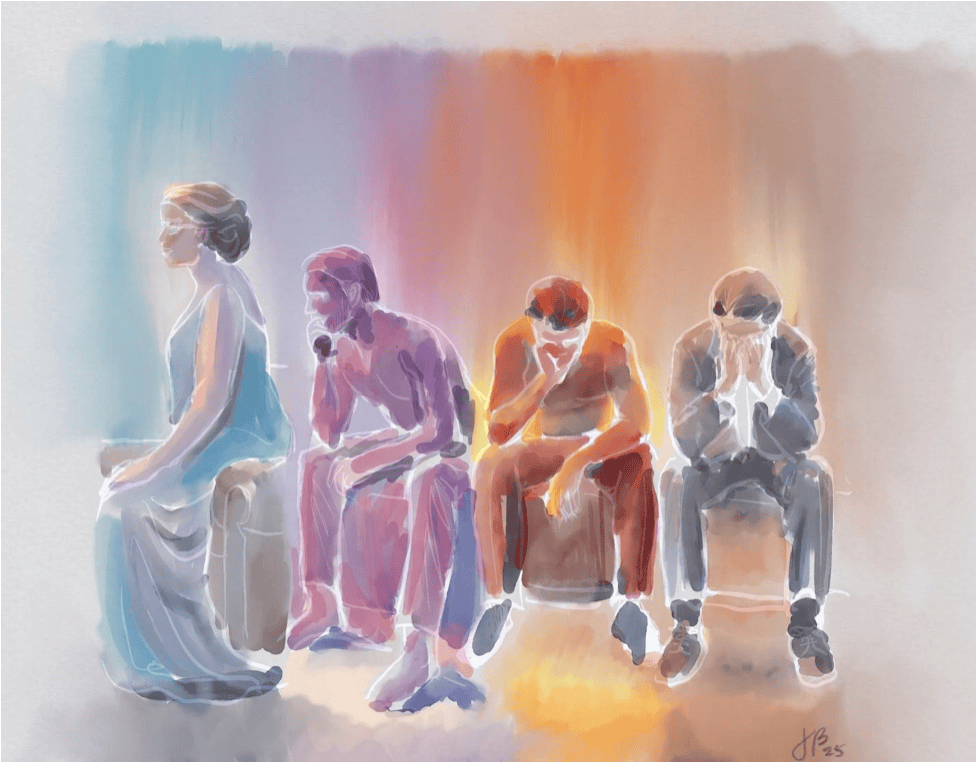
“I drew this one wondering where we would go and seeing so many in our community scattering in every direction” (anonymized for safety).

My friends in France have very different socioeconomic backgrounds, but one thing in common; they had homes they could sell and access to income. In one case, as a retiree and in the other as a couple of professional workers in desirable fields. As Atwood thought, it is best to be loved…but in the absence of love, it is vital to have a money value so that others will not damage you too much.

Like most of our species, I have little money value; this is a serious barrier to migration.

The decision to migrate began in the winter of 2024–25, after the last federal elections. I was sitting on the floor of the bedroom I shared with my partner in a cooperative house in Buffalo, New York, coming apart from grief and anxiety.

I got a phone call from a dear friend and former partner whose father was a holocaust survivor. This friend was the first person to tell me directly that he was preparing to leave the United States with his family, and that I should be leaving too. He sent me the information for what’s called the DAFT treaty, or the “Dutch American Friendship Treaty,” and the contact information for a friend of his who had migrated there decades earlier. 

The DAFT treaty was established in the 1950’s and is (at the time of this writing) a strong contender for US citizens who need or want to migrate.4US citizens only; there is always a hard line or limit around who gets to be safe, or even play the lottery on whether or not others will find them valuable enough to provide help and refuge. You must have €5,000 to capitalize a business and enough to live on as you get started.5Most countries require much higher investments, but the DAFT investment requirement has not been altered in over forty years. Your spouse may work locally, but the applicant must make enough money from the business. The more money you have, the longer your initial residency permit will likely be and the better the chances you will be able to stay to the fifth year and apply for permanent residency.

I sat with this a day and talked to my partner. Then I called a family member in France. Her urgency shocked me. Could I get to Canada, and how soon? What did we know of fascism in this country? She was concerned at its pace here—today nowhere is safe from fascism, but the speed of it in the United States is very alarming.

Being a social animal, I wanted to go to France. Another family member very kindly said, “just come” and look into “l’asile politique.” Of course, that was impossible. Safety is contextual and relative, and the will to provide aid is constrained by international geopolitics.

…that's really the bottom line for everyone. Do you cost them anything, and what do you cost? The likelihood of making it to the five-year mark to apply for permanent residency or citizenship is much lower for someone who does not have much money.

In the case of the United States, the level of military armament and nuclear capacity surely play an outsized role. To accept a US asylum seeker is to suggest there is something in the United States to seek asylum from. We are closer to that acknowledgment today, I think—at least among the peoples of the world if not their institutions. But this country’s incredible capacity for violence still looms large and serves as a deterrent for moral courage and direct address to the ongoing political and humanitarian crises unfolding in the United States.6Especially after Venezuela, and in the midst of billions of dollars the United States spent to blow up school children and infrastructure in Iran. And now the United States will spend hundreds of billions to rebuild that catastrophic damage because oil is at the heart of contemporary capitalism and structures of international power.

France’s acceptance rate for asylum seekers coming from countries outside an internationally acknowledged state of war or humanitarian crisis is less than ten percent. You must apply on arrival. If you are denied, you must immediately go back to your country of origin. In this case, that means entering the US international border—for us, as two transgender leftists, only one of whom had a secondary passport.

Even if asylum or protected persons status is possible, the burden of proof is extremely high. LGBTQ+ people and other migrants must generally perform and document our trauma repeatedly to strangers to be considered. We must be calm through this humiliation and carefully balance the adequate demonstration of our endangerment with measured restraint so we don’t seem like too big of a burden.

So, France was out. The Netherlands seemed more attainable—historically, it has been a relatively tolerant country, with a progressive understanding of human behavior and responses to things like substance use, differences in gender expression, and sex work.7Emphasis on relatively here—my entire understanding here comes from talking to several Dutch people, reading news and analysis, and reviewing medical standards and practices. I don’t by any means claim a comprehensive understanding of the political and cultural situation of a nation I have never visited.

But like the United States, Canada, the United Kingdom, France, or Germany—like so much of the world—they are struggling with far right populism, xenophobia, and fascists.8And will be, for as long as an international order of borders and displaced suffering and labor function to extract profit and vital natural resources, pressing us against and past both human and planetary limits. Even the Swiss are considering capping their population at 10 million right now, with polls showing 52 percent of the population in favor.

In the Netherlands, resentment of and violence against transgender people has risen, and barriers to medical care are significant. It’s a medicalist system that requires each transgender person, even those arriving with existing diagnoses and submitting every available form of evidence, to navigate a complex bureaucracy and brutal waiting period often counted in years…unless you can find and afford private endocrinology.9Medicalism broadly describes the way that pathology is applied to social contexts. In medicine, diagnoses are used to identify illness or disorder in order to treat it. That’s fine for strep throat—we don’t want to waste antibiotics on a cold virus for example—but not for how we categorize and limit the agency of social categories of person. In the case of transgendered people, medicalism has resulted in everything from forced sterilization to extreme wait lists for care and arbitrary bans on youth care. Diagnosis and disease are often used interchangeably…which is necessarily troubling when applied to oppressed peoples. Over-emphasizing pathology fuels baseless attacks on transgender populations as mentally ill while legitimizing ever-growing “precautionary” rollbacks of access to care.

Peer support is a suggested coping strategy for extreme waits. “Transgender Care,” Transgender Netwerk, accessed June 26, 2026, https://www.transgendernetwerk.nl/thema/zorg/transgender-care/. : Transgender care – Transgender Netwerk.I don’t know about you, but the idea of suddenly having no hormones in my body for an unknown number of months or years is untenable medically and psychologically. Hormones play a vital role in our bodies. After nearly nine years on testosterone and a good deal of unrelated medical complexity, sudden discontinuation would pose potentially serious health risks. The United Kingdom will have at least a five year wait if I cannot find a general practitioner who will prescribe them.

Beyond the medical situation: while that €5,000 investment in a business of any kind is comparatively “cheap,” it is still more than most of us have…and you then have to live from that business for the duration of your stay and pay for relocation, documents, lawyers, complex taxes, language learning, entry into the health system, and housing. Your spouse or partner can work locally, but there’s usually a review period within a couple of years, and the likelihood that you’ve made adequate progress with the business—that is, their confidence that you won’t cost them anything—that’s really the bottom line for everyone. Do you cost them anything, and what do you cost? The likelihood of making it to the five-year mark to apply for permanent residency or citizenship is much lower for someone who does not have much money.

So, between the social, medical, and housing factors, we decided that the Netherlands was not workable.

The next place we thought we could go was Portugal. Portugal is more affordable, quite welcoming, beautiful. One of the only places—actually, the only place—I’ve ever been in Europe. England is only a concept to me. Portugal, at the time, had a five-year citizenship wait and remote work visa options, and I thought: editing, tutoring, online adjunct classes, and my research work could sustain myself and my partner.

But everything changes. The housing crisis, the distribution of people, and the economic discrepancy between wage labor in different countries means that Portugal is experiencing an influx of people from wealthier nations whose incomes drive up costs—or at least, it feels like that for those suffering from inadequate regulation of housing costs and insufficient prioritization of public housing. Because of that, the foreigner again becomes a source of both deserved and undeserved resentment, depending on whether you’re distinguishing between a form of international gentrification and people who are simply trying to live. But again, nobody wants the cost. How expensive are you? is a massive question in terms of your ability to migrate.

So, perhaps not Portugal either—they doubled their wait to citizenship to ten years. As a person in my early forties, ten years is a very long time to commit to a place I’ve only been for a few weeks. And there’s the additional awareness that if the law can double in that way, it can change again.

My then-fiancé and I then considered trying for Spain. Spain also has remote work visas, and my fiancé had three years of Spanish and could understand it reasonably well. We thought about Barcelona—about medical care, social norms, the political environment, access to community, and despite language barriers, access to people who think and work and organize together.

But Barcelona ethically requires learning two languages and their housing costs have soared…I won’t move somewhere where my existence will generate struggle for others. Regardless, the income requirement is quite high, and it increases again for two people. My partner at the time was insecurely employed, with an educational background in creative writing, and living in Barcelona would have depended entirely on my capacity to keep us in the country, which creates its own pressure.

We are not only marked by our economic circumstances—our economic being is determined by what other people and institutions see when they look at us. Insurance, documents, rent: How risky are you? How expensive might you be? Do we want you? What are you worth? What are your conditions?

A border is not only a passport or a visa or a green card. It eviscerates migratory species, including human beings. It is language access, disability, HIV status, wealth, cultural acceptance, medical care, bureaucracies, and the risk of state and personal violence. 

And we would be entering into that context as an academic approaching the end of a nonrenewable contract coming from extreme poverty and a brilliant writer with a mental illness diagnosis that requires managing environmental stress, support networks, and continuous access to medications.

So the question arose, and I could not put it down once I thought it to its conclusion: what would happen if we came apart? What would happen to me? To him? With the British passport, I could be summarily deposited in a place I’d never been—but I would not have to present myself, after having done political writing and migrating, at a US border. I could go to the United Kingdom. I asked him what he would do. He said he would have to come back to the States.

By this point in the conversation, he was my husband. And by this point in the conversation, I knew he wouldn’t be for very long.

Nobody needs a postmortem on my marriage, or the specific interpersonal and mental health incompatibilities of a relationship. But migration puts pressure on all relationships and severs us from what we know and love. It strains our connections to other people. It asks us to account for a scale of grief that is difficult to convey—and that’s even before accounting for the fact that what people think of as home is culturally variable.

I have been an itinerant wanderer, by poverty and inclination, since childhood. I think of people as my home and so I will not miss this country, only the motions and minds and hearts of those I love. But the reality of migration, when one is externally displaced across a hostile border, is that you will not attend celebrations and milestone rituals anymore. You will not attend wakes and funerals. You will not sit by the bedsides of those who cared for you when you were small to care for them as they approach the end. And you must confront the reality that you do not know who will sit with you at the end of your own life.

I found this a terrible grief. And I was, at the time, struggling mightily with other griefs as well—the grief of so much death and the loss of my partnership.

People do not begin migrating from a blank slate. And generally, those who are most vulnerable are the most likely to have a trail of unspeakable losses or be economically precarious. The exhaustion of survival expends the resources necessary for processing and integrating trauma—and for completing the endless bureaucratic supplications required to migrate.

Acquiring birth certificates that are recent enough, reviewed by the Department of State of the state from which they were issued, then taken with signatures and seals to obtain an apostille so that you can prove who you are—maybe once, maybe twice—even if you can never go home. How will you get that document? How will you get that document, especially in a context where your name itself can be revoked at any time by your state? 

I don’t know what will happen when my US passport expires and I can no longer match it with my British one because the current US regime will change the gender marker  if I renew it. What will airlines do when they see a departing and arriving passport that do not match, and one of these must necessarily conflict with the plane ticket? 

It’s impossible to accurately estimate the impacts of this displacement. I am white. I am poor, but I also pass as cisgendered and I have a doctorate and a support network, at least until I get on a flight. I am not feeling the full brunt of this and what I am experiencing exceeds my capacity to cope. I try to find an antidepressant that is licensed both here and in Europe that my liver won’t shred through in an hour. 

And some days I sit with my sister and pretend, as in childhood, that we will win the lottery—even though we don’t play it—and go somewhere together and open a bookstore or community space. That I won’t have to say goodbye to her or my brother-in-law. I pack and unpack and their dog cries and clings to me. I call my mother and her doctors. I look for any kind of work. I talk to and stop talking to my estranged spouse. Neither option gives any relief.

A border is not only a passport or a visa or a green card. It eviscerates migratory species, including human beings. It is language access, disability, HIV status, wealth, cultural acceptance, medical care, bureaucracies, and the risk of state and personal violence. 

This fragmentation and destruction of life is unnecessary. It is my fervent hope that as many of us as are able to choose, choose to stay in the world. The love is worth the grief. 

I worry about the fatalism of this moment: exhaustion from COVID and fascism and fear that we are past the climate tipping point. I do not think that migration is surrender; it is predicated on the possibility of a habitable future, somewhere. 

Most of our daily lives exist in built physical and conceptual spaces. How are these not conditions? And if they are, and if we make them, does that not signify that together we can transform this world? A life beyond borders and the violence they reflect is possible if we learn to reconcile our grief with living and to persist despite fear. 

I am still so often frightened. But for a world without landlords, bosses, or borders? I know we can be brave, together.

SHARE

HELLO, COMRADE

While logged in, you may access all print issues.

If you’d like to log out, click here:

NEED TO UPDATE YOUR DETAILS?

Support our Work

Gift Subscriptions, Renewals, and More