
When Empires Claim Ancestors
Greece, Iran, and the Civilizational Claims of US Power
November 10, 2026
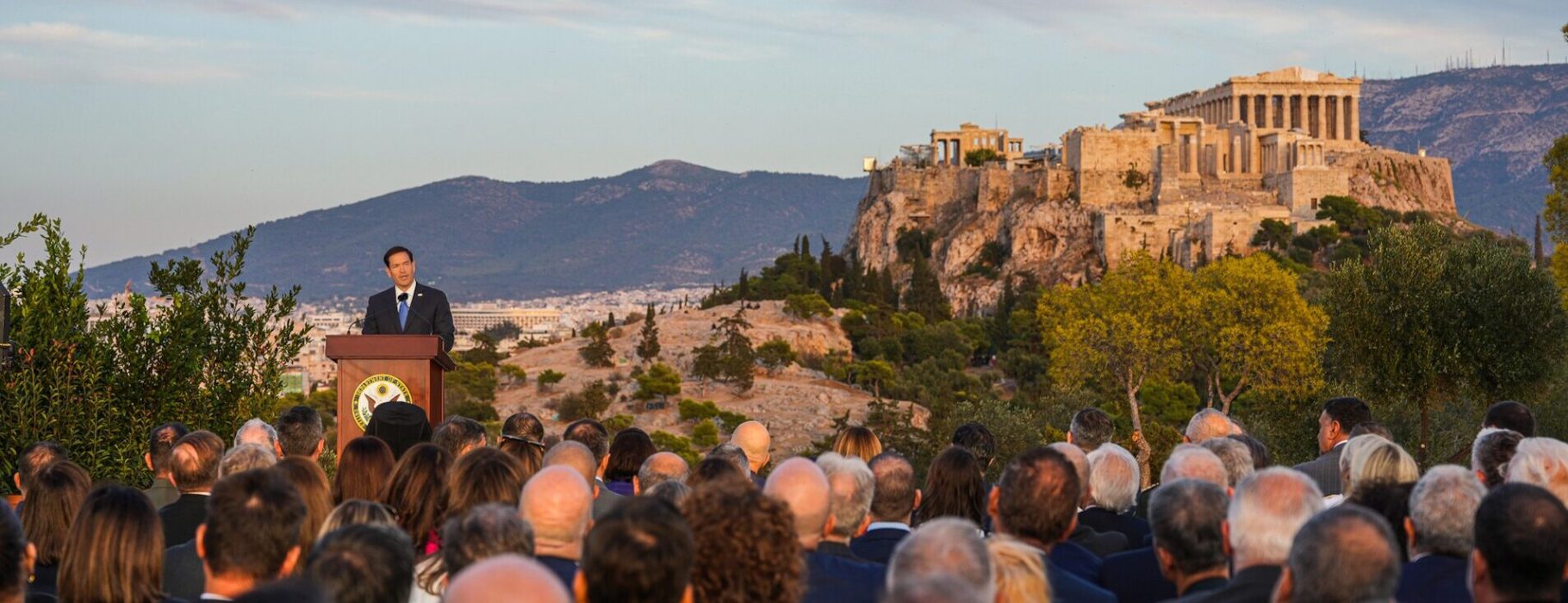
On October 7, 2026, standing at the Pnyx in Athens where the popular assembly of ancient Athenian democracy once convened, US Secretary of State Marco Rubio reached back twenty-five centuries to summon an old “enemy.” With the Acropolis behind him and Greek President Constantine Tassoulas attending, Rubio recalled how the armies of the Persian king Xerxes had arrived in Athens in 480 BCE and put its sanctuaries “to the torch.”1 For images and a transcript of Rubio’s speech, see: “At the Speech of US Secretary of State Marco Rubio,” Presidency of the Hellenic Republic, October 7, 2026, https://www.presidency.gr/en/at-the-speech-by-u-s-secretary-of-state-marco-rubio/; US Mission Greece, “Secretary of State Marco Rubio Remarks,” US Embassy and Consulate in Greece, October 8, 2026, https://gr.usembassy.gov/secretary-of-state-marco-rubio-remarks-at-pnyx/. With the United States now at war with Iran, Rubio’s account of ancient Persia gave a familiar historical narrative renewed political purpose.
Rubio’s history traveled quickly from the Greek resistance to Persia through Rome, Christianity, and European expansion to the founding of the United States. The greatest “Americans,” he declared, carried the features of ancestors “born in Athens, formed by Rome, [and] baptized in Christendom.” Centuries of conquest and historical change were compressed into a continuous narrative of Western greatness, whose defining virtues appeared to survive intact across radically different political worlds. Greece supplied more than an intellectual inheritance to the “American” republic: it became the ancestral source of a civilization whose contemporary interests Washington now claimed the authority to define. The Athenians, who could scarcely have imagined such descendants, had acquired a new political spokesman.
The ambition was explicit. Rubio spoke of reclaiming a classical understanding of statecraft “not just for our country, but for the whole of our civilization.” By collapsing this historical distance, the United States emerged as the latest custodian of a tradition stretching back to antiquity, its pursuit of national power recast as the recovery of a political legacy whose authority seemed to precede the “American” republic itself. The ancient conflict between Greece and Persia was thus made to resonate with the contemporary confrontation between Washington and Tehran, with the United States positioning itself as the heir to Greek resistance. Beyond the question of what ancient Greece had bequeathed to the modern world lay a more fundamental one: how does a claim to historical inheritance acquires political substance that allows the United States to speak for an entire civilization and invoke its defense in the exercise of power?
How Greece Became Western: The Invention of an Ancestral Homeland
Greece occupies a peculiar place in the Western imagination. Although celebrated as the birthplace of a civilization claimed by Europe and the United States, the country has seen its contemporary inhabitants judged against an idealized antiquity, their political institutions and cultural practices measured against the achievements of their ancestors. This paradox has its roots in the very process through which ancient Greece came to be regarded as the ancestral homeland of the West.
The ancient world offers little support for the civilizational division Rubio takes for granted. Greek writers differentiated Europe from Asia and sometimes invested that distinction with political significance, but the allegiances of their world bore little resemblance to those of the modern West. Herodotus, the fifth-century BCE Greek historian whose account of the Persian Wars became one of antiquity’s most influential histories, recorded that Ionian Greeks from the western coast of present-day Turkey supplied a hundred ships to the fleet of Xerxes in 480 BCE.2Herodotus, Histories, translated by G. C. Macaulay, available at https://lexundria.com/hdt/7.94/mcly, 7.94. Themistocles, the Athenian commander celebrated for his role in the Greek naval victory at Salamis, later sought refuge under the protection of the Persian king. These examples reveal a world of overlapping affiliations and shifting political loyalties, rather than two internally unified civilizations confronting one another. Greeks inhabited both Europe and Asia; Greeks and Persians traded, fought, negotiated, and lived under one another’s authority. Their conflicts came to be understood as an early confrontation between East and West only through later reconstruction of antiquity that made Greece and Rome the origins of a supposedly continuous Western civilization.3Naoise Mac Sweeney, The West: A New History in Fourteen Lives (New York: Random House, 2023).
Rubio’s invocation of Western decline is therefore not remarkable simply because it looks backward. Its contemporary significance lies in how supposedly shared civilizational inheritance is mobilized to legitimize the priorities of the Trump administration and redefine its relationship with Europe. Questions of national sovereignty and economic control become matters of civilizational survival, allowing particular political choices to be presented as obligations to a historical community whose future depends upon their fulfillment.
Classical Greece gradually became central to Europe’s accounts of its origins, particularly as European powers defined themselves against an imagined East associated with political despotism and cultural backwardness.4Stathis Gourgouris, Dream Nation: Enlightenment, Colonization, and the Institution of Modern Greece, Twenty-Fifth Anniversary Edition (Redwood City: Stanford University Press, 2021), https://doi.org/10.1515/9781503630642.Yet Greece itself occupied an uncertain position within this emerging division. Its ancient past supplied Europe with a prestigious ancestry, while centuries of Byzantine Christian and Ottoman imperial rule complicated European perceptions of modern Greeks. When Greeks fought for independence from the Ottoman Empire beginning in 1821, European philhellenes celebrated the prospect of restoring Greece to its imagined classical glory. Their support, however, carried expectations about what the new nation should become. Modern Greeks were encouraged to recover the language, institutions, and cultural achievements associated with classical antiquity, even as their existing traditions reflected centuries of historical change. Greek intellectuals and political leaders also participated in this project, drawing upon the ancient past to secure international recognition and establish the identity of the new state.5Obrad Savić and Stathis Gourgouris, “Dream Nation and the Phantasm of Europe, Part I,” Los Angeles Review of Books, May 6, 2015, https://lareviewofbooks.org/article/dream-nation-and-the-phantasm-of-europe-part-i/. Modern Greece was thus expected to remake itself in the image of an idealized antiquity, effectively becoming colonized by its own past.6Umut Özkırımlı and Spyros Sofos, Tormented by History: Nationalism in Greece and Turkey (Oxford: Oxford University Press, 2008).
Yet admiration for classical Greece has never guaranteed the modern country an equal voice in determining the political future of the West. During the sovereign debt crisis that began in 2009, Greece’s economic decisions came under extensive supervision from European institutions and international creditors, including the European Commission, the European Central Bank, and the International Monetary Fund. The crisis exposed how readily the celebration of ancient Greece could coexist with contempt for its contemporary inhabitants.7Stephen Kaufmann, “‘Sell Your Islands, You Bankrupt Greeks’: 20 Popular Fallacies Concerning the Debt Crisis” (Berlin: Rosa Luxemburg Foundation, 2011), available at https://www.rosalux.de/en/publication/id/5119/sell-your-islands-you-bankrupt-greeks. In 2010, amid growing opposition in Germany to providing financial assistance to Greece, the German tabloid Bild declared: “Sell your islands, you bankrupt Greeks! And sell the Acropolis too!”8“Verkauft doch eure Inseln, ihr Pleite-Griechen,” Bild, October 27, 2010, https://www.bild.de/politik/wirtschaft/griechenland-krise/regierung-athen-sparen-verkauft-inseln-pleite-akropolis-11692338.bild.html. Ancient monuments celebrated as the common inheritance of European civilization could be invoked as assets to satisfy creditors, while contemporary Greeks faced austerity measures and disparaging judgments about their character and economic conduct. Five years later, in a referendum held in July 2015, Greek voters rejected the bailout terms put before them, only for their government to accept another agreement under mounting financial pressure and the threat of Greece’s exit from the eurozone.9“Greece Debt Crisis: Greek Voters Reject Bailout Offer,” BBC News, July 6, 2015, https://www.bbc.com/news/world-europe-33403665. Greece’s classical prestige offered little protection from the unequal distribution of political and financial power within contemporary Europe.
Rubio’s praise enters this longer history of recognition and unequal authority. Members of the Greek government—including Prime Minister Kyriakos Mitsotakis and Health Minister Adonis Georgiadis, a figure of the Greek far right—enthusiastically received Rubio’s claim to leadership.10“Prime Minister Kyriakos Mitsotakis’ Meeting with US Secretary of State Marco Rubio,” Ελληνική Δημοκρατία – Πρωθυπουργός, October 7, 2026, https://www.primeminister.gr/en/2026/10/07/39499; “Ο Άδωνις Γεωργιάδης αποθεώνει τον Μάρκο Ρούμπιο: Η πιο σπουδαία πολιτική ομιλία που έχω ακούσει ποτέ,” Athens Voice, October 7, 2026, Georgiadis described Rubio’s address as the most important political speech he had ever heard and presented him as a representative of Western peoples across past and future generations. His response captured the paradox: Greece’s historical standing was being affirmed through a US official’s claim to speak on behalf of the West, a claim that also positioned Washington as an authority over the meaning and political direction of that shared legacy.
While members of the Greek government embraced Rubio’s account of their civilizational legacy, Iranian officials were far less receptive to the role assigned to their country in his historical narrative. They too turned to antiquity, but to tell a very different story.
The Battle over the Past: Civilizations Out of Time
In Tehran, Iranian officials responded by turning to a Persian past in which conquerors had come and gone while Iran remained. Their retorts turned the ancient world into a contest over historical standing, with rulers separated by centuries recruited into the disputes of contemporary states.
Mohammad Javad Zarif, Iran’s former foreign minister, invoked the country’s long history of surviving foreign invasions and imperial ambitions.11 “Zarif: Iran Has Outlasted Declining Empires” [ظریف: ایران از امپراتوری رو به افول …], Asr Khabar, October 9, 2026, https://asrkhabar.com/fa/news/807113. Referring to Iran’s cultural and artistic heritage, he described a “civilization-state” with roots extending back millennia. The term presented Iran as more than a modern nation-state, grounding its political identity in a civilization presumed to endure across successive regimes and historical ruptures. Rubio, he wrote, had been blinded by ignorance and the worship of power, unable to see how Iran had absorbed its conquerors into its own culture. “We have outlasted everyone,” he declared, “and we will outlast his declining empire too.” Against Rubio’s account of Western greatness, Zarif offered historical endurance as the measure of civilizational achievement.
Mohammad Bagher Ghalibaf, speaker of Iran’s parliament, offered a more confrontational response. “Throughout history, we Iranians have faced those who declared themselves masters of the world and sought to erase ancient civilizations,” he wrote.12“Ghalibaf Responds to Rubio: You Will Kneel” [قالیباف در پاسخ به روبیو: زانو خواهید زد], Tasnim News Agency, October 9, 2026, https://www.tasnimnews.ir/fa/news/1405/07/17/3718668/. “They came with fire and flames, but departed in dust and humiliation.” His warning then turned to two figures from antiquity: “Those who seek Alexander’s legacy will meet Valerian’s fate: you will kneel.” Alexander the Great, the Macedonian conqueror who defeated the Achaemenid Persian Empire in the fourth century BCE, had long occupied an ambiguous place in Iranian historical memory, remembered as both a destroyer and a figure subsequently absorbed into Persian literary traditions. Valerian, the Roman emperor captured in 260 CE by the Sasanian Persian ruler Shapur I, supplied Ghalibaf with a different historical outcome. Drawing on the same ancient world that Rubio had invoked, Ghalibaf rearranged its protagonists to reverse the roles of conqueror and conquered: the capture of a Roman emperor became a warning to a US official who had claimed both Greece and Rome as ancestors of Western civilization. The centuries separating Alexander from Valerian, and both from the present, mattered less than their usefulness in reversing the distribution of historical triumph and humiliation.
The struggle over the past also concerned the moral character of the societies being compared. Ali Akbar Salehi, Iran’s former foreign minister and former head of its Atomic Energy Organization, recalled Cyrus the Great, the sixth-century BCE founder of the Achaemenid Empire, as a ruler who freed captives and respected the beliefs of others.13“Ali Akbar Salehi Responds to Rubio’s Remarks on Iran’s History” [واکنش علی اکبر صالحی به اظهارات روبیو علیه تاریخ ایران], Sarnevis, October 9, 2026, https://sarnevis.ir/view/132562/. “The land of Cyrus the Great,” he told Rubio, “is not an enemy of civilization.” Invoking Cyrus as a symbol of tolerance, Salehi challenged Rubio to reconcile his defense of civilization with President Donald Trump’s threats to bomb Iran back to the “Stone Ages” and his April 2026 declaration that “a whole civilization will die tonight.”14Tweet by Donald J. Trump (@realDonaldTrump), Truth Social, April 7, 2026, 8:06 a.m., https://truthsocial.com/@realDonaldTrump/posts/116363336033995961. The country cast as civilization’s adversary was now claiming to embody its virtues, while the power professing to defend civilization was being asked to account for its threats against another people’s existence.
The Iranian responses also reveal the Islamic Republic’s longstanding but ambivalent relationship with the country’s pre-Islamic past. The monarchy of Mohammad Reza Shah Pahlavi, overthrown in the 1979 revolution, had made ancient Persia central to its claims of national legitimacy, most spectacularly through the lavish 1971 celebrations of 2,500 years of Persian monarchy at Persepolis, the ceremonial capital of the Achaemenid Empire. The Islamic Republic rejected the monarchy’s political uses of that heritage while continuing to govern a society in which the ancient past remained an important source of cultural and national identification. This tension has periodically surfaced in disputes over how Iranian history should be taught and remembered. In 2009, an Education Ministry official announced plans to remove royal dynasties from history textbooks, provoking objections over the treatment of Iran’s pre-Islamic past.15“Imperial Dynasties Removed from History Textbooks” [سلسلههای شاهنشاهی از کتابهای درسی تاریخ حذف شد], Hamshahri Online, October 30, 2009, https://www.hamshahrionline.ir/news/94035. Yet appeals to ancient Persia have also remained part of the Islamic Republic’s own political repertoire, particularly when officials seek to emphasize Iran’s historical endurance and standing in the world. The invocation of Cyrus, Alexander, and Valerian in response to Rubio was therefore neither an entirely new embrace of pre-Islamic heritage, nor a straightforward expression of an uncontested national identity. The kings whose place in the national narrative had been disputed could be reclaimed as symbols of Iranian greatness when confronting a foreign power’s claims about civilization and its enemies.
Rubio’s speech celebrates the expansion of European influence across the world as evidence of an inherited capacity for ambition and achievement. Christopher Columbus…and Hernán Cortés…appear within a genealogy that culminates in the United States’ expansion across a supposedly “open and wild land” and its emergence as a “continental empire.”
Such claims also leave unresolved the question of whose history is being represented. Iran’s population encompasses diverse ethnic, linguistic, and religious communities whose relationships to the country’s past cannot be reduced to a single narrative of Persian continuity. The Arab-Muslim conquests of the seventh century, the development of Persianate cultures across a much wider region, and the histories of Iran’s diverse communities complicate any account that treats the nation as an unchanged political or cultural community stretching back to antiquity.16Ahmad Ashraf, “Iranian Identity i. Perspectives,” in Encyclopaedia Iranica, (December 15, 2006), https://www.iranicaonline.org/articles/iranian-identity-i-perspectives/. Appeals to ancient Persia can thus draw upon a widely recognized cultural legacy while obscuring the differences and struggles through which contemporary Iranian society has taken shape. That same past can also be used to establish a particular account of who belongs to the nation and who may speak in its name.
Across these competing accounts, peoples separated by centuries, whose political allegiances and understandings of belonging may have differed profoundly, are gathered into seemingly continuous historical communities. The political circumstances in which these histories are invoked, however, are far from equal. Yet the political work performed by these claims is not the same. The dispute concerns more than the interpretation of antiquity. At stake is the assumption that civilizations possess histories that contemporary states can claim as their own, and that these claims establish political entitlements in the present.
Civilizational Populism and the Authorization of Power
For Rubio, the claim to a shared Western past also provides an explanation for the political troubles of the present. The West, he argues, has lost confidence in the qualities that once made it great. “We no longer believed we deserved and had earned our greatness,” he declared.17“Secretary of State Marco Rubio Remarks.” Its leaders have apologized for Western history and surrendered authority to international institutions, while allowing control over industries and national borders to slip away. Reversing this decline, in Rubio’s account, requires Western leaders to recover their political resolve. President Donald Trump’s pursuit of American national interests becomes part of a larger project of Western restoration. Policies that might otherwise require justification on their own terms acquire the authority of a civilizational mission.
This narrative of decline and restoration is hardly new. European intellectual traditions have repeatedly imagined the present in relation to an exemplary past, from Renaissance humanism and the recovery of classical antiquity to later diagnoses of civilizational crisis.18Erwin Panofsky, Renaissance and Renascences in Western Art (London: Routledge, 1972). The idea of the West as a shared civilizational identity has its own, more recent and contested history, and appeals to historical greatness have served different and sometimes contradictory political purposes.19Georgios Varouxakis, The West: The History of an Idea (Princeton: Princeton University Press, 2025), https://doi.org/10.2307/jj.24033725. Rubio’s invocation of Western decline is therefore not remarkable simply because it looks backward. Its contemporary significance lies in how supposedly shared civilizational inheritance is mobilized to legitimize the priorities of the Trump administration and redefine its relationship with Europe. Questions of national sovereignty and economic control become matters of civilizational survival, allowing particular political choices to be presented as obligations to a historical community whose future depends upon their fulfillment.
This account of decline and recovery has become a recognizable feature of the Trump administration’s relationship with Europe. Speaking at the Munich Security Conference in February 2025, Vice President JD Vance identified Europe’s greatest danger as a “threat from within,” arguing that European governments were retreating from fundamental values they shared with the United States.20Patsy Widakuswara, “At Munich Conference, Vance Warns European Allies of ‘Threat From Within,’” Voice of America, February 14, 2025, https://www.voanews.com/a/at-munich-conference-us-vp-vance-warns-european-allies-of-threat-from-within-/7975270.html. His criticism focused on restrictions on political expression and the treatment of parties and movements challenging established European institutions. The administration’s National Security Strategy, published in December 2025, went further, warning that migration and the erosion of national identities threatened Europe with “civilizational erasure.”21President of the United States of America, National Security Strategy of the United States of America: November 2025 (Washington DC: White House, 2025), available at https://www.whitehouse.gov/wp-content/uploads/2025/12/2025-National-Security-Strategy.pdf. It also welcomed the growing influence of European parties committed to restoring national sovereignty and cultural identity. In this account, the threat to Western civilization arose partly from the conduct of Europe’s own governments. Washington could therefore present itself as defending Europe’s authentic interests even when challenging the political choices of its elected leaders.
The language has also found receptive audiences among European political figures. During her April 2025 meeting with Trump at the White House, Italian Prime Minister Giorgia Meloni, whose right-wing government has made national sovereignty and immigration control central political concerns, declared, “the goal for me is to make the West great again, and I think we can do it together.”22“President Trump Participates in Bilateral Meeting with the Prime Minister of Italy, April 17, 2025,” YouTube video, 33:36, posted by “The White House,” April 17, 2025, https://www.youtube.com/watch?v=p6dsJpBx_aY. Her adaptation of Trump’s political slogan suggested a common project of Western restoration organized around the recovery of national sovereignty. Yet the place of US leadership within such a project remains unsettled. Rubio celebrates the right of Western nations to pursue their interests and reject external constraints, while assigning the United States a privileged role in defining the interests, enemies, and obligations of a civilization extending far beyond its own borders. The promise of sovereignty thus sits uneasily alongside Washington’s claim to determine the political direction of Western renewal.
Here, the language of civilizational restoration intersects with populism. Populist politics commonly presents society as divided between an authentic people and elites accused of betraying its interests.23Spyros A. Sofos, Turkish Politics and “The People”: Mass Mobilisation and Populism (Edinburgh: Edinburgh University Press, 2022). That people may be defined through national belonging or extended to a larger community imagined to share a common history and destiny. Rubio’s West is such a community: its civilizational inheritance has supposedly been betrayed by political leaders who have abandoned the values and ambitions that once made it great. Its restoration therefore requires a renewed assertion of political will. As scholarship on civilizationism and contemporary populism has shown, appeals to a threatened Western civilization can unite nationalist movements across borders, often against perceived threats associated with migration and Islam.24Rogers Brubaker, “Between Nationalism and Civilizationalism: The European Populist Movement in a Comparative Perspective,” Ethnic and Racial Studies 40, no. 8 (2017): 1191–296, https://doi.org/10.1080/01419870.2017.1294700. Rubio gives this imagined community a US center.
The implications for political representation are significant. If the authentic people are understood to extend across national boundaries, the populist claim to speak on their behalf need not remain confined within them. Washington can present itself as defending European peoples against European governments accused of betraying their own civilization, even when those governments possess the electoral authority to represent their citizens. The distinction between a virtuous people and unfaithful elites is thus extended beyond the US political community and applied to the internal politics of other states. In this framework, affinity with sympathetic European parties can be portrayed as solidarity with Europe’s peoples rather than interference in their domestic affairs.25Jon Henly, “‘Cultivate Resistance’: Policy Paper Lays Bare Trump Support for Europe’s Far Right,” Guardian, December 5, 2025, https://www.theguardian.com/us-news/2025/dec/05/civilisational-erasure-us-strategy-document-appears-to-echo-far-right-conspiracy-theories-about-europe. The claim to defend national sovereignty becomes a means through which the United States asserts an authority that transcends it.
Historical correction can expose the omissions and distortions through which that genealogy is assembled, but the further question is why any such genealogy should authorize contemporary political action.
The language of shared civilizational inheritance does more than justify US involvement in European political struggles. By constructing “the West” and “the Orient” as distinct, seemingly coherent historical communities, civilizational discourse establishes boundaries of belonging and identifies those entitled to claim a shared past. Its political significance lies partly in the authority it confers to distinguish legitimate representatives of that community from those accused of betraying it. The question of who may speak for Western civilization is therefore inseparable from the question of who gets to define its interests and determine the obligations of those said to belong to it.
The claimed authority also has consequences for how power exercised in civilization’s name is understood and justified. Rubio’s speech celebrates the expansion of European influence across the world as evidence of an inherited capacity for ambition and achievement. Christopher Columbus (whose 1492 voyage opened the way for European colonization of the Americas) and Hernán Cortés (who led the Spanish conquest of the Aztec Empire) appear within a genealogy that culminates in the United States’ expansion across a supposedly “open and wild land” and its emergence as a “continental empire.”26“Secretary of State Marco Rubio Remarks.” The Indigenous peoples already inhabiting those territories, including the societies devastated by Spanish conquest and the Native American nations subjected to dispossession during US westward expansion, receive little place in the history being celebrated. By treating imperial conquest as evidence of civilizational greatness, Rubio turns the capacity to impose power upon others into a virtue for contemporary leaders to reclaim.
Rubio’s distinction between Western sacrifice and the fanaticism he attributes to Iran’s clerical rulers performs a related operation.27“Secretary of State Marco Rubio Remarks.” At the Pnyx, he traced the willingness of Western heroes to sacrifice their lives for worthy causes from ancient Greece through Christian martyrdom to modern patriotism, setting their devotion to life against the supposed “cult of death” embraced by what he called the “radical mullahs of Iran.” This opposition assigns moral character to entire political traditions before the circumstances of particular actions have been examined. Western violence can be interpreted through the language of duty and courage, while the actions of its adversaries are approached through an assumption of fanaticism. Although Rubio’s immediate target is the Islamic Republic’s leadership, his argument draws upon a broader civilizational hierarchy in which the West claims virtues denied to its enemies.
Such distinctions are significant when the use of military force is presented as a test of civilizational resolve. Attention shifts toward the courage and resolve of those who order it, leaving less room to question why military force was chosen and what its consequences might be for those subjected to it. The circumstances surrounding the US decision to attack Iran make this framing particularly revealing. On February 27, 2026, Oman’s foreign minister, who had mediated negotiations between Washington and Tehran, declared that a “peace deal is within our reach.”28“Full Transcript: Omani Foreign Minister Badr Abusaidi tells ‘Face the Nation’ a U.S–Iran Deal is ‘Within Our Reach.’” CBS News, updated February 27, 2026, https://www.cbsnews.com/news/full-transcript-omani-foreign-minister-badr-albusaidi/. The following day, the United States and Israel launched their attacks, abruptly halting a diplomatic process that the mediator believed was making substantial progress.
The significance of this sequence is not that civilizational narratives determined the decision to attack Iran or brought diplomacy to an end. Rather, it lies in how that decision can subsequently be represented and justified. In Athens, Rubio invoked the ancient Greeks’ understanding that statecraft required diplomacy but also the willingness to use force when diplomacy failed. Yet whether diplomacy had exhausted its possibilities was precisely what remained in question. By presenting the defense of Western civilization as a historical obligation, Rubio’s narrative allows the decision to wage war to appear less as a political choice requiring justification than as an expression of resolve and fidelity to an inherited duty. This does not mean that such arguments necessarily secure popular consent. Their political significance also lies in the terms on which military action is defended and the questions about its alternatives and consequences that this framing pushes into the background.
Civilization as Alibi
One response to Rubio’s account of the Persian Wars has been to reverse its moral judgments: to argue that Persia was the more tolerant or sophisticated civilization, that the Greeks initiated the conflict, or that the virtues Rubio attributes to the West belonged instead to its ancient adversaries. Such arguments may challenge particular claims in his speech, but they remain within the contours of the contest he has staged. They replace one hierarchy with another while preserving the idea that Greece and Persia represented distinct civilizations whose historical accomplishments can be weighed against one another and whose moral standing can somehow be inherited by contemporary states. The question becomes which civilization deserves to be celebrated, rather than why the conduct of ancient peoples should establish the political entitlements of those claiming to speak for them today.
This is different from the work of historical correction. Scholarship challenging Hellenocentric accounts of antiquity has recovered the achievements of the Persian empires and questioned representations of Persian despotism shaped by the perspectives of their Greek adversaries.29Abbas Amanat, Iran: A Modern History (New Haven: Yale University Press, 2017), https://doi.org/10.2307/j.ctv19prrqm. Such work has also brought into view the exchanges and political entanglements that conventional narratives of an enduring East-West opposition tend to obscure. It is indeed important to correct the historical record because inherited accounts of antiquity have helped establish hierarchies of cultural prestige and political legitimacy that extend well beyond the ancient world. Recovering the histories marginalized by those accounts can unsettle the very categories through which Western civilization has come to understand itself.30Amanat, Iran.
Yet even a more accurate account of antiquity cannot settle the political question raised by Rubio’s speech. His argument does not depend entirely on whether the Greeks or Persians were more tolerant, which empire was more accomplished, or who first initiated hostilities. It depends on turning a selective account of the past into a claim of authority in the present. Historical correction can expose the omissions and distortions through which that genealogy is assembled, but the further question is why any such genealogy should authorize contemporary political action. When the defense of an inherited civilization is invoked to justify the exercise of military power, decisions made by political actors under particular circumstances can appear as obligations imposed by history. Civilization becomes an alibi not because it conceals the exercise of power, but because it supplies political choices with a justification that appears to originate beyond contemporary politics.
There is a particular irony in claiming descent from the ancient Greek city-states, presenting their resistance to Persian conquest as the foundation of a Western tradition defined by the defense of freedom, while overlooking the imperial ambitions of some of those same city-states and using that history to legitimize the military power of a modern empire. The violence of empire thus acquires the moral standing of resistance to empire.
At the Pnyx, where ancient Athenians once gathered to deliberate over the affairs of their city, Rubio sought to bring the Persian Wars back to life as a struggle still being waged. But ancient Greece and Persia have no wars left to fight. The wars of the present arise from political decisions for which their authors remain responsible. Those who wage them today cannot claim that history has already decided on their behalf.