
Communes and Crisis
A Venezuelan Migrant Replies to George Ciccariello-Maher
March 23, 2026
While reading Spectre’s interview with George Ciccariello-Maher on the US military intervention in my country, Venezuela, I found myself in sharp disagreement.1Maga Miranda, “The US Kidnapping of Nicolás Maduro: An Interview with Geo Maher,” Spectre Journal, February 7, 2026, https://spectrejournal.com/the-us-kidnapping-of-nicolas-maduro/, https://doi.org/10.63478/90LWLIK6. In that interview, Ciccariello-Maher makes a series of claims that exaggerate the scope and depth of local communal experiences that have had little to no impact on the Venezuelan economy. This echoes claims by the Venezuelan regime that have little basis in reality and have been deployed to justify the repression of working-class and left-wing dissidents. I am compelled to respond as both a Venezuelan migrant who lived through all the Chavista governments until 2018 (when I left the country), and as a political dissident seeking the restoration of the fundamental constitutional rights and protections that the PSUV regime stripped from the working class as a whole when the general crisis struck Venezuela.
In what follows, I will address in detail some of the strongest claims Ciccariello-Maher makes in the interview—namely, that U.S. sanctions are the “single most important cause of the crisis”; that the country is the victim of a “hybrid war”; and that Venezuela’s communes “represent the only actual solution to the longstanding coloniality” of the country’s economy and were expanded in “scope and power” by the Chavista government. Overall, I argue that Ciccariello‑Maher’s account of both the crisis and the Chavista government’s actions relies on, and ultimately reproduces, the official narrative and state propaganda. After presenting evidence in stark contrast to the picture Ciccariello-Maher presents, I will argue that neither the Chavista government nor the crisis Venezuela underwent can be explained, as he suggests, primarily as the outcome of defensive measures taken by the Chavista regime under the duress of US imperialism.
A compelling explanation for the current crisis must proceed from the material conditions shaping Venezuela: the unity of global capital accumulation and the specificity of Venezuela as an exporter of oil. This explanation must show how the regime’s social reproduction is bound up with the flux of ground rent. Only then is it possible to develop the political manifestations of the crisis and the very real class struggles which Ciccariello-Maher papers over by presenting state repression merely as the result of “duress.”
The Commune, Extrapolated in a Vacuum
To begin with, let us consider Ciccariello-Maher’s claims regarding the communes, which for him constitute the decisive political project of the Chavista governments. In the interview, Ciccariello-Maher criticizes leftist critics for focusing on the internal contradictions of the “Bolivarian Revolution” instead of what, according to him is essential: that “the current government [i.e., Nicolás Maduro and his cabinet, including current Acting President Delcy Rodríguez], despite internal contradictions, has been working to expand the scope and power of the communes for years.” He states that “Venezuela’s communes represent the only actual solution to the longstanding coloniality of Venezuela’s economy, and the pernicious impact of oil in particular.” While colonialism and oil dependency deepen Venezuela’s economic problems, he argues, “the communes point in the opposite direction—toward what later dependency theorists called ‘endogenous development’ and toward food sovereignty.” In fact, Venezuela’s communes have had only a limited reach and a modest impact on the country’s food sovereignty and agricultural production. Moreover, they have increasingly functioned as mechanisms for managing a growing relative surplus population generated by the Venezuelan crisis.
Available official data suggest that the economic reach of Venezuela’s communes has been far more limited than often assumed, both in terms of their scale and their productive structure. Moreover, the expansion in scope and power that Ciccariello-Maher claims has occurred points in a direction very different from the emergence of food sovereignty or a communal socialist economy. Between 2012 and 2025, a total of 3924 communes were registered in Venezuela. Approximately one-quarter of these are rural communes, another quarter are urban, 47 percent are classified as “mixed” or “semi-urban,” and the remainder are “indigenous.” With regard to the communal economy—which Ciccariello-Maher considers central to the structural transformation of Venezuela’s economy—there are 41,855 registered “socio-productive organizations” (SPOs). Of these, 10 percent are classified as “Communal Direct Social Property Enterprises.” The remaining 90 percent of SPOs are what the Ministry of People’s Power for the Communes terms “Family Productive Units,” defined as “organizations whose members belong to a family nucleus and carry out socio-productive projects aimed at meeting their own needs and those of the community.”2Ministerio del Poder Popular para las Comunas y los Movimientos Sociales (MPPCYMS), “Sistema Estadístico del Poder Popular”, Sistema Estadístico, accessed 11 February 2026, https://roraima.comunas.gob.ve/ambito/economico/osp/resumen. In fact, according to labor force occupation statistics published by the National Institute of Statistics, by 2017–2018 workers in the “communal economy” accounted for just 0.4 percent of Venezuela’s total employed labor force.3Instituto Nacional de Estadística (INE), “Fuerza de Trabajo – Estadísticas,” INE.gob.ve, accessed 11 February, 2026, http://www.ine.gob.ve/documentos/Social/FuerzadeTrabajo/xls/SERIES/OcupadosenelSectorPublicoyPrivadomensuales.xls. As of 2026, this specific INE webpage and its labor statistics are no longer available on the current version of the institutional website; the link provided is to the archived version captured on June 14, 2024, via Wayback Machine.. As of 2026, this specific INE webpage and its labor statistics are no longer available on the current version of the institutional website; the link provided is to the archived version captured on June 14, 2024, via Wayback Machine. This structure suggests that the communal economy is composed overwhelmingly of microscale family self-employment rather than collective production, a pattern consistent with the rapid expansion of precarious self-employment during the Venezuelan crisis.
Nonetheless, even the most productive examples of communal organization are embedded within this broader structure of small-scale family production. Two issues are worth examining. The first is how the agrarian sector developed under Chavismo. The second is what Ciccariello-Maher, in one of his books, calls “one of the largest, most productive, and most politically successful communes in all of Venezuela”: El Maizal. Before accepting his claims, we would need to assess El Maizal’s contributions to transforming social relations of production over nearly seventeen years of communal experiences in the country.4George Ciccariello-Maher, Building the Commune: Radical Democracy in Venezuela (Brooklyn, NY: Verso, 2016), chap. 5, p. 37. According to the index of agrarian production published by ECLAC, Venezuela’s agricultural sector grew significantly during Hugo Chávez’s first two administrations—around 26 percent.5Comisión Económica para América Latina y el Caribe (CEPAL), “Agricultura – Estadísticas Sectoriales – CEPALSTAT: Bases de Datos y Publicaciones Estadísticas,”, United Nations, accessed 11 February, 2026, https://statistics.cepal.org/portal/cepalstat/dashboard.html?indicator_id=1636&area_id=434&lang=es. By his third term, that growth had slowed to approximately 4 percent. After Chávez’s death, under Maduro, the sector stopped growing and began to contract. Without diving too deeply into the effects of sanctions—which we will address shortly—let us note that by 2016, agrarian production had already declined 10 percent from its 2013 level. This was well before the first U.S. sanctions, the 2017 financial sanctions, followed by 2019 oil sanctions, were enforced. Real value added in the sector stagnated between 2008 and 2013, then fell 40 percent from 2013 to 2016—again, prior to sanctions. Yet despite this domestic stagnation, the average protein supply grew by around 10 percent during Chávez’s third term, according to FAO statistics.6See Organización de las Naciones Unidas para la Alimentación y la Agricultura (FAO), “Average protein supply (g/cap/day) (3-year average),” FAOSTAT: Seguridad Alimentaria, acceso el 11 de febrero de 2026, https://www.fao.org/faostat/en/#data/FS?countries=236&elements=6120&items=21013&years3=20003,20013,20023,20033,20043,20053,20063,20073,20083,20093,20103,20113,20123,20133,20143,20153,20163,20173,20183,20193,20203,20213,20223,20233,20243&output_type=table&file_type=csv&submit=true
Neither the Chavista government nor the crisis Venezuela underwent can be explained... primarily as the outcome of defensive measures taken by the Chavista regime under the duress of US imperialism.
The transformation of food production was not a priority for the Chavista bureaucracy Ciccariello-Maher defends as pro-communal. He acknowledges this when he notes that “in every crisis and every electoral season, the cheaper and more effective option was always to use oil revenue to stock the supermarket shelves.” This pattern, however, cannot be reduced to short-term electoral behavior. It reflects a structural feature of Venezuela’s ground-rent-based accumulation process—one that Chavismo not only reproduced but ultimately deepened. Venezuelans were not eating more domestic food; they were eating more imported food. Meat imports surged 321 percent between 2006 and 2012 while imports of cereals and vegetables for human consumption rose 218 percent.7tituto Nacional de Estadística (INE), “Comercio Exterior – Estadísticas,” INE.gob.ve.The growth of agrarian value added was not a precondition for rising protein intake. What was required was that the government have dollars and, until 2013, it did. In particular, during this period the overvaluation of the currency—which allows for cheaper imports—constituted a general mechanism through which ground rent could be appropriated by actors other than landlords. Rather than transforming the dynamics of accumulation, this reinforces it. This process was especially evident for the Bolívar during this period.8Purcell verifies how this impinged on the specific form of production in the communes, cooperatives and empresas de producción social (EPS), not as evidence of a transition beyond rentier capitalism, but as forms whose expansion was materially conditioned by the circulation of oil ground rent through state-controlled mechanisms (cheap credit, negative real interest rates, subsidized inputs, protected markets, and especially the overvalued currency). See the bibliography below for the relevant references.
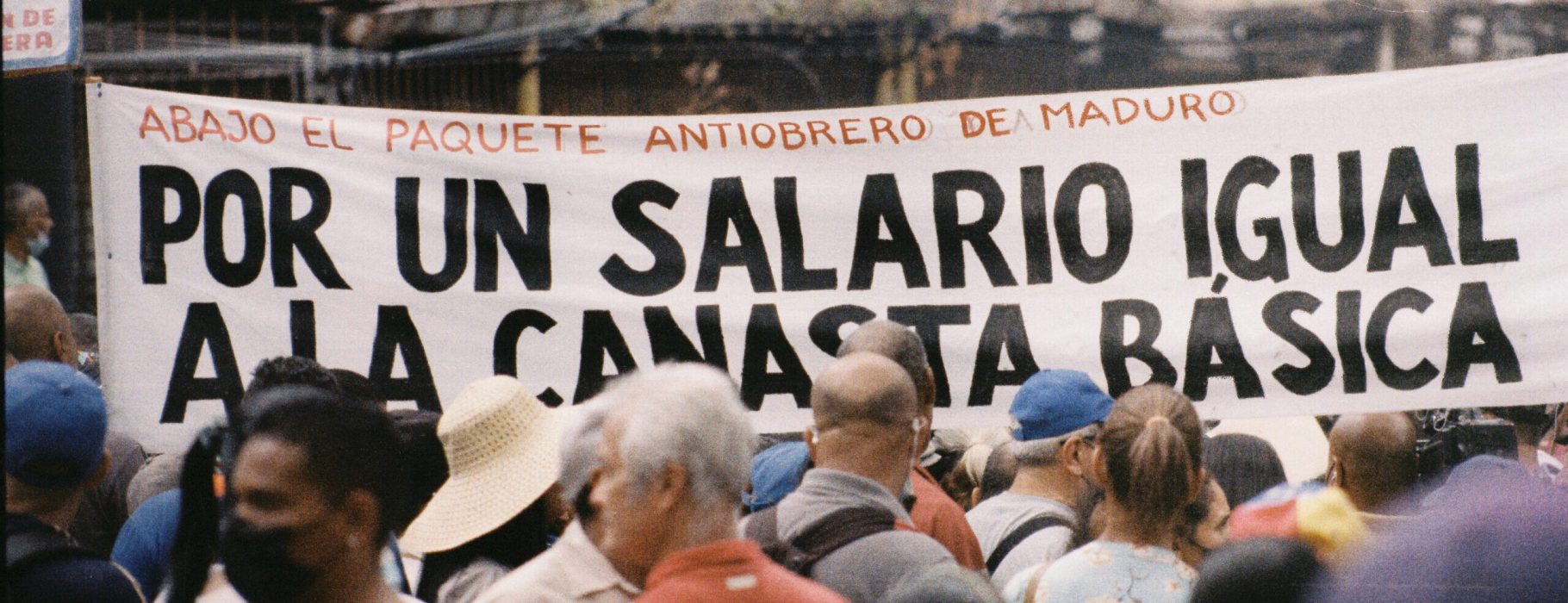
Returning to labor statistics, they reveal a transformation that is directly relevant to working-class organization and subjectivity: the expansion of self-employment. Between 2013 and 2018, self-employment grew by 41 percent, accounting for 37 percent of total employment, while formal employment increased by only 6 percent. If one were to write a history of the Venezuelan working class and its transformation during the crisis, it would not be a history of communal organization, but rather one of labor precarization. Maduro’s expansion of communes has actually coincided, not with empowerment, but disempowerment of the working class. The outcome of this shift is evident in the decline of real wages: average salaries paid to workers in Venezuela fell by 43 percent between 2007 and 2018.9For a deeper analysis of salary dynamics in Venezuela see Manuel Casique Herrera, “Sobreproducción en el mercado petrolero global y transformaciones en la industria petrolera mundial. Renta de la tierra petrolera, crisis y Estado nación en Venezuela y Libia 1990-2018” (Tesis de maestria, Universidad de Buenos Aires, 2024). As argued above, people employed in the communal economy account for less than 1 percent of the labor force, and 90 percent of the communal economy is made up of Family Productive Units. Communal growth during Maduro’s government was not independent of this broader transformation of labor; it was directly related to it. The Venezuelan crisis expanded self-employment and saw the proliferation of SPOs within the communal economy.
These organizations were utilized by needy families to access financing for microenterprises. Over time, they increasingly came to function as part of a clientelist network through which the state bureaucracy mobilized support during elections and political rallies. Rather than a means through which to realize new socio-productive relations, the communal economy was a means for the state to manage the self-employment and family-owned microenterprises, itself necessitated by the processes of wage collapse and precarization. Rather than constituting a pathway toward “endogenous development” or “food sovereignty,” communal experiences have functioned primarily as mechanisms through which the state manages a growing rural relative surplus population generated by the crisis, largely through ground-rent transfers.
Once we situate them within the broader transformation of labor brought about by the Venezuelan crisis, the causes of the limited productive capacity of the communes become easier to understand. Consider the concrete case of the El Maizal commune. According to Ciccariello-Maher, in 2015 this commune produced “2.5 million kilos of corn, 30,000 kilos of coffee, and more than 50,000 liters of milk, alongside other products.”10Instituto Nacional de Estadística (INE), “Comercio Exterior – Estadísticas,” INE.gob.ve. For the 2015 population of Venezuela, this output amounts to roughly 0.78 kcal per capita per day. The FAO estimated Venezuela’s dietary energy supply in 2015 at 2,616 kcal per capita per day.11Organización de las Naciones Unidas para la Alimentación y la Agricultura (FAO), “Dietary energy supply used in the estimation of the prevalence of undernourishment (kcal/cap/day),” FAOSTAT: Seguridad Alimentaria, accessed 11 February, 2026, https://www.fao.org/faostat/en/#data/FS?countries=2,3,4,5,6,7,8,9,1,10,11,52,12,13,16,14,57,255,23,53,17,18,19,80,20,21,26,27,233,29,35,115,32,33,37,39,40,351,96,128,214,41,44,45,46,47,48,98,49,50,167,107,116,250,54,72,55,56,58,59,60,61,178,63,209,238,66,67,68,70,74,75,73,79,81,84,85,86,89,90,175,91,93,95,97,99,100,101,102,103,104,105,106,109,110,112,108,114,83,118,113,120,119,121,122,123,124,126,256,129,130,131,132,133,134,127,136,137,138,145,141,273,143,144,28,147,148,149,150,153,156,157,158,159,160,154,162,221,165,180,299,166,168,169,170,171,173,174,177,179,117,146,183,185,184,188,189,191,244,193,194,195,272,196,197,200,199,198,25,201,202,277,203,38,276,207,210,211,212,208,216,176,217,218,219,220,222,213,227,223,226,230,225,229,215,231,234,235,155,236,237,249,251,181&elements=6120&items=220001&years3=20003,20013,20023,20033,20043,20053,20063,20073,20083,20093,20103,20113,20123,20133,20143,20153,20163,20173,20183,20193,20203,20213,20223,20233,20243&output_type=table&file_type=csv&submit=true. This means that “one of the largest, most productive, and most politically successful communes in all of Venezuela”—whose productivity per acre, according to Ciccariello-Maher, was “twice the national average”—supplied just 0.03 percent of the Venezuelan people’s daily energy needs.12Ciccariello-Maher, Building the Commune. It also contributed only 0.20 percent of total corn production in 2015.13According to FEDEAGRO, the Venezuelan agricultural producers’ association, corn production yielded 1.8 MT in 2015. See FEDEAGRO, “Producción,” Estadísticas Agrícolas, accessed 13 March, 2026, https://fedeagro.org/estadisticas-agricolas/produccion-agropecuaria/produccion/. This limited capacity is not simply a problem of organization or resources. It is directly related to the role communes occupy within the structure of the Venezuelan state. These agricultural SPOs act as the supplementary, local production network that supplies subsidized food to part of the impoverished households in their respective communities, including the Family Productive Units.
In sum, Ciccariello-Maher magnifies localized experiences of agrarian producers organized in communes to make an argument in favor of the Chavista project and, in doing so, to implicitly legitimize the increasingly authoritarian character of the Maduro government. Also, let us note that the claim regarding El Maizal’s per-acre productivity—allegedly “twice the national average”—rests not on any verifiable metric, but on confirmation by “state officials.” This treatment of official narrative as material fact in his book is also present in the interview, as we will see next.14It is also empirically false. El Maizal has around two thousand acres of corn, which means a yield of 1265 kilos of corn per acre in 2015. That’s slightly below the 1395 kilos per acre national average reported by FEDEAGRO for 2015.
Myths, Legends, and Truths about the U.S. Sanctions and Their Impact on the Humanitarian Crisis
The use of the Chavista government’s official narrative as material fact does not end with what Ciccariello-Maher says about the communes. It is a constant in Ciccariello-Maher’s arguments, and it becomes especially evident when he addresses U.S. sanctions and the Venezuelan crisis. Ciccariello-Maher claims that “the single most important cause of the crisis, and certainly of the catastrophe, has been the absolutely brutal and murderous sanctions regime instituted by both Barack Obama and Donald Trump” and that for more than two decades “Venezuela has been facing a hybrid war that has devastated oil production, crippled the economy, starved the population, provoked a mass emigration crisis.” Both claims constitute a denial of Nicolás Maduro’s government’s responsibility for the humanitarian crisis, as well as a justification of the increasingly militarized authoritarian police state that Chavismo has created—and both exaggerate the role of sanctions while obscuring the structural causes of Venezuela’s crisis.
Ciccariello-Maher magnifies localized experiences of agrarian producers organized in communes to make an argument in favor of the Chavista project and, in doing so, to implicitly legitimize the increasingly authoritarian character of the Maduro government.
The characterization of U.S. sanctions and a “hybrid war” as the main cause of Venezuela’s crisis is odd, as the crisis actually predates the sanctions themselves. By the time these sanctions were imposed, Venezuela was already experiencing a general accumulation crisis of historic proportions. This narrative can be traced back to propaganda disseminated by the Venezuelan government through its ideological apparatus, which between 2014 and 2016 framed the crisis as the result of “economic warfare.” One of the partisan intellectuals of this propaganda apparatus wrote in a book distributed within Chavista ranks that:
Since mid-2012, Venezuela has been subjected to severe aggression; its people have been victims of an economic war. This is an unconventional war, waged with powerful and massive weapons that—though not firearms—have managed to distort the economy and affect all households without discrimination.15Pasqualina Curcio Curcio. La mano visible del mercado: guerra económica en Venezuela. Caracas: Editorial Nosotros Mismos/Ediciones Minci, 2017, p. 15, emphasis added.
The same author later admits, “What has been written thus far is not new … Moreover, with the same arguments, the Government has denounced these destabilization plans both nationally and internationally, characterizing them as economic warfare.”16Pasqualina Curcio Curcio, La mano visible del mercado, p. 26, emphasis added.
These arguments took on new meaning with the imposition of U.S. sanctions, but they remain essentially the same: namely, that the Venezuelan government was the victim of a conspiracy among the national bourgeoisie, petit-bourgeois elements, and U.S. imperialism—a conspiracy aimed at suffocating the “Bolivarian Revolution” and destroying its economy with the intention of overthrowing Chavismo. However, as the militarized police state and Chavismo’s authoritarianism expanded, this focus on “economic warfare” began to recede, and the so-called “hybrid war”—a more military framing of the Venezuelan conflict—started to gain ground, providing a justification for the growing militarization of the state. In 2020, the Ministry of People’s Power for Defense even drafted a document characterizing the situation in Venezuela as an “unconventional, diffuse, and multidimensional war.”17Ministerio del Poder Popular para la Defensa, Diffuse War: A Multidimensional and Multifaceted Unconventional War Applied to the Bolivarian Republic of Venezuela, uploaded to SlideShare by user “O.P.”, June 29, 2020, https://es.slideshare.net/slideshow/guerra-difusapdf/255748047. Rather than explaining the Venezuelan crisis, this characterization serves to justify the government’s response to it—a response that Ciccariello-Maher describes as having been “[forced] to take a range of desperate and defensive measures in an attempt to stabilize the economy and feed its people.” Externalizing the causes of the crisis moves explanation away from the specific form of capital accumulation that structured the Venezuelan economy, minimizes the centrality of the latter. The narrative that results is designed to legitimize the state’s coercive adjustment and repression by portraying dissent as sabotage or foreign interference.
What, then, were these “desperate and defensive” measures? From Ciccariello-Maher’s account, we can infer that he is referring to the “empowerment of certain military sectors,” the “overtures toward both the private sector and foreign investors,” and the absence of any genuine transfer of control over key economic sectors to the communes to stop “private-sector corruption.”18This inference is justified given Cicariello-Maher’s piece in Jacobin: “Which Way Out of the Venezuela Crisis,” Jacobin, July 29, 2017, https://jacobin.com/2017/07/venezuela-elections-chavez-maduro-bolivarianism./mfn]Yet these were not the only developments defining Venezuela under Maduro—and what is absent from his account is no minor omission.
According to a series of reports by the United Nations Fact-Finding Mission on Venezuela (FFM), between 2020 and 2025 an estimated 2000 to 2500 individual cases were documented as amounting to crimes against humanity. These include approximately 600 killings or extrajudicial executions, 1000 cases of imprisonment or other severe deprivation of liberty, 700 instances of torture and cruel treatment, 200 acts of sexual and gender-based violence, 150 enforced disappearances, and 300 cases of political persecution on ideological or oppositional grounds.18United Nations Human Rights Council, Report of the Independent International Fact-Finding Mission on the Bolivarian Republic of Venezuela, A/HRC/45/CRP.11 (Geneva: UNHRC, 2020), §§1180–1182; A/HRC/48/CRP.5 (2021), §205; A/HRC/51/CRP.3 (2022), §§110–122; A/HRC/54/CRP.8–9 (2023), §§44–424; A/HRC/57/CRP.5 (2024), §14–77; A/HRC/60/CRP.4 (2025), §§10–108. The FFM findings are clear in pointing out the systematic pattern of state-led violence and repression—one that both predates and extends well beyond the narrative favored by official discourse.
Moreover, between 2016 and 2024, the use of lethal force by the repressive apparatus increased dramatically. According to various NGOs and research centers in Venezuela, between 9,822 and 15,118 civilian killings can be attributed to military and police agents.19Programa Venezolano de Educación-Acción en Derechos Humanos (PROVEA), Derecho a la VIDA 2024: Situación de los Derechos Humanos en Venezuela (Caracas: PROVEA, 2024), 2–9, https://provea.org/wp-content/uploads/2021/05/18Vida-3.pdf, and Monitor del Uso de la Fuerza Letal en Venezuela (MUFLVEN), “Tabla Pública: Personas fallecidas por intervención de la fuerza pública (2016–2025),” 27 February, 2025, https://muflven.org/muflven/tabla_publica.php. Most of these killings occurred in impoverished areas and were marked by documented racial profiling of the victims.20Keymer Ávila, “Racismo y violencia de Estado en Venezuela: Entrevista a Keymer Ávila,” Nueva Sociedad, no. 289 (September-October, 2020), https://nuso.org/articulo/racismo-y-violencia-de-estado-en-venezuela/. In relative terms, these figures amount to between 3.84 and 5.90 police- and military-related killings per 100,000 population, making Venezuela’s police and security forces the most lethal repressive apparatus in Latin America.21Ignacio Cano, Carlos Silva Forné, y Catalina Pérez Correa, coords., Monitor of Use of Lethal Force in Latin America and the Caribbean: A Comparative Study of Brazil, Chile, Colombia, El Salvador, Jamaica, Mexico, Peru, Trinidad and Tobago and Venezuela. 2024 Regional Report (Ciudad de México / Río de Janeiro: Open Society Foundations, 2024), 4–11, https://monitorfuerzaletal.com/docs/MFL2024_Regional_Report.pdf. This political context is essential for understanding the scale of the repression that followed.
Dissent in Venezuela had changed significantly from Hugo Chávez’s last term to more recent years. In the last election Chávez contested, in 2012, he won with 55 percent of the vote, defeating opposition candidate Henrique Capriles Radonski by 11 percentage points. After Chávez’s death, however, political polarization intensified. In the 2013 presidential election, Maduro won by a margin of only about 200,000 votes against Capriles. As the broader economic crisis unfolded, Chavismo’s electoral base eroded further, culminating in the 2015 parliamentary elections, where the government lost by more than two million votes.
As living conditions deteriorated, opposition parties expanded their capacity for mass mobilization. Large protest waves erupted in 2014, 2017, and 2019 and were met with unprecedented repression by police and military forces, resulting in 33, 102, and 41 civilian deaths, respectively.22UN-FFMV. Even though the parties that led this general mobilization were liberal parties ranging from the center to the far right, it is important to note that the mobilization itself—especially from 2017 onwards—was massive and involved broad participation from the popular strata of society. The government responded by using force and dismantling the opposition’s party structures.23For a more detailed discussion of the dismantling process of opposition’s political structures see Manuel Casique Herrera, “Venezuela: elecciones a la carta,” ANRed, December 8, 2020, https://www.anred.org/venezuela-elecciones-a-la-.
Ciccariello-Maher’s characterization of these events illustrates how he interprets the repression and the use of force by the Venezuelan state. In 2017, he depicted the repression of protests largely as a response to opposition violence, claiming that the opposition had “encouraged violent protests in the streets that have left more than one hundred dead,” many of whom, he argued, were “killed directly or indirectly by the protesters themselves.”24George Ciccariello-Maher, “Which Way Out of the Venezuelan Crisis?,” Jacobin, July 28, 2017, https://jacobin.com/2017/07/venezuela-elections-chavez-maduro-bolivarianism. These remarks made in 2017 have no basis. In those protest there were around one hundred twenty-five dead of which one hundred two can be attributed to the use of lethal force by repressive forces, according to the UN-FFMV. Later, in 2019, he argued in another interview that left-wing criticism of the “so-called human rights abuses” in Venezuela reflected a form of liberalism, because “revolutionary chavistas” understood that “class war means defeating your enemies,” whereas some sectors of the left insisted on protecting “the so-called human rights of our enemies.”25George Ciccariello-Maher, “Revolutionary Solidarity With Venezuela,” interviewed by the hosts, Millennials Are Killing Capitalism (podcast), episode 30, accessed March 14, 2026, https://millennialsarekillingcapitalism.libsyn.com/episode-30-george-ciccariello-maher-on-revolutionary-solidarity-with-venezuela.
Nonetheless, generalized repression involved none of the revolutionary masses Ciccariello-Maher talks about. This expansion of the militarized police state began under the pretext of crime control and anti-drug operations within the framework of the “Operación de Liberación del Pueblo” (OLP) [People’s Liberation Operation]—but it did not end there. I agree with Ciccariello-Maher that the United States used crime and drug trafficking as a pretext for the January 3rd military intervention, serving political ends and material interests—though I do not accept his claim that the so-called Cártel de los Soles is “fictitious.” Exaggerated and instrumentalized by the Trump administration and the DOJ, certainly, but not fictitious.26According to Insight Crime’s investigation, the Cártel de los Soles is not a traditional hierarchical criminal organization but rather a designation applied to a diffuse network of corrupt officials and factions embedded within the Venezuelan state (including the army, navy, air force, national guard, police, and executive branch). These autonomous cells engage in a wide range of illicit activities, including drug trafficking, gasoline smuggling, and illegal mining, often operating in collaboration with other criminal organizations.’ InSight Crime, “Cartel de los Soles,” profile, InSight Crime, January 16, 2026, https://insightcrime.org/es/noticias-crimen-organizado-venezuela/cartel-de-los-soles-perfil/. Yet this same justification was first deployed by the Bolivarian government itself, with the aim of militarizing the country, disciplining dissent, and containing social mobilization in impoverished areas.
Mobilization itself—especially from 2017 onwards—was massive and involved broad participation from the popular strata of society. The government responded by using force and dismantling the opposition’s party structures.
Another point of contact between Ciccariello-Maher and the official narrative is the claim that U.S. sanctions against Venezuela began prior to Executive Order (EO) 13808, issued on August 24, 2017. This assertion rests on EO 13692, signed by Barack Obama in March 2015. However, that EO imposed sanctions exclusively on precisely seven individual government officials and military officers, and did not affect Venezuela’s capacity to sell oil, service its debt, or import capital or consumer goods. As a matter of fact, the massive food shortages of 2016 were caused by the Venezuelan government’s decision to service its debt at the expense of imports—which, as discussed above, were vital to the country’s food supply.27Leonardo Vera, “¿Cómo explicar la catástrofe económica venezolana?,” Nueva Sociedad, no. 274 (March-April 2018): 83-88, https://static.nuso.org/media/articles/downloads/5.TC_Vera_274.pdf, José Natanson, Venezuela: Ensayo sobre la descomposición (Buenos Aires: Debate, 2024).
While a reader might object that sanctions targeting officials could have indirect effects on capital movements, there is simply no solid evidence that Obama’s EO meaningfully impacted the Venezuelan economy especially when compared to the collapse of oil prices between 2014 and 2016, driven by global overproduction. The sanctions imposed during Trump’s first administration—financial sanctions in August 2017 and oil-related sanctions in January 2019—did have a significant impact on the Venezuelan economy. However, as mentioned above, by the time these measures were enforced Venezuela was already in the throes of a general accumulation crisis of historic proportions, as well as a deep humanitarian crisis that, to quote Ciccariello-Maher, “devastated oil production, crippled the economy, starved the population, [and] provoked a mass emigration crisis.”
Let us consider the numbers. Between January 2013 and August 2017, oil production had declined by 18 percent. By March 2018, seven months after EO 13808 was issued, oil production had fallen to its lowest level since May 1982 (excluding the drop during the 2002–2003 oil lockout). Real GDP per capita had declined by 27 percent between 2013 and 2016. For context: during the 1980s oil overproduction crisis, real GDP per capita in Venezuela fell by 25 percent between 1979 and 1989—a decade-long crisis that impoverished one third of the population. As noted above, average wages paid to workers fell by 32 percent over this period, while poverty rose from 48 percent to 82 percent.28Universidad Católica Andrés Bello (UCAB), Instituto de Investigaciones Económicas y Sociales (IIES), Condiciones de vida de los venezolanos: ENCOVI 2022 (Caracas: UCAB, noviembre de 2022), 7–15. The prevalence of undernourishment increased from an average of 3.9 percent in 2013–2015 to 17.4 percent in 2015–2017, and child mortality rose by 35 percent.29See Organización de las Naciones Unidas para la Alimentación y la Agricultura (FAO), “Prevalence of undernourishment (percent) (3-year average),” FAOSTAT: Seguridad Alimentaria, acceso el 11 de febrero de 2026, https://www.fao.org/faostat/en/#data/FS?countries=236&elements=6120&items=21004&years3=20003,20013,20023,20033,20043,20053,20063,20073,20083,20093,20103,20113,20123,20133,20143,20153,20163,20173,20183,20193,20203,20213,20223,20233,20243&output_type=table&file_type=csv&submit=true, World Health Organization (WHO), “Under-five mortality rate (per 1000 live births) [Indicator],” WHO: The Global Health Observatory, last updated May 15, 2024, accessed February 12, 2026, https://data.who.int/indicators/i/E3CAF2B/2322814. Also, life expectancy at birth declined 1.6 years between 2000 and 2016, leaving it roughly four years below the Americas’ average.30World Health Organization (WHO), “Life expectancy at birth [Indicator],” WHO: The Global Health Observatory, last updated May 15, 2024, accessed February 19, 2026, https://data.who.int/indicators/i/E3CAF2B/2322814. Furthermore, between 2015 and 2017, Venezuela registered a net emigration of over one million people—the largest migratory movement in the region. This cannot be explained, as Ciccariello-Maher would have it, by the final four months of 2017, during which Venezuelans lived under U.S. sanctions.
Returning to oil production, it is clear that the financial sanctions imposed in August 2017 quickly affected output. But why? Because the state-owned Petróleos de Venezuela, S.A (PDVSA) was already effectively bankrupt and had come to depend on secondary financing to keep its rigs operational. By the end of December 2016, PDVSA’s debt (excluding commercial debt) stood at US$41 billion. Its return on capital was negative for two consecutive years: -5.3 percent in 2015 and -0.6 percent in 2016.31[PDVSA, Estados financieros consolidados. 31 de diciembre de 2016 (Caracas: Petróleos de Venezuela, S.A., 2017). The company had been operating by relying on medium-term debt with U.S. oil service providers and by trading bonds in U.S. markets. Once sanctions were enforced, PDVSA was no longer able to sustain operations, and the already declining production curve rapidly collapsed. Despite the sanctions the value of Venezuela’s oil exports in 2017 and 2018 was, respectively, 21 percent and 15 percent higher than in 2016—a recovery driven by rising international oil prices. Yet, even as export revenues increased living conditions for Venezuelan workers continued to deteriorate.
Citing a study made by Weisbrot and Sachs in 2019, Ciccariello-Maher points out that, unlike Venezuela, other countries saw their oil production decline in early 2016 but subsequently recovered, and from this he infers that sanctions were responsible for the difference.32Mark Weisbrot y Jeffrey Sachs, “Economic Sanctions as Collective Punishment: The Case of Venezuela” (Washington, D.C.: Center for Economic and Policy Research, April 2019), https://cepr.net/images/stories/reports/venezuela-sanctions-2019-04.pdf. Yet he completely ignores the operational state of PDVSA, as well as the fact that—as the very graphic he cites suggests—Colombian production began recovering by August 2016, while Venezuelan production continued to decline for another full year before any sanctions were imposed.
In general, Ciccariello-Maher attempts to explain the crisis as the result of U.S. actions against Venezuela, yet he offers neither a proper analysis of the actual scope of the sanctions nor any context regarding the state of the Venezuelan economy before they were imposed. Although he acknowledges elements of corruption, repression, and military empowerment—and confesses to being troubled by them—the narrative he constructs not only minimizes these phenomena but indirectly justifies them. They are framed as a kind of necessary evil: desperate but unavoidable responses to external aggression rather than political choices made by the Chavista government. However, despite the raging repression, dissent in Venezuela continued to grow and was reflected in the 2024 presidential elections, with a massive vote against Maduro.
Everything Taken into Account…Except Popular Sovereignty
Another striking absence in Ciccariello-Maher’s analysis is any mention of the July 28, 2024 presidential elections in Venezuela. After a long election day, the official communication of results was delayed past midnight. When the CNE—Venezuela’s electoral branch of the state—finally announced the results, it declared Maduro the winner with 52 percent of the vote against 43 percent for Edmundo González Urrutia, the opposition candidate. Immediately, María Corina Machado, the opposition’s main leader, accused the government of fraud. Opposition leaders in Venezuela had repeatedly accused Chavistas of rigging elections in the past, but this time it was different: they had proof. The opposition’s electoral command published thousands of tally sheets from thousands of polling stations on a website, demonstrating that Edmundo González Urrutia had won the election with 67 percent of the vote against 30 percent, and that he had won in every state of the countryas well. Outraged by the fraud, people took to the streets to protest. After one week, the result was around two thousand people imprisoned and twenty-five killed.
Ciccariello-Maher attempts to explain the crisis as the result of U.S. actions against Venezuela, yet he offers neither a proper analysis of the actual scope of the sanctions nor any context regarding the state of the Venezuelan economy before they were imposed.
Both Venezuelan opposition organizations and independent actors have published 25,584 vote tally sheets, representing 85.22 percent of the total. They had been systematized, and one can currently view the results at the polling station level, along with a digital copy of each tally sheet.33See https://macedoniadelnorte.com/. The tally sheet is a public document, and every polling station is required to issue roughly seven copies to witnesses and polling officers, which should have yielded around 179,000 tally copies of the ones published by the opposition camp. These sheets feature a unique hash code at the top and, at the bottom, a QR code containing the digital results, along with an additional code intended for potential audits. By law, the CNE was required to conduct three audits to validate the results announced in its initial bulletin—telecommunications II, verification II, and data II. None of these were carried out after the election. Instead, TSJ—Venezuela’s Supreme Court, overstepping its constitutional mandate—ordered political parties to hand over their tally sheets for verification. The only genuinely secular opposition candidate, Enrique Márquez, complied. Márquez was imprisoned on January 7, 2025 for denouncing the fraud and was released nearly a year later, on January 8, 2026.
The PSUV deployed over 30,000 polling station witnesses. 600 days since the election, not a single witness has been able to produce a tally sheet verifiably showing results different from those published by the opposition. In 2013, facing similar fraud allegations, the PSUV published the tally sheets collected by its own witnesses on its official website.34Partido Socialista Unido de Venezuela (PSUV), “PSUV publica actas de escrutinio de las elecciones del 14A en su página web,” Noticias, org.ve, accessed February 23, 202, http://www.psuv.org.ve/portada/psuv-publica-actas-escrutinio-elecciones-14a-su-pagina-web/.Today, by contrast, the Venezuelan government has not even published the disaggregated results it claims to have.
The absence of these facts in Ciccariello-Maher’s analysis does more than simply ignore presidential fraud (at best) or justify it within the framework of “sanctions” and “war” (at worst). It infantilizes the Venezuelan people, stripping them of agency by suggesting that they made their decision under coercion. In the interview, Ciccariello-Maher delegitimizes to the point of insult the scholars who, like millions of Venezuelans, characterize the Chavista government as a dictatorship. He insists that the left organizations and intellectuals who claim this are just “parroting” liberal narrative. When asked about the popular legitimacy of Chavismo, he claims, “Any sustained economic crisis will mean less support for those in power” and that it is “incredibly foolish to interpret…any election under the duress of sanctions and war, as a victory for democracy.” Although he never explicitly alludes to the 2024 Venezuelan presidential elections, these remarks are clearly a way to undermine the popular mandate they expressed. In doing so, Ciccariello-Maher discredits those critics who, alongside a citizenry stripped of its mandate, denounce the fraudulent government of Nicolás Maduro, and now Delcy Rodríguez, and its repressive apparatus as a dictatorship. Yes, people voted under coercion. They voted, they won, they were robbed, they protested, and they were murdered—all under the coercive military-police state that Chavismo installed in Venezuela.
Oil, Ground Rent, and Crisis
How might we explain, from a materialist perspective, the last couple of decades of development in Venezuela? To do this, one must examine its place in the global economy. Within this system, the country functions primarily as an oil exporter. As the owner of the oil fields, the Venezuelan state obtains from this sale an extraordinary profit—ground rent—that exceeds the normal profit earned by other productive capitals. This ground rent is contested internally by a range of social actors, both within and beyond the oil industry. This situates Venezuela like much of Latin America. Venezuela has a specific role within the international division of labor, namely that of a global supplier of commodities that yield this form of ground rent, mainly differential rent.
This has three implications for understanding the events that shook the country during the first week of January 2026. First, it means that international capitals must negotiate with a state that is simultaneously the owner of the resource. Their objective is to recover a portion of that extraordinary profit ceded when purchasing oil. Second, the state’s capacity to control and exploit oil depends on the global need to bring Venezuelan fields into production. Its decision-making power is not absolute; it is mediated by competition in the world market. Third, and perhaps most relevant to current events, state control over oil-bearing land is indistinguishable from the exercise of national sovereignty. Any attempt to break that monopoly and alter how ground rent is disputed necessarily implies a violation of Venezuela’s sovereignty.
In this sense, Chavismo brought about a profound transformation in the forms of appropriation of ground rent circulating in Venezuela. During the period of Venezuela’s two-party democracy (1958–1998) known as puntofijismo, the bulk of rent was appropriated by oil capital operating in the country—both before and after nationalization in 1976. Under Chavismo, and in the midst of the most significant oil boom in history, it was non-oil capital that became the principal appropriator of ground rent, even at the cost of the oil sector’s valorisation falling below the normal rate of profit. At the same time, Chavismo reconfigured the oil extraction regime. The 2001 Hydrocarbons Law raised royalties to 30 percent and increased specific oil taxes. Production in the Orinoco Oil Belt was restructured through the mixed-company model and oil output shifted from conventional wells toward the unconventional extraction of extra-heavy crude from the Belt.
This shift altered the specific form of Venezuela’s insertion into the global oil market, particularly into the U.S. market. While the U.S. shale revolution flooded its domestic market with light crude, Venezuela became a specialized supplier of heavy crude blends, intensifying its competition to sell to Gulf Coast refineries, which were especially configured to process this type of crude. This pitted Venezuela principally against Canadian crude—heavy, unconventional, and itself experiencing a production boom during the years of high oil prices—which entered the U.S. market at a discount due to higher inland transportation costs. The result was the gradual displacement of Venezuelan oil by Canadian oil in the U.S. market. When oil overproduction took hold and prices collapsed, this displacement deepened.
Following the capitalist overproduction crisis of 2008, Venezuela’s ability to sustain an increasingly unproductive non-oil sector through ground rent became progressively untenable. By late 2014, when this broader crisis manifested itself in the global oil industry through overproduction and a sharp collapse in prices, the implications became more far-reaching. It was no longer only non-oil capital that appeared as surplus to the requirements of capital accumulation, but also the oil capital operating in Venezuela. In turn, this revealed the surplus character of the working population employed in both sectors.As a result, the humanitarian crisis was unleashed. Chavismo thus became the administrator a burgeoning relative surplus population, managing it through growing authoritarianism, which crystallized into a form of civic-military dictatorship given the very role of the army as the state’s arm to manage the appropriation of ground rent. Amidst overproduction, this structure increasingly embedded itself in the illegal economy in order to retain power.
Yes, people voted under coercion. They voted, they won, they were robbed, they protested, and they were murdered—all under the coercive military-police state that Chavismo installed in Venezuela.
As global capital confronted the crisis, it sought to challenge the Venezuelan state’s position as landlord by undermining its sovereignty. As Venezuelan oil fields became increasingly surplus to global accumulation, the United States, acting as the political representative of total capital operating within its national space, took them out of production through the imposition of successive sanctions. This consolidated Venezuela’s expulsion from the global supply of oil-bearing land. In response, the Venezuelan government centralized power even further while patrimonializing what remained of the Venezuelan economy and the ground rent still circulating within the country. This centralization of power and patrimonialization of ground rent could only be sustained through a deepening of authoritarianism, leading to the institutionalization of the militarized police state, the deployment of state terrorism, and the systematic use of electoral fraud.
Simultaneously, the United States had developed its own unconventional shale oil production, reaching historic highs by the end of 2019. Yet the crisis remained latent and was deepened by the pandemic. With the outbreak of the Russian–Ukrainian war, the crisis resurfaced—but now sanctions on Russian oil compelled the Biden administration to negotiate special licenses allowing U.S. oil capital, represented by Chevron, to operate in Venezuela. The urgency to expand oil production under these conditions began to permit, de facto, a modest return of oil capital to Venezuelan wells. From its low point in June 2020 to November 2022—when the first license was approved by OFAC—Venezuelan production had already doubled, and with the licenses in place, output rose from 664,000 to approximately 900,000 barrels per day by mid-2025.
Trump’s return to the U.S. presidency hardened policy toward Venezuela. American oil capital faced several obstacles there: Chevron, operating under sanctions-related restrictions, advocated for greater flexibility, while Exxon had confronted, since 2015, the constant threat of military action from Chavismo over its megaproject in Guyanese waters claimed by Venezuela. Moreover, in the competition for Venezuelan oil rent, the United States had to contend with rival geopolitical actors. In the current global oil market, with low prices straining U.S. unconventional production, global capital has once again taken an interest in expanding output from Venezuela’s oil fields. To do so, once again, capital had to contend with the state as landlord. It was this combination of factors that led the United States to initiate and escalate the military build-up culminating in the intervention on January 3.
Where Ciccariello-Maher sees imperialist geopolitical appropriation of natural resources, the study of Venezuelan capital accumulation reveals a global competition to appropriate ground rent. In the former view, solely US actions are predatory of natural resources. In the latter, global competitors (US, China, Russia, etc.) jockey for ground rent that is circulated in the global market, and landed property (in this case the Venezuelan state) limits capital mobility and intervenes in the formation of general rate of profit. Where Ciccariello-Maher sees revolution, a materialist analysis uncovers how capital contends with landed property—and how a national state acts as landlord for the global market. Where Ciccariello-Maher sees communal organization and the promise of an alternative society, we find a fragment of the working class which constitutes a relative surplus population whose subsistence in rural localities depended on transfers of ground rent. Ciccariello-Maher attempts to explain the events of January 3, but his account is no different than the propaganda from an authoritarian government, draped over the remnants of a communal project that was never realized—and that never possessed the power he attributes to it.
The Bigger Picture
As we have been able to show, Ciccariello-Maher’s interpretation of Venezuela’s recent trajectory relies heavily on the Chavista government’s own narrative about the origins and dynamics of the country’s crisis. All throughout his account, explanatory weight is placed primarily on external imperialist aggression—U.S. sanctions, hybrid warfare, and imperialist destabilization—while the internal dynamics of Venezuela’s process of capital accumulation and the political choices of the Chavista leadership are treated as secondary or defensive responses.
But this framework obscures key aspects of the Venezuelan crisis. The limited productive reach of the communes, the chronology of the economic collapse preceding the most consequential sanctions, and the expansion of a highly militarized repressive apparatus all point to dynamics that cannot, and should not, be reduced to external aggression. Rather than being primarily the result of sanctions or a “hybrid war,” the Venezuelan crisis must be understood as the unfolding of a broader accumulation crisis within a ground-rent-based capitalistic economy—one that the Chavista government not only did not overcome, but in important respects, deepened.
The problem is not simply one of emphasis but of method. By repeatedly relying on official narratives and state-produced interpretations as explanatory frameworks, Ciccariello-Maher reproduces the government’s own account of the crisis rather than subjecting it to critical analysis. This approach transforms what should be the subject of critical discussion—the state’s narrative about the crisis—into the explanation itself. A better analysis of the Chavista regime would submit both the official and liberal accounts of the crisis to critique and offer an explanation of both the political transformation of Chavismo itself and the US actions toward Venezuela. Ciccariello-Maher criticizes the bureaucratic sector of the Chavista regime, but in practice he becomes a spokesman of this sector. Furthermore, this dichotomy of Chavismo’s internal tensions—popular revolutionary partisans versus bureaucratic apparatus—falls apart when one marks the level of dissent and rejection with which the Chavismo regime and its political project have been met by the working class.
Ciccariello-Maher systematically ignores not only the facts but the lived experience of millions of Venezuelans across every continent who endured the humanitarian crisis and watched Chavismo mutate into a ferocious repressive apparatus. This is a state that persecutes, tortures, and murders dissidents, driving millions of workers from their homes, their family, and their friends, while trying to salvage some measure of the dignity they were denied. Ciccariello-Maher absolutely rejects characterizing this as a dictatorship, yet he offers little more than scattered evidence to the contrary. In contrast, the evidence supporting such a characterization is ample. Through his arguments, Ciccariello-Maher ends up downplaying the harsh living and material conditions of the Venezuelan working class and celebrating symbolic gestures for political convenience. Only through honest critique can we liberate the discussion around Venezuela from such biases.
Now, with Maduro out of the picture and the Chavista regime working closely with Washington, the Venezuelan working class cannot subordinate itself to the timetable of its repressors. Its objectives remain the same as they were before the bombs began to fall on those repressing it. Chief among them are the release of political prisoners, the restoration of constitutional guarantees and the rule of law, freedom of association and protest, free elections, and a transition to democracy. Jobs with decent wages remain an unavoidable priority. It falls to the working class itself to organize in defense of these objectives. Today, more than ever, there is a need to rebuild the political and party organizations that Chavismo has devoted itself to destroying. The international left should take a stand not for the ideals and symbols that Chavismo falsely claims to represent, but in solidarity with the Venezuelan working class, helping it to achieve these priorities.